
The science of taste: molecular maps for food's future
Where a molecule sits changes how food tastes. This researcher is turning that into a science.
Published on September 24, 2026
.png&w=2048&q=75)

Mauro swapped Sardinia for Eindhoven and has been an IO+ editor for 3 years. As a GREEN+ expert, he covers the energy transition with data-driven stories.
“It’s a bit like taking a picture, except each pixel corresponds to a molecule,” says Mudita Vats, describing how mass spectrometry imaging (MSI) works. The technique lets researchers zoom in on food molecules. This level of insight can be instrumental in designing the food of tomorrow. "It's similar to your iPhone picture, but if you zoom in, then there's a molecule,” she says.
Vats is a postdoctoral researcher at Maastricht University's M4I Institute and has worked with MSI for years. The technique not only tells what is in a piece of food, but where it is. And where molecules are located matters to how we experience food.
The researcher gives another example to show the level of detail MSI can achieve compared with other imaging techniques. “Blend a set of vegetables into a smoothie, and you can identify every compound inside it, but not where each one came from. Slice those same vegetables onto a pizza instead, and know exactly where each of them is.”
For a research project with a mushroom farm, she analyzed thin mushroom slices "between 17 and 35 micrometres," she notes, thinner than a human hair. The result is a map showing the distribution of flavor molecules, with some present in the cap and others in the stem. Such differences are reflected in taste.
Designing texture – avoiding the guesswork
Nowhere does Vats's research feel more relevant to the future of food than in her work on plant-based meat. "You really need to come close to what people love as texture, flavour, and how it looks," she says. "Sometimes you make a beautiful-looking alternative burger, but as soon as the consumer eats it, it does not taste like meat."
Her work on plant-based burgers suggests why, and points toward a fix. Real meat's texture comes from the combination of muscle fibers and fat aligned in specific patterns, and that structure shifts while cooking. Replicating these structures is the key to recreating that architecture. “Sometimes upon heating or during processing, things change," she says. MSI thus earns its keep, tracking "what changes happen at which stage of processing to bring it as close as to the real meat."
The flavour side is its own battle. "When soy or a legume-based ingredient is used, it gives an off flavour, astringent flavour," she says, "as it is — their meat gives a lot of umami flavour." And even a perfect formula runs into a more human obstacle. "Sometimes people are not aware of what is out there in the supermarket besides what they are used to buying," she says. "It's also the customer being afraid of trying something new. There are also trust issues."
She's sympathetic, too, to recent debate over how these products are even labelled. When asked whether it's partly a marketing problem, Vats agrees readily and admitted her own hesitation around products that involve animal-derived ingredients in some form, even when the overall prodcution approach aims to curb reliance on conventional animal agriculture.
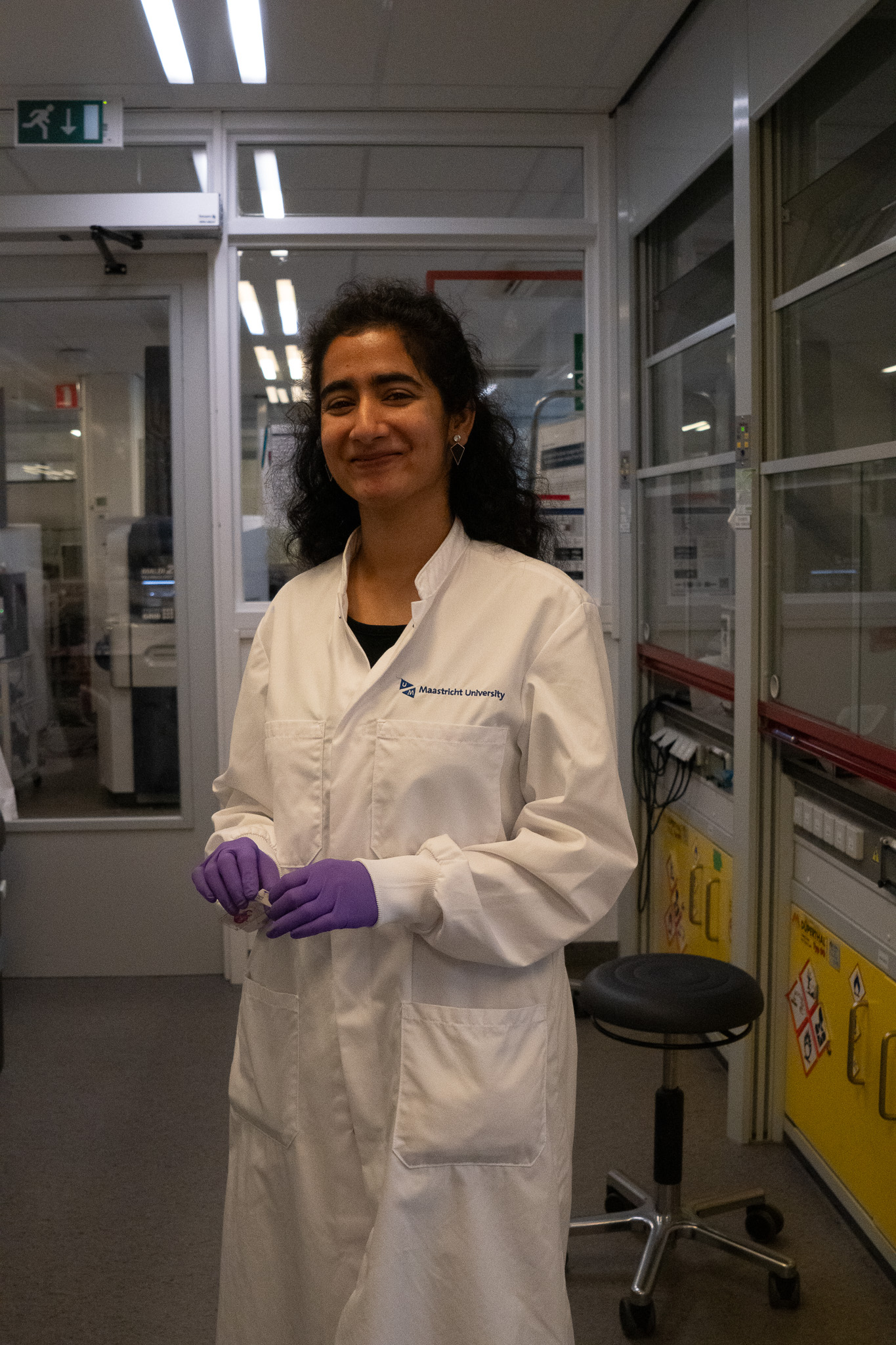
Mudita Vats
Postdoc researcher at Maastricht University
She is part of the university's Maastricht MultiModal Molecular Imaging Institute (M4I), researching molecular imaging techniques.
From a conference question to a PhD in the Netherlands
Vats's path into this niche field began almost by accident. Originally from India, she attended an online panel featuring Ron Heeren, director of M4I, and asked him a question. "I just asked him a question, and then we had a discussion online," she recalls. She had planned to study mass spectrometry imaging in New Zealand, but travel there was difficult at the time, and Heeren mentioned another option. "He said he might have a position I can apply to," she says, and she found a PhD funded through FoodTraNet, a Marie Skłodowska-Curie training network.
Her first project compared vineyards in southern Limburg — one organic, one conventional — "and it was interesting to look into the microbiota of both," she says. From there, one collaboration led to the next: "a company came up with the idea of looking into vitamins of mushrooms," which led to work with the Technical University of Munich, and eventually to burgers, and now seafood. "That's how I started to dive into this field," she says.
Tracking food contamination
One of the researcher's new projects is tracking mussel contamination from microplastics and painkillers using MSI. Mussels, it turns out, are natural filters. "Mussels are a blessing to the water bodies," she says, "that they keep filtering, and they collect all the materials in them, and what goes through them is clean water. So if we take up the mussel, we can — if we see certain molecules in them, that means that is in our water as well."
That indicator role cuts both ways. Her early, unpublished results show the drug localising in specific organs — and something more unsettling: "if we leave that mussel in fresh water, in clean water, it is again doing the filtration and releasing the drug from its body," she says. "So it's scary and important."
Either analyzing food samples for nutrients or contamination, Vats is committed to bringing her contribution to science and society. “Helping maybe a farmer in the vineyards, or a person in a food factory — to come close to where they want to be,” she says. And that work can be instrumental in building the next generation of food with much more precision.