
The race for chips is also a race for talent
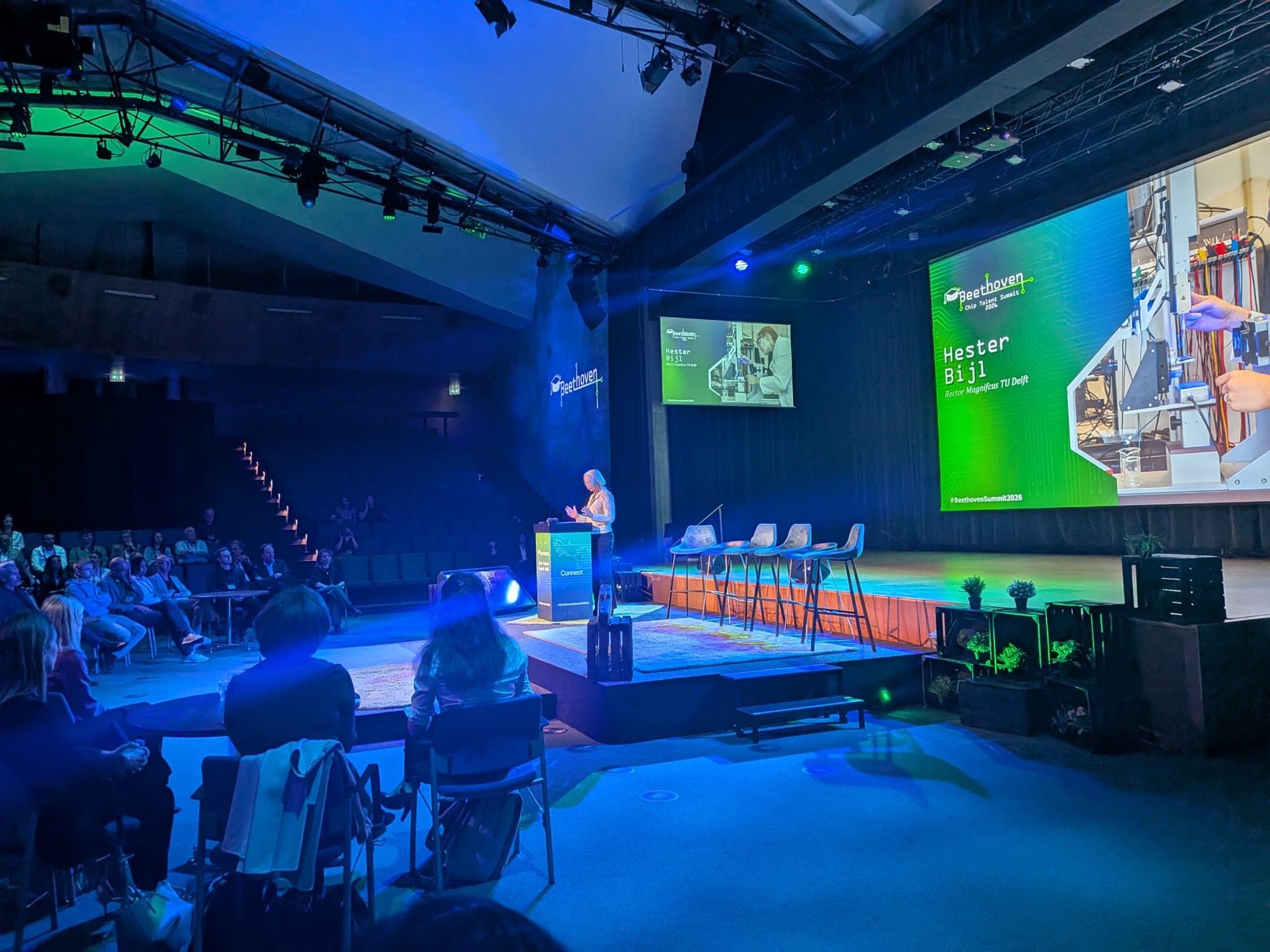
At yesterday's Beethoven Chip Talent Summit, the chip ecosystem came together to shape the future of microchip talent.
Published on October 7, 2026

Our DATA+ expert and Editor-in-Chief, Elcke Vels, explores AI, cyber security, and Dutch innovation. Her "What if..." column imagines bold scenarios beyond the norm.
The Netherlands ranks among the world leaders in the semiconductor industry. We want to maintain and strengthen that position. This requires not only technology and investment, but above all: talent. During yesterday’s Beethoven Chip Talent Summit, the chip ecosystem came together to shape the future of microchip talent in the Netherlands. ASML, Nearfield Instruments, Delft University of Technology, the Leiden School of Instrument Makers, and numerous other players from the chip industry were in attendance.
In March 2024, Project Beethoven was launched: a massive, multi-billion-euro package from the national government and the regions to strengthen the Dutch ecosystem surrounding the microchip industry. A key component of this is training new technicians. By 2030, no fewer than 33,000 additional people must be trained for the sector.
Yesterday, the community gathered in Delft for the Beethoven Chip Talent Summit 2026. With hundreds of participants from various backgrounds, it was a great illustration of just how much is now in motion. The program offered a mix of inspiring presentations, panel discussions, and guided tours of the TU Delft campus. There was also a musical interlude: a performance of a work by Beethoven.
‘Across all institutions’
Hester Bijl, rector of TU Delft, kicked off the event. Every year, TU Delft trains thousands of students who will later contribute to technological innovation as engineers, researchers, designers, or entrepreneurs. The university now has nearly 28,000 students—a record number. “These are the future designers, researchers, and entrepreneurs who will make tomorrow’s innovations possible,” said Bijl.
A significant milestone. However, she noted that educational institutions cannot shoulder this task alone. She emphasized a message that recurred throughout the rest of the day. “People have gathered here today who don’t often find themselves in the same room: policymakers, educational institutions, scale-ups, and startups. That’s important, because the challenge we face cuts across our institutions.” In other words: only by working together will we reach the 33,000 mark.
‘The Netherlands has chosen to preserve an important industry’
According to Hans de Jong, former CEO of Philips, that collaboration is one of Beethoven’s defining characteristics. “What makes Beethoven unique is that the Netherlands has chosen to preserve and further strengthen an industry that is vital to the country. Central and local governments are working closely with companies and research institutions. We’ve never seen this combination of collaboration and scale in the Netherlands before.”
The importance of talent for ASML
Cristina Monteiro also addressed the audience. Monteiro is the Executive Vice President of Human Resources & Organization at ASML. The company was founded in 1984 as a joint venture between Philips and ASM, with 31 employees. ASML has since grown into a global company with tens of thousands of employees and locations on three continents.
Tens of thousands of employees sounds like a lot, but Monteiro also emphasizes that technical talent is scarce. For ASML, training enough chip talent is therefore essential.
“Behind every technological breakthrough are people,” Monteiro emphasizes. “ASML has been investing in that talent pipeline for years,” she explains, citing initiatives ranging from engineering classes for elementary school students to work-study programs for vocational and community college students, as well as scholarships for master’s students in engineering. Through the Beethoven initiative, the company is now working with educational institutions and the government to scale up this approach further.
The road to 2030
Two panel discussions brought four key challenges for 2030 into sharp focus: training more talent, retaining talent, attracting international talent, and continuing to provide professional development for employees.
High-quality education is a key pillar, as the panel discussion with the education sector revealed. Last year, for example, Kuijpers developed the first educational cleanroom in the MBO system at Ter AA in Helmond. “Where there’s a will, there’s a way. Beethoven has strongly encouraged that shared ambition,” says Marjolein Rijpkema, director at Kuijpers.
“Retaining people within the field will also be a challenge,” says Roland van Vliet, co-founder and Chief Partnership Officer of Nearfield Instruments, during the panel discussion with industry representatives. That doesn’t mean, however, that people have to stay with the same employer for their entire career. On the contrary: it’s actually a good thing when employees make the move to another company, as long as they stay within the sector. “Ultimately, that makes everyone stronger. By giving people the freedom to rotate within the sector, they can gain new experience, share knowledge, and continue to develop.”
He also emphasizes that it will be important in the coming years to ensure that international talent continues to feel welcome in the Netherlands. “We have employees from 52 different nationalities.” “It’s not a given that they’ll feel at ease in the Netherlands.” Foreign talent finds itself in an increasingly polarized society where migration is a topic of debate, he notes. This is an issue that needs to be addressed in the coming years.
Finally, the importance of lifelong learning (LLL) was discussed. For example, Nearfield Instruments is working on its own Academy, in collaboration with educational institutions, to train people specifically for the company’s needs.
A festive conclusion
The plenary session was concluded by the Leiden School of Instrument Makers (LiS). For 125 years, the school has been producing skilled professionals for the technical sector. Three students from the new generation took the stage, including Connor. “I’m a sophomore. What I like is that the value of vocational education is increasingly recognized. Vocational education is becoming more and more appreciated, and fortunately, the stigma that it isn’t good enough is fading.”
The 125th anniversary isn’t the only reason LiS closed out the plenary session. The summit also marked the official launch of the school’s national expansion. LiS doesn’t intend to open its own branches everywhere, but rather to collaborate with regional vocational education partners within existing high-tech ecosystems. In Brainport, this is happening with Summa; in other regions, with organizations such as Firda, ROC van Twente, and VISTA. This creates a nationwide network in which regional programs are linked to the LiS’s expertise and professional standards. “With this nationwide expansion, we can grow to approximately 700 students,” said Stef Vink, Executive Director of LiS.
Erwin Borgmeijer, project manager for Beethoven and LLO High-Tech Industry, concludes the event. He emphasizes the collaboration that has emerged in part thanks to Beethoven. “You see what happens when you join forces. Then you can really make a difference for talent in a region: retaining talent and training new talent.”
After a countdown from ten to zero, the national expansion was officially launched. With the push of a large green button, a shower of confetti erupted.