
The modern milkman: How Picnic uses data to reinvent shopping
At NCAS26, Frederik Nieuwenhuys illustrated how the online supermarket became a game changer by reimagining the distribution model.
Published on April 19, 2026
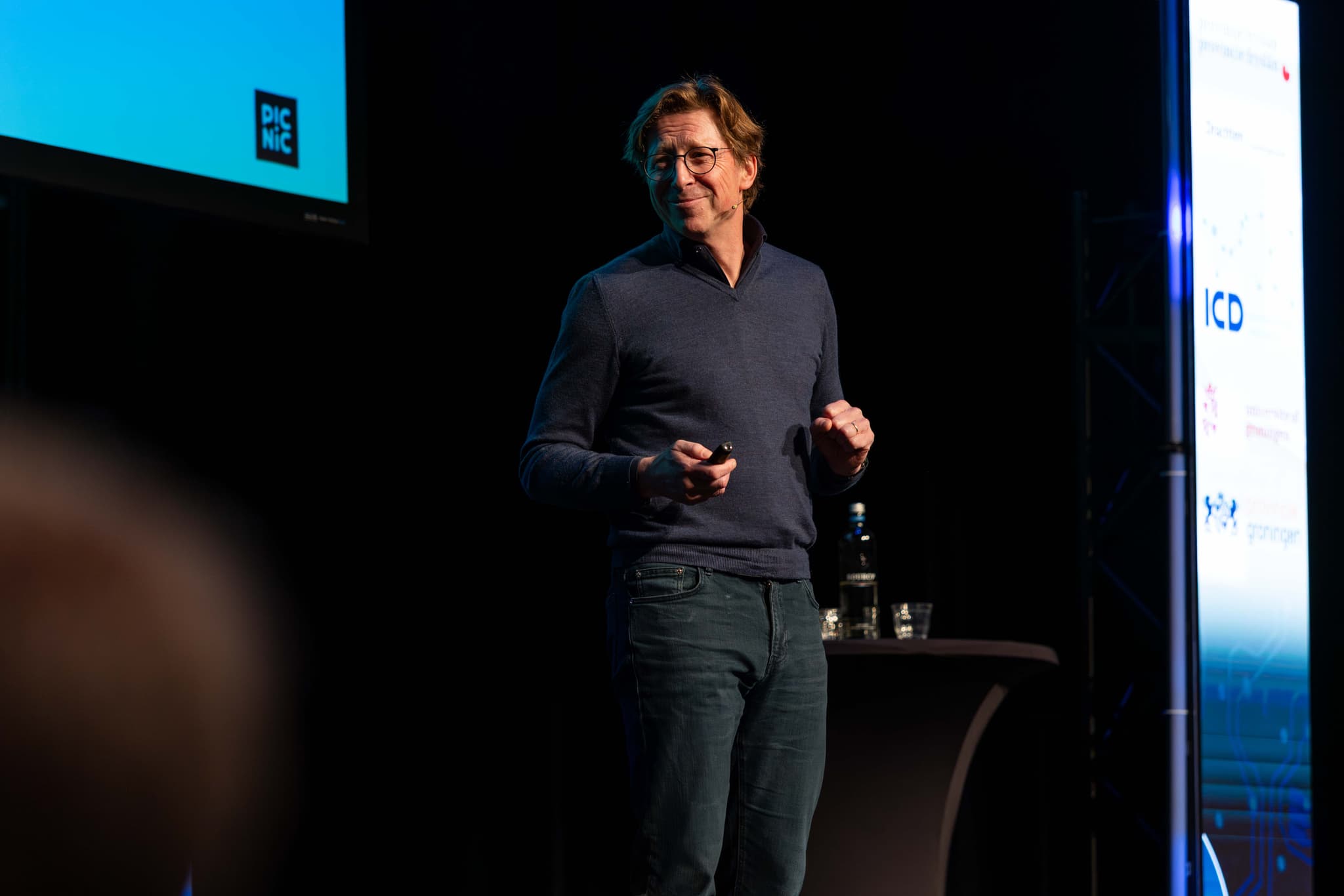
Frederik Nieuwenhuys, CTO of Picnic, NCAS 2026 © NCAS

Bart, co-founder of Media52 and Professor of Journalism oversees IO+, events, and Laio. A journalist at heart, he keeps writing as many stories as possible.
At the Nationaal Congres Autonomous Systems (NCAS’26), Frederik Nieuwenhuys, CTO of Picnic, illustrated how the online supermarket became a true game-changer by fundamentally reimagining the traditional distribution model. Describing the company as the "modern milkman," Nieuwenhuys noted the striking similarities between their iconic electric delivery vehicles and the small milk carts used in the UK during the 1970s.
When Picnic started, they successfully tackled three major barriers to online grocery shopping: expensive delivery fees (by introducing parity pricing and free delivery), unpredictable waiting times (by creating highly reliable 20-minute delivery windows), and cumbersome ordering processes (by designing an intuitive, app-only "three-minute shopping trip"). Today, the company generates over €2 billion in revenue, processes hundreds of thousands of orders per week, and is rapidly scaling across the Netherlands, Germany, and France.
Machine learning in the last mile
To manage this massive logistical puzzle, Picnic relies heavily on autonomous systems, data, and machine learning. A core component of their success is their highly advanced trip planning algorithm, which tackles the complex "multi-traveling salesman problem." Remarkably, this foundational algorithm was originally developed by a 21-year-old math intern from TU Delft, and it still ranks among the best in the world on public data sets.
Machine learning predicts everything from the exact number of bananas needed tomorrow to the precise duration of a delivery stop, dynamically adjusting based on the individual runner's experience level. Picnic also utilizes hardware telemetry to ensure road safety for its young delivery drivers. By monitoring accelerometer data for speed and cornering, Picnic developed an automated "driving coach" that proactively speaks to the driver to warn them before approaching roundabouts, fostering a culture of safety.
Automating the warehouse: Cameras, conveyors, and melted sugar
Behind the scenes, Picnic is expected to pick over a billion items this year. While many items are still picked manually - especially heavy goods like water, which require ergonomic solutions to keep workers happy - the company is aggressively scaling its physical robotics.
Picnic uses high-speed conveyors equipped with cameras and Large Language Models (LLMs) to automatically count stock, check for broken products, and assess product orientation. Because robotic arms struggle to grip neatly arranged items but excel with chaotic orientations, this vision system helps the warehouse instantly decide whether a stock tote should be sent to a robotic arm or a human operator for a successful pick.
Implementing robotic picking arms, however, comes with unique, real-world hardware challenges. Nieuwenhuys shared a fascinating physical edge case about picking sugar: A few stray grains of sugar leaked from a package, got sucked into the robot's vacuum pump, heated up from the airflow, melted, and broke the pump. These nitty-gritty physical realities are exactly the hurdles Picnic is actively solving as they scale their robotic picking cells to operate 20 hours a day.
The generative AI revolution in software
Beyond physical logistics, Picnic is aggressively embracing generative AI to accelerate its digital development. Nieuwenhuys revealed that between 300 and 500 Picnic employees now start their day using AI code generation tools. This integration is so profound that designers and product owners can now build fully working software prototypes without needing a dedicated developer, and data analysts use AI to instantly write complex SQL queries. AI is even being used in HR, with Voice AI agents handling the initial screening calls for a portion of the 400,000 job applications Picnic receives annually.
From smart routing algorithms to robots managing warehouse totes, Picnic's presentation highlighted that achieving true autonomy requires a deeply curious, entrepreneurial culture driven by engineers who are willing to launch first, learn from mistakes, and scale second.

Optimize your total product lifecycle, not only the first version of your product
Picnic’s Daniel Gebler is one of the keynote speakers at the Level-Up event. He speaks about the challenges of a company with physical and digital assets.