
The IO+ week: The future is already in your walls
Every Sunday, our weekly review offers an overview of the most interesting stories around important innovations.
Published on November 1, 2026
Bart, co-founder of Media52 and Professor of Journalism oversees IO+, events, and Laio. A journalist at heart, he keeps writing as many stories as possible.
Our best-read story this week began with a wonderfully ordinary idea: your home can store heat. Ona uses smart controls to run an air conditioner when electricity is cheap, letting the building retain warmth for later. No big home battery required. Why did that resonate so strongly? Perhaps because the energy transition has become a very personal puzzle. Readers are trying to reconcile bills, changing incentives and unfamiliar technology with something as basic as a comfortable evening at home. A story that makes those pieces fit together offers more than an interesting invention. It offers a little relief.
There may also be a quiet fatigue behind its appeal. So much advice about the future seems to involve buying something expensive, replacing something that still works, or mastering another complicated system. Here is a startup suggesting that part of the answer is already around us, literally. Its €165 kit promises to make better use of an existing air conditioner and a building's heat-retaining capacity. Actual savings will depend on the home and how it is used, but the proposition has an emotional logic: progress can begin with what you have. That makes participation feel within reach.
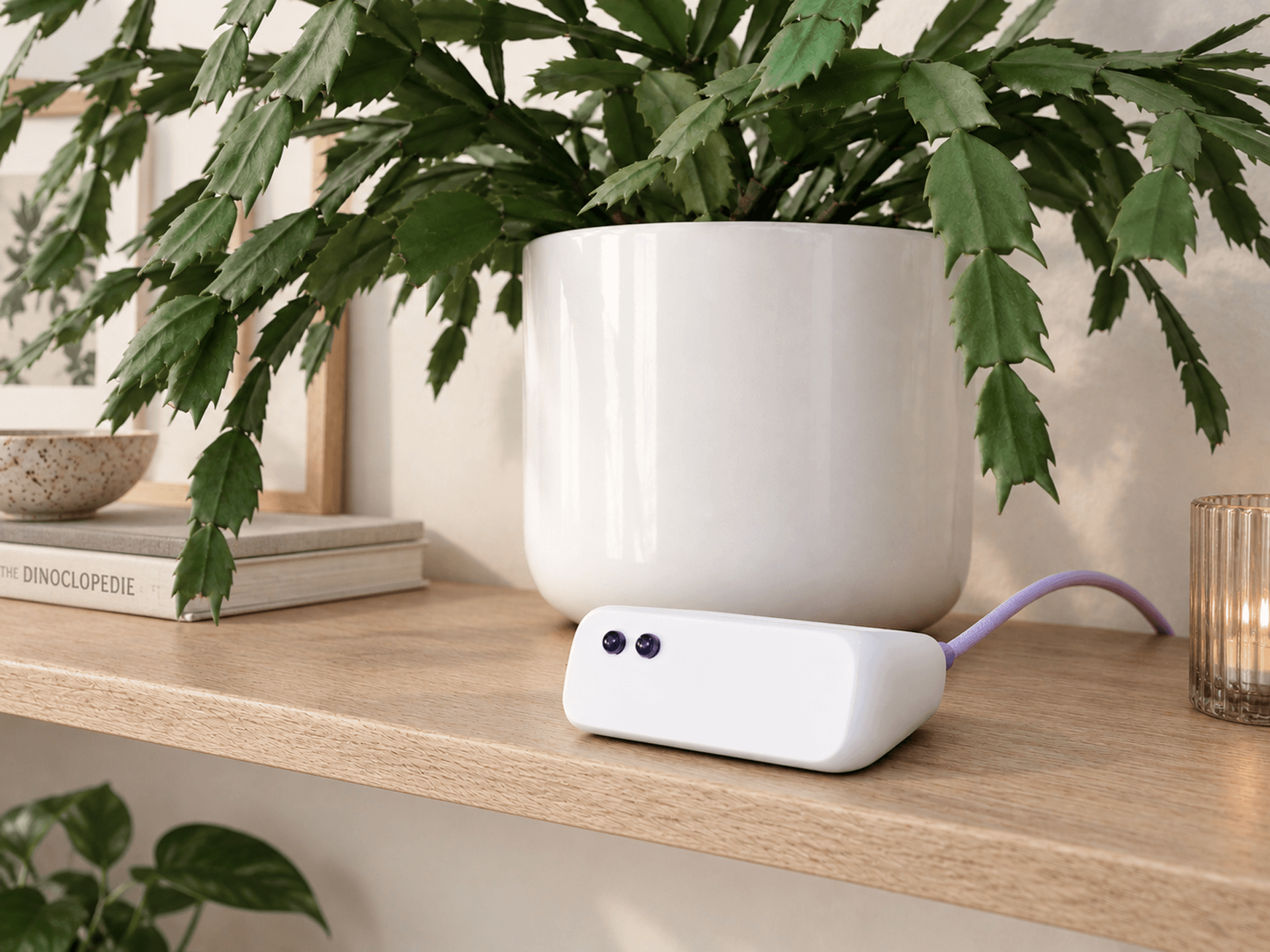
Ona's controller - © Ona
We cannot read everyone’s motives from our traffic figures. Still, I suspect this story touched a desire that extends beyond energy: to regain some agency in a world whose biggest systems feel increasingly difficult to influence. We cannot personally settle geopolitical disputes or rebuild the electricity grid. We can make a useful decision about our own home. There is something hopeful in that modest scale. The future becomes easier to imagine when it arrives as a practical improvement to daily life. Perhaps our readers’ enthusiasm reminds us that innovation earns trust when people can recognise their own lives in it. https://ioplus.nl/en/posts/no-home-battery-needed-ona-stores-cheap-heat-in-your-walls-
Lots of reading...
Elsewhere, our newsroom clearly did a lot of reading this week :-). Reports, studies, position papers and policy agendas filled our desks and our coverage. Read together, they ask a surprisingly consistent question: how do we turn the potential we already possess into something people and businesses can actually use?
Let's look at some of these papers and studies:
Tomorrow’s scaleups need room to start today
A country cannot grow more international technology companies if fewer young businesses make it to the starting line. That concern runs through Techleap’s position paper for the parliamentary debate on startups and scaleups. Its six priorities range from employee ownership and early investment to public procurement, university spin-offs, European rules and employment conditions. The proposals describe an interconnected system: founders need people, investors need prospects, and promising products need customers. Bigger funding rounds at the top cannot compensate indefinitely for a thinning pipeline below. https://ioplus.nl/en/posts/from-startup-to-global-player-techleap-calls-for-room-to-grow
Brabant’s funding records hide an early-stage problem
© BOM, Rabobank
Brabant has plenty to celebrate: BOM and its co-investors mobilised €561 million across 47 funding rounds in the first nine months of 2026. Yet a paper from Rabobank and BOM looks beneath those impressive totals. Money is increasingly concentrating in larger rounds, raising concerns about support for companies still proving their technology and business model. With productivity under pressure, that matters well beyond the startup community. Today’s regional prosperity depends partly on established successes; tomorrow’s depends on giving their successors a chance to emerge. https://ioplus.nl/en/posts/brabant-funding-boom-has-a-blind-spot-tomorrows-tech-champions
Agrifood’s next harvest depends on decisions now
The Netherlands knows how to develop biological crop protection, climate-resilient crops and fermentation-derived food ingredients. Bringing them to market is another matter. Invest-NL’s new report, drawing on more than 150 interviews and fifteen years of investment data, identifies slow approvals and gaps in scale-up financing as barriers to growth. It calculates that faster commercialisation could help Dutch agrifood biotech generate around €17 billion in additional annual revenue by 2040. That is an opportunity, not a guaranteed outcome—and one that requires regulators, customers, and financiers to move alongside the science. ioplus.nl https://ioplus.nl/en/posts/invest-nl-we-risk-losing-our-lead-in-agrifood-innovation
Put down the policy butter knife
Dutch innovation policy has plenty of ambition. Arnaud de Jong wants it to acquire the funding, focus and commercial courage to match. Drawing on TNO analyses in his NXTGEN Conference keynote, he argues that spreading scarce resources across too many initiatives prevents promising technologies from reaching industrial scale. His prescription: a handful of substantial programmes, leadership by people who understand technologies and markets, clear milestones, and a government willing to become a first customer. Research excellence creates possibilities; sustained choices determine whether companies can build a business around them. ioplus.nl https://ioplus.nl/en/posts/arnaud-de-jong-tno-stop-spreading-innovation-funding-too-thin
Keeping the lights on takes a whole supply chain
What happens when electricity, internet or telephone services disappear for 72 hours? Techniek Nederland’s new practical guide asks installation and technical service companies to prepare for precisely those scenarios. Building on an earlier resilience report, it accompanies the association’s entry into a sector pact with grid operators and energy companies. The emphasis is on shared threat assessments, crisis exercises and clear responsibilities. Energy security depends on the people who maintain and restore systems, too: their ability to keep working during disruption is part of everyone else’s resilience. ioplus.nl https://ioplus.nl/en/posts/technical-sector-joins-forces-for-a-more-secure-energy-system
AI needs people who can take responsibility
The familiar question is whether AI will replace technology workers. Randstad’s latest report points to a more complicated shift: 86% of surveyed business decision-makers expect to need more tech talent to develop AI-enabled services and revenue streams. Demand is growing for people who can integrate systems, understand business processes and manage risks. Expertise in AI governance is particularly sought after, with demand outpacing the available talent pool. For workers and employers alike, the challenge is becoming clearer: learning to use AI also means learning how to judge and oversee it. ioplus.nl https://ioplus.nl/en/posts/ai-is-changing-demand-for-tech-talent
Climate resilience comes with a €70 billion question
Europe’s climate challenge increasingly includes preparing for damage already becoming harder to avoid. Our coverage of the European Commission’s Climate Resilience Framework examines an estimated €70 billion in annual investment needs for adapting infrastructure, cities and industry to floods, droughts and heatwaves. The distinction matters: an investment requirement is not the same as money already allocated. Risk assessments and resilience plans can identify priorities, but governments, businesses and financiers still have to fund the work. The economic argument is straightforward, even when the politics are difficult: preparation can prevent much greater losses later. ioplus.nl https://ioplus.nl/en/posts/70-billion-a-year-eus-new-plan-to-climate-proof-europe
ASML’s strength raises a question about everyone else
An ING analysis estimates that ASML, its Dutch suppliers and associated investment could account for 2.2% of the Dutch economy in 2026. That helps explain why the Netherlands stands out while much of Europe struggles to capture the global technology boom. It also raises a question about dependence. ING sees a more diversified economy than Finland had at Nokia’s peak, but semiconductor cycles, export restrictions and shortages of talent and space still matter. ASML demonstrates what a world-leading technology cluster can deliver—and why building a broader base of success deserves attention. ioplus.nl https://ioplus.nl/en/posts/asml-puts-the-netherlands-ahead-in-europes-tech-race-ing-says
Medtech’s ambition must reach the patient
The MedTech 2035 policy agenda sets a bold objective: making the Netherlands Europe’s strongest medical technology sector. The commitments include €102.5 million from government, €150 million in private financing announced by Invest-NL with institutional investors, and a previously announced €50 million investment from Philips. AI, robotics and image-guided therapies feature prominently. The agenda also addresses the less visible work of collaboration, market access, finance and adoption in healthcare. Its practical test will be whether promising technology reaches patients and helps healthcare professionals manage a growing workload. ioplus.nl https://ioplus.nl/en/posts/government-and-businesses-invest-hundreds-of-millions-in-medtech
Rather listen?
Here's a small selection of last week's highlights in a half-hour podcast:
External Content
This content is from spotify. To protect your privacy, it'ts not loaded until you accept.
Our Other Newsletters
Thank you for reading this newsletter. But there’s more. Subscribing is easy — via the options on the IO+ homepage or simply by clicking one of the newsletters below:
- IO+ Daily (1,200 subscribers)
- Mauro’s Green Corner (monthly, 13,800 subscribers)
- Elcke’s Saturday Data Dive (monthly, 20,550 subscribers)
- Elcke en Mauro’s BIO+ Bites (monthly, 29,300 subscribers)
- Bart’s Saturday CHIPS (monthly, 16,300 subscribers)