
The IO+ week: Could the brain make more of its own dopamine?
Every Sunday, our weekly review offers an overview of the most interesting stories around important innovations.
Published on November 8, 2026
Bart, co-founder of Media52 and Professor of Journalism oversees IO+, events, and Laio. A journalist at heart, he keeps writing as many stories as possible.
When I read Mauro Mereu’s story this week, I kept coming back to the cells that remain. Parkinson’s destroys dopamine-producing brain cells, but some are still at work when symptoms such as tremor and stiffness appear. What if those cells could make more dopamine? And what if the same approach could help keep them alive? Here's what Mauro found out after talking to researchers at the University of Amsterdam.
They are looking for a molecule that can switch on a receptor called Gucy2c. Levodopa, a standard Parkinson’s medication, enters the brain and is converted into dopamine. The Amsterdam team wants to prompt the surviving cells to make more dopamine where they normally produce it. Whether activating the receptor can also protect those cells is one of the questions the researchers are pursuing.
In mice, activating the receptor improved movement symptoms about as much as levodopa did during the experiment. The researchers had to deliver the compound directly into the animals’ brains, and they’re now looking for a molecule that could be suitable for people. It shows just how much work can sit between an encouraging result and something a doctor can prescribe.
AI helped the chemists sift through hundreds of thousands of candidate molecules. Then, in simulations, some of the promising candidates simply drifted away from the receptor they were meant to bind to. The team takes the strongest candidates into the lab and uses the results to refine the next round. I’d happily read a follow-up about what they learn from the molecules that fail.
https://ioplus.nl/en/posts/a-new-parkinsons-treatment-a-brain-making-its-own-dopamine
When your alarm clock was a person

Before alarm clocks were commonplace, you could pay someone to tap on your bedroom window with a long stick. Elcke's column on vanishing jobs revisits that wonderfully odd job before turning to taxi drivers, cashiers and, closer to home, journalists. If robots ever take over the writing, who gets the job of checking their moral compass?
https://ioplus.nl/en/posts/these-jobs-have-disappeared-remember-them
Eindhoven takes the active-living summit out on bikes
Where should a city add shade if it wants people to keep walking on hotter days? One Dutch-Spanish team is pairing satellite heat maps with street-level camera data to find out which paths people actually use. It’s one of the ideas at the ELIS Innovation Summit on 11 and 12 November. On day two, participants will cycle to some of Eindhoven’s testing sites, from an urban sports park to the pool where TeamNL swimmers train.
https://ioplus.nl/en/posts/eindhoven-puts-active-living-to-the-test-in-innovation-summit
Europe can take the compliment
Elcke Vels went to Milan to speak with Gary Shapiro, who chairs the organisation behind CES. He argues that Europe’s freedom to think and experiment draws talent, and points to its engineers and technology designed around people’s needs. I think we could stand to be a little prouder of those strengths. I’d also keep in mind that the man making the case has a trade show to fill.
https://ioplus.nl/en/posts/europes-culture-of-freedom-acts-as-a-magnet-for-talent
A cervical screening sample you could collect at home
Groningen startup CC Diagnostics won the MedTech Twente NextGen Award and €10,000 for a cervical cancer screening test it is developing. The idea is to let people collect a sample at home and send it to a lab for PCR analysis. The team plans to put the prize money towards getting pilot studies underway in the US.
https://ioplus.nl/en/posts/cc-diagnostics-wins-nextgen-award-for-home-cervical-cancer-test
When a chatbot starts to sound like a friend
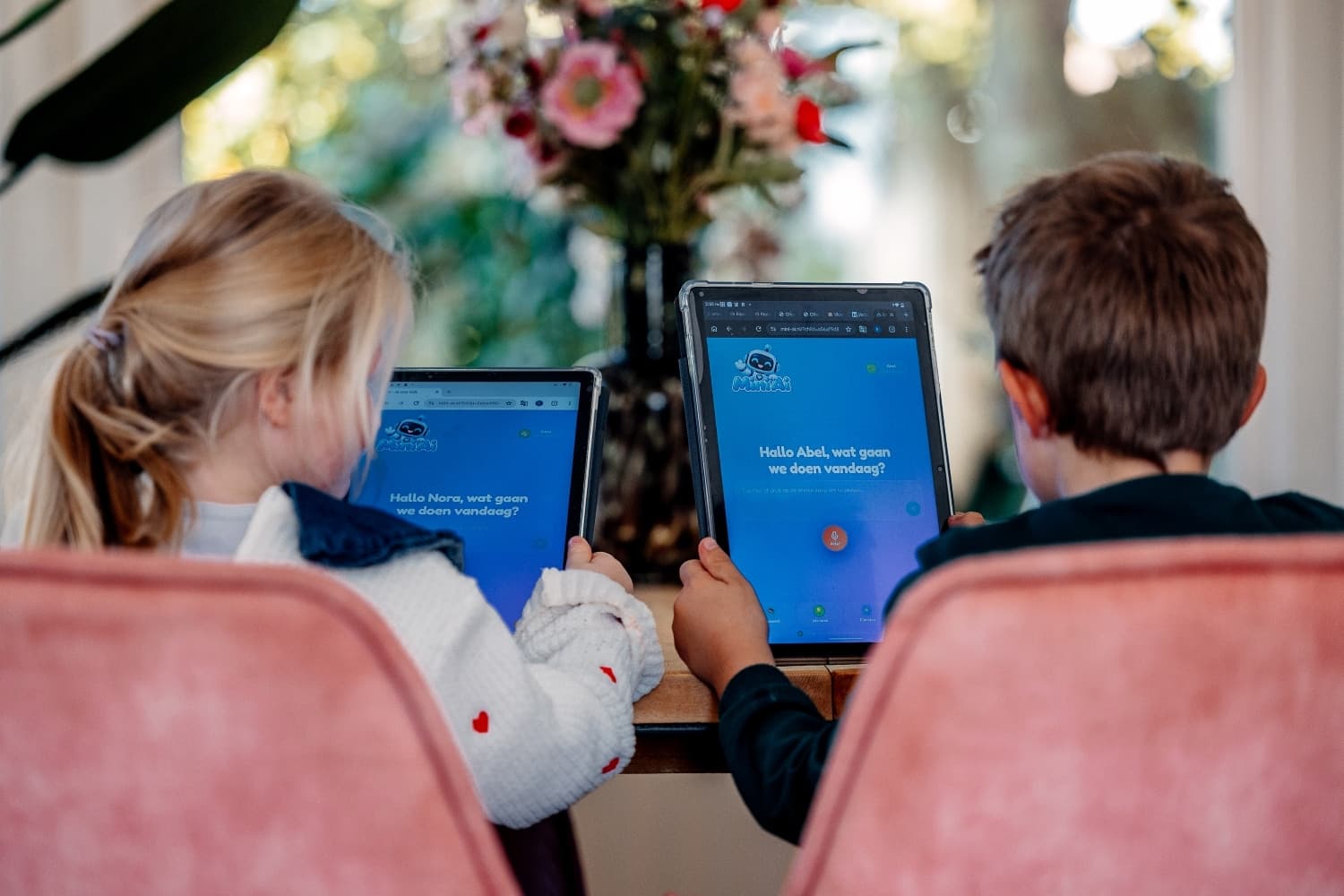
Dutch developer Nick Hoogveldt wanted MiniAI to help children work through homework questions. Then his daughter started treating its friendly voice as an actual friend, so he toned it down. Radboud University professor Eliane Segers asks where to draw the line in the classroom. A chatbot can help children practise thinking or do the thinking for them, depending on how they use it.
https://ioplus.nl/en/posts/ai-as-a-friend-a-helpful-tool-or-a-bad-influence
Europe’s deep-tech scale-ups raise €4 billion
Companies in the EIC Scaling Club raised €4.06 billion in two years, according to the club’s own report, outpacing a group of comparable companies. About 80% of that money came in rounds that included the European Innovation Council or another public backer. A handful of big deals did much of the lifting, with nine rounds of €100 million or more accounting for just over half the total.
https://ioplus.nl/en/posts/eic-scaling-club-scale-ups-outpace-peers-with-4b-raised
Hardt Hyperloop gets another run
After one of its group companies went bankrupt earlier this year, Hardt Hyperloop has raised several million euros in a round led by US investor Green Rock. Hardt plans to continue developing systems such as magnetic levitation and high-speed track switching, which it tests on a 420-metre track in Veendam. The deal also opens the door to joint projects in the Americas.
https://ioplus.nl/en/posts/hardt-hyperloop-makes-a-comeback-with-a-multi-million-investment
The caravan designed with an electric tow car in mind

Lume Ranger
The Lume Ranger weighs 1,150 kilos empty and lowers its pop-up roof for the road, giving it a lower profile designed to reduce drag. How much energy it saves in practice is still an open question. Then there’s the charging stop. How many stations have room for a car with the caravan still attached?
https://ioplus.nl/en/posts/caravan-goes-electric-lume-ranger-rides-a-new-trend
Rather listen?
Here's a small selection of last week's highlights in a half-hour podcast:
External Content
This content is from spotify. To protect your privacy, it'ts not loaded until you accept.
Our Other Newsletters
Thank you for reading this newsletter. But there’s more. Subscribing is easy — via the options on the IO+ homepage or simply by clicking one of the newsletters below:
- IO+ Daily (1,200 subscribers)
- Mauro’s Green Corner (monthly, 13,800 subscribers)
- Elcke’s Saturday Data Dive (monthly, 20,550 subscribers)
- Elcke en Mauro’s BIO+ Bites (monthly, 29,300 subscribers)
- Bart’s Saturday CHIPS (monthly, 16,300 subscribers)