
The future of education is digital and filled with games
Teaching and learning via VR-headsets, games, digital devices is likely to become the norm
Published on February 12, 2026
Masterstudente journalistiek aan de RUG, stagiair bij IO+, schrijft graag over de integratie van AI in het dagelijks leven
Classrooms are changing faster than ever. From AI-generated lesson plans to virtual reality field trips and playground games powered by smart devices, the future of education was on full display at IPON 2026 in Utrecht.
IPON 2026, an event about innovation in education, took place on the 11th and 12th of February. The event attracted many visitors. Among them were teachers, advisors, future teachers, IT and software professionals, and anyone else who wanted to learn more about what the future has in store for education.
The event hosted many different stands coming from the Benelux and Germany. From new ways to teach to companies providing safety policies surrounding privacy and the prevention of data leaks. Among the stands, electronic brands aiming to sell their devices, such as HP, Lenovo, Intel, and Huawei, could also be found.
The main themes presented during the event can be boiled down to 5. Teaching kids via play; making the teacher’s work less demanding by introducing a digital aid; the prevention of digital dangers; new ways to test IQ; and the importance of giving school children capabilities that will help them in the future, such as blind typing, communication skills, and creativity. Most events included the use of automation or AI. IO+ attended the event and had the opportunity to see the emerging innovations that promise to redefine teaching.
Ideas play to the strength of the kid
Research shows that children learn better through play. An example of this is a 2025 study that highlights the benefits of play for a young child’s cognitive and social development.
The study also indicates the need to balance structured and free play, to design for diverse and inclusive audiences, navigate tensions between fun and educational depth, and address resource and institutional constraints. All presentations at IPON 2026, whether on purpose or not, attempted to address one of those points.
Product developers such as Picoo combine technology and the outdoors, by providing devices that keep score during games and aim to prevent arguments about who gets to be which character or whose turn it is during tag. They say it is better than going outside deviceless, as “it will encourage and motivate the children more,” says consultant Anika Kok.
Various companies created games that develop critical thinking skills and language learning abilities. Jungle the Bungle developed games for the iPad, Smart Toys and Games, took a different approach and introduced physical games, and MediaJungle combines electronic devices and physical game play to educate its users on the influence of media and its responsible use.
Another combination of electronic devices and physical gameplay comes from Greenscreenbox. The company and product developer sells a small green screen, accessories, and an app that people can use to take pictures or videos or create stop-motion pictures with only the backgrounds being AI-generated. “The idea behind this is to stimulate communication skills, critical thinking skills, and activate the child's imagination, all the while also teaching them about digital literacy,” according to a media coach and trainer, Kaleigh Hijmering.
AI to aid the teacher
AI not only helps children learn, but teachers also teach. A teacher has many tasks, some of which could be taken over by automating them or introducing an AI model as an aid, according to some expositions at IPON 2026. Alfie, for example, is an AI model that takes and creates an analogue game in seconds. Selecting the mode that creates a matching game, creator Bart Giethoorn made a game about the food chain in seconds.
“The analogue part of Alfie should motivate students and stimulate connections,” says Giethoorn. The teacher can edit the questions and answers if they do not meet their wishes. “Before playing, the teacher must make sure that the information is correct”, says Giethoorn.
One institution that was not a surprise, yet was, was the European Council. They were there to introduce a lesson plan that could help the teacher explain what the council is and what role the different heads of state play. Additionally, it is also possible to emulate the European Council with a game where each participant gets a role, and they must solve a problem together.
Other ideas presented include using AI to grade exams faster, generate lesson plans that cater to what the teacher wants to educate the students on, or provide an instant feedback loop to the child and the teacher.
Learning with Virtual Reality
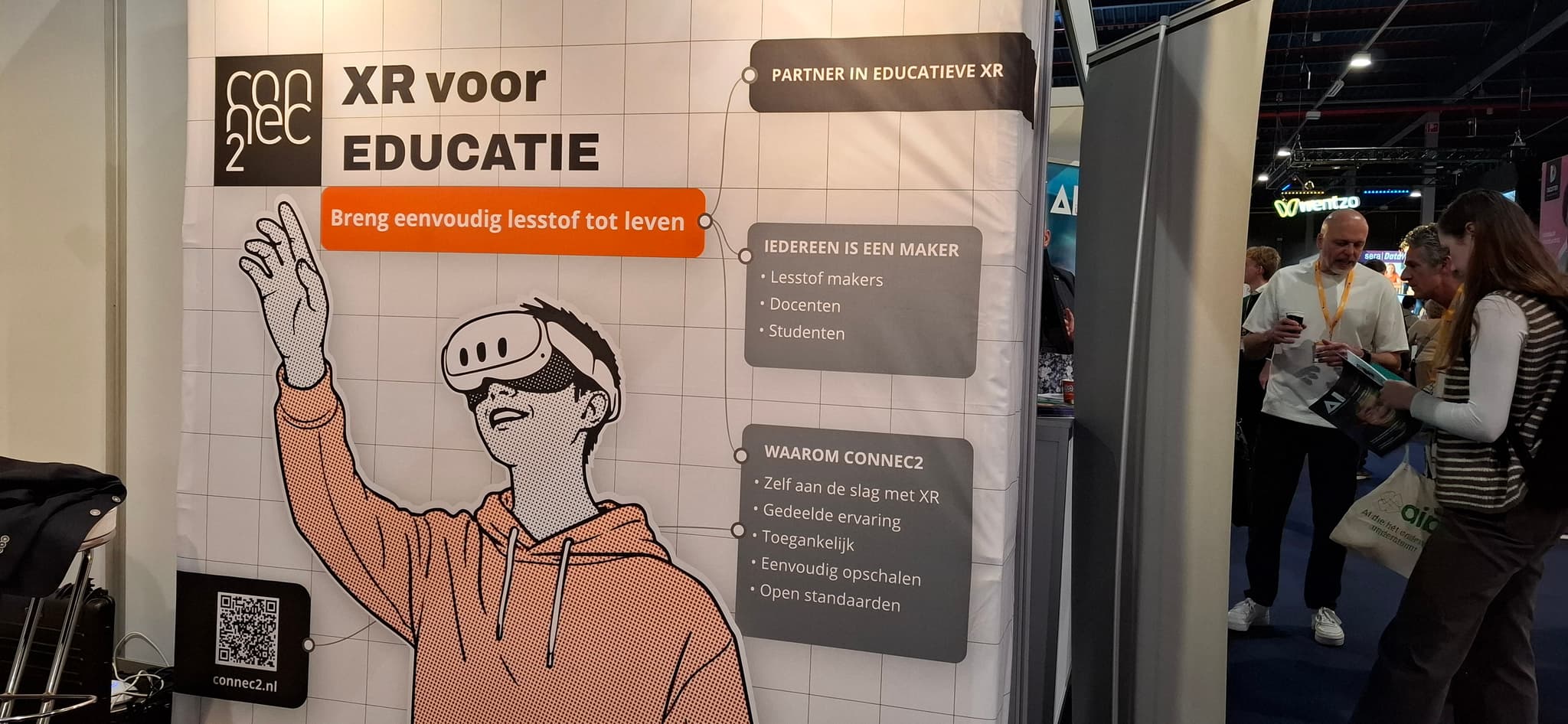
With many ideas aiming to bring education to life and appeal to the digital child, company Connec2 provides a platform for lesson creation applicable to VR-headsets. Their services allow teachers to create their own lessons without needing to go to an external programming company. This is more efficient and cost-effective, according to business developer Michel van Eersel. Based on open standards, methods, and lessons are publicly available and free to use for everyone. This is to encourage people to be creators and do things themselves.
“With VR, you can do things that would otherwise not be possible,” says Van Eersel. For example, a fire can be started quickly, and the pupil can put it out without causing actual damage, explains Van Eersel. Or, a 3D image of a cell can be generated and enlarged so much so that it is possible to stand in it. The same can be done with PowerPoint presentations. “The 2D becomes 3D, and most likely, this will appeal to students more,” says Van Eersel.
Though what cannot be trained with VR is the future surgeons’ steady hands or the builders’ strength. “It is not a replacement of actual training, but rather procedure training,” says van Eersel.
To listen is to learn
Another new teaching method called Ears up was presented by its CEO Tjeerd van den Elsen. This idea is based on reading out loud into a microphone, hearing it back, and noticing where mistakes are made. The end goal is that such mistakes are filtered out by the student making them. This feedback loop encourages the student to correct and teach themselves to read.
This self-teaching method should aid the teacher in their teaching practices and help them understand which students require more attention. Eventually, the educator's role could shift from how something is taught to why, according to Van Den Elsen.
A paradox in the digital age
Although the exhibitions focus heavily on the digital age and the fact that there is no escaping it, Typ10, a service that offers training courses to schools and therapists on how to teach children to type blindly, sees a paradox. Namely, despite the fact that children often spend time on computers, they cannot type. According to their research, children could feel excluded if they cannot type as well as others. Typ10 advocates for digital equality through the teaching of typing, so that all children have equal opportunities to learn to type at their own pace and level.
What happens after the event?
For most stands, the goal is to attract new clients. According to educational advisors Maila van Keimpema and Karina Leferink, the products that are practical and can be implemented with ease are adopted by schools quite quickly. While ideas that require more work are often discussed by staff members.
Something that Leferink and van Keimpema notice is that many of the exhibitions present ideas that aim to activate the child’s creativity and resituate the role of the teacher. “Many ideas are tools for teachers, allowing them to devote more time to stimulating pupils' creativity,” says van Keimpema.