
The F-35 paradox: expensive quality versus cheap quantity
As long as we spend €40,000 per hour hunting down a “flying lawnmower,” we will lose the battle.
Published on December 9, 2025
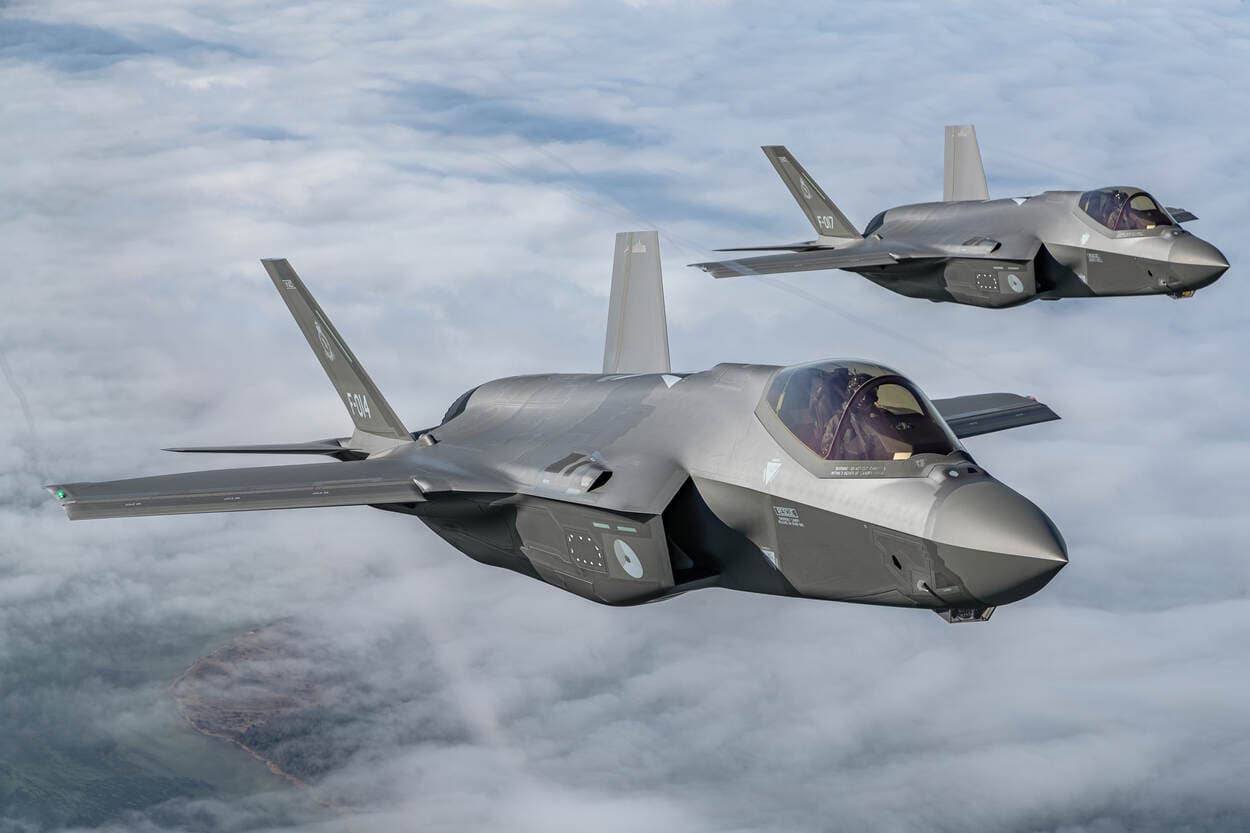
Source of photo: Ministry of Defence

Team IO+ selects and features the most important news stories on innovation and technology, carefully curated by our editors.
Last weekend, there was a loud noise above Volkel. Two F-35s from the Royal Netherlands Air Force took to the skies for a so-called QRA (Quick Reaction Alert). The reason? A report of a drone. Although the object ultimately posed no immediate threat, this incident exposes a painful economic and strategic reality: our current defense doctrine is financially unsustainable in modern warfare.
At first glance, last Sunday's news report seems to be proof of readiness. The system works; there is a report, and our best fighter jets take to the skies. But if you take out your calculator, you will see a worrying asymmetry.
The economics of air combat
Let's look at the figures. An hour of flight time with an F-35 Lightning II costs around €40,000, depending on the calculation method and variant. An Iranian Shahed drone, the type frequently used by Russia against Ukraine, has an estimated purchase price of around €80,000.
The math is sobering: as soon as an F-35 spends two hours in the air patrolling or searching for a threat, we have ‘burned’ the equivalent of an entire enemy attack drone in fuel and maintenance. And that's not even counting the ammunition. A single AIM-120 AMRAAM missile can easily cost a million euros. Shooting down an €80,000 drone with a million-euro missile, fired from a platform that costs €40,000 per hour, is economic suicide.
The lesson from Ukraine: Drone vs. Drone
In Ukraine, where these economic laws are tested daily on the battlefield, this lesson has already been learned. There, expensive fighter jets are rarely used for drone interception. It is simply not efficient.
Instead, we are seeing a shift towards ‘drone-versus-drone’ warfare. Ukraine is increasingly using its own inexpensive drones to shoot down Russian reconnaissance and attack drones. Innovations such as the Atreyd AI drone wall and the use of FPV drones for air defense demonstrate that the solution to a low-cost problem must also be low-cost. Long-range operations are also not carried out with expensive aircraft, but with systems such as the Liutyi, a relatively inexpensive Ukrainian-made drone.
The scenario of the 52 F-35s
The Netherlands will soon have a fleet of 52 F-35s. These are technological marvels, designed for air superiority and precision bombing in heavily defended areas. But in an asymmetric conflict, they are vulnerable.
Imagine a hypothetical scenario: an adversary fires a swarm of 100 inexpensive drones at strategic targets in the Netherlands. The total cost to the attacker might be €8 million.
Even if we get all our F-35s in the air, they cannot possibly intercept all the targets without immediately exhausting their ammunition supply. The logistics chain becomes bogged down, costs explode, and part of the swarm gets through. In the economics of warfare, cheap quantity wins out over expensive quality. We are nowhere if we try to kill mosquitoes with cannonballs.
Innovation as a necessity
The incident above Volkel should therefore not be seen as a successful interception, but as a warning. It shows that we have a gaping hole in our defense: a cost-effective layer for combating massive, cheap threats.
The solution lies not in more steel, but in smarter software and autonomous systems. This is precisely the domain that Dutch and international tech companies are now jumping into. We wrote earlier about how parties such as Intelic AI are rewriting the rules of drone warfare by creating smart networks that respond faster than a human pilot.
In addition, physical interception is subject to change. Where the F-35 falls short in terms of cost efficiency, autonomous ground and air systems offer a solution. An example of this is how companies such as Fiducial are using autonomous systems to combat drones. These systems can be operational 24/7 at a fraction of the cost of a manned fighter jet.
The future of our security does not depend solely on having the best aircraft in the world. It depends on having the right response to the threat. As long as we spend €40,000 per hour hunting a ‘flying lawnmower’, we are fighting a battle that we will lose in the long term – both economically and strategically.