
'The Dutch approach to systems engineering is successful'
In this series, you’ll get to know the people at Holland High Tech (the High-Tech Systems and Materials sector).
Published on April 28, 2026

Our DATA+ expert and Editor-in-Chief, Elcke Vels, explores AI, cyber security, and Dutch innovation. Her "What if..." column imagines bold scenarios beyond the norm.
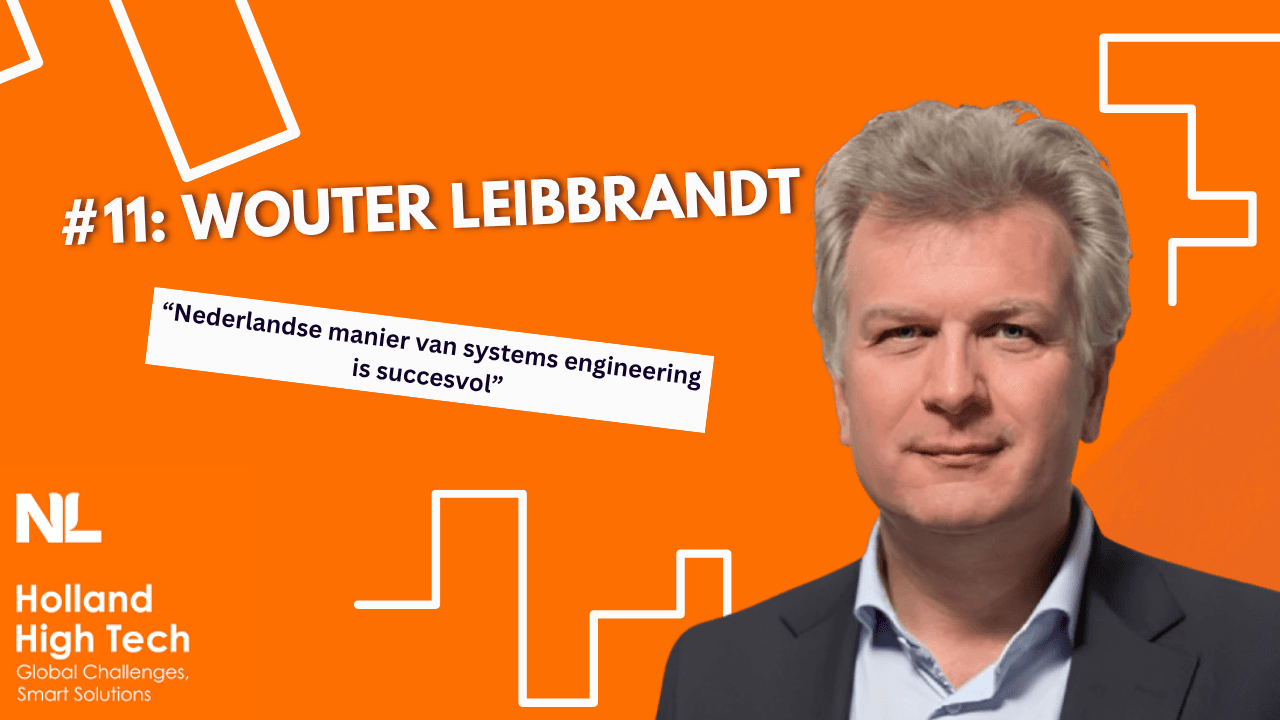
Quantum computing, sustainable mobility, security. High-tech is playing an increasingly important role in our daily lives. Today, we’re interviewing Wouter Leibbrandt: a member of the program council for the Systems Engineering innovation domain at Holland High Tech. He also works at TNO as Market Director for Digital Systems. Systems engineering is essential; without it, we cannot develop or scale up key technologies. It is precisely this integrated approach that is essential for ensuring complex systems operate reliably. According to Leibbrandt, the informal, Dutch approach to systems engineering is very successful.
How would you describe yourself in one word?
“If I had to do that in one word: integrator. Many aspects of my career involve connecting. Making connections between different disciplines and ideas. And then working together with others to actually integrate those ideas into a concept, idea, or system.
For people who aren’t exactly familiar with it: what exactly is systems engineering?
“Systems engineering really comes into play when systems become complex. About 25 to 30 years ago, major systems builders like Philips and ASML ran into the problem that they could no longer build their systems the traditional way. There was someone who had the design in their head and led a team—we called that person the systems architect. But more and more often, projects went over time and budget, and it was no longer possible to build what they had intended.
The cause lay in the increasing amount of software in systems. Everything was becoming more digital. As a result, much more was possible, but everything also became interconnected. If you changed something in one place, it had unexpected effects elsewhere. That’s called emergent behavior. To address that, you need a different approach, involving systems thinking, systems concepts, and specific methods. That is systems engineering.”
Is systems engineering primarily important during product design, or at other stages as well?
“It’s not just about design or implementation, but also about use and decommissioning. Thinking in terms of cradle-to-cradle is becoming increasingly important. So, when a system is taken out of service, what do you do with the components? How do they become part of a new system again? In addition, a system is never truly finished these days. A device that’s delivered will already be different a year later due to updates. That’s why systems engineering plays a role throughout the entire lifecycle.”
You’re involved with Holland High Tech as a program council member. What do you focus on primarily?
“As a program council member, I ensure that systems engineering is given a place within the high-tech, systems, and materials sectors. My colleagues and I make sure that the connecting element is reflected across the other disciplines. In a sense, systems engineering is also a cross-cutting discipline. Of course, I don’t do this alone. Fortunately, there is an innovation council with people who support me in this.”
And what do you focus on as Market Director for Digital Systems at TNO?
“As Market Director, I’m responsible for the business segment: a portfolio of projects that together form a single substantive direction. Together with business developers and subject matter experts, I determine the strategic course: where are we headed? I then work to ensure that concrete research, development, and innovation projects are set up within that segment to flesh out that direction and give it structure.”
Why is the Netherlands actually so good at systems engineering?
“That goes back to Philips and the way they work there: relatively informal and strongly focused on collaboration. In the Netherlands, we have many companies that are market leaders in their segment, such as ASML, Philips, Thermo Fisher, Canon Production Printing, and Thales. These are often complex systems produced in small volumes but with high value. What they have in common is that they work in a transdisciplinary manner and are skilled at integration. Moreover, the Dutch are somewhat independent-minded and not very hierarchical in their approach. As a result, people are more likely to cross departmental boundaries and seek collaboration.”
Where are the areas for improvement in the Netherlands?
“We still focus too often on the large market-leading companies, but there are many more sectors and value chains where systems engineering is important. Think of smaller high-tech companies, the food industry such as Lely and MOBA, but also mobility and energy. Systems engineering could be widely applied there as well.”
AI is on the rise. What does that mean for systems engineering?
“AI helps, but it also brings challenges. It can assist in training new employees, since experienced experts are scarce. AI can also help with routine tasks and modeling. A model is an abstraction of reality, and AI can help create and refine it. But the danger is that you start relying too much on AI. Systems engineering is precisely about recognizing unexpected effects and emergent behavior. AI itself is also increasingly becoming part of systems. That raises new questions: what does it mean when AI is embedded in a system? How do you design and test it? How do you handle it during use and phasing out? That calls for new methodologies and further research within systems engineering.”
Finally, do you have a message for the reader?
“People who make decisions in industry and society need to be aware that they must always think in context. You can’t just improve something without considering the entire system. That applies to technology, but also to policy and regulations. We sometimes think you can make a local adjustment, but later, unexpected effects turn out to exist. So always be context-aware.”
External Content
This content is from youtube. To protect your privacy, it'ts not loaded until you accept.
Sponsored
This story is the result of a collaboration between Holland High Tech and our editorial team. IO+ is an independent journalism platform that carefully chooses its partners and only cooperates with companies and institutions that share our mission: spreading the story of innovation. This way we can offer our readers valuable stories that are created according to journalistic guidelines.
Want to know more about how IO+ works with other companies? Click here