
The 3D printer is already there. Now the organisation has to see
Additive Center is making a step beyond industrial 3D-printing applications: right at the heart of the organisations that use one.
Published on July 4, 2026

Bart, co-founder of Media52 and Professor of Journalism oversees IO+, events, and Laio. A journalist at heart, he keeps writing as many stories as possible.
Amify, part of Additive Center Group at the Brainport Industries Campus, helps companies take 3D printing out of the hands of a small expert group. The biggest obstacle to additive manufacturing is usually not the technology itself, but knowledge, culture and the way organisations make decisions.
For many companies, buying an industrial 3D printer is no longer an exotic step. There are engineers who know how to use it, perhaps a competence team is already in place, and somewhere within the organisation, a few convincing applications may have been developed. Yet the real impact often remains limited. The printer is running, and the expertise exists, but the rest of the company does not see the opportunities or does not know when additive manufacturing can truly add value.
What is Additive Center?
- Additive Center was founded in 2018.
- Amify is currently being established as a separate company after operating as a brand within Additive Center for the past two years. It already has around ten industrial clients, including ASML, Shell, NS and AAE.
- Additive Center has 12 employees, five of whom work for Amify.
That is precisely where Amify focuses. The new brand emerged from the practical work of Additive Center, which supports companies from the Brainport Industries Campus (BIC) in industrial 3D-printing applications: from initial exploration and design to production and business cases.
Amify was originally founded on the idea of sharing expertise under the motto ‘By the industry. For the industry’. BIC is an ideal environment for that. Amify now adds an organisational layer to this vision: how do you turn a handful of experts into an organisation capable of recognising, assessing and seizing opportunities at scale?
“The bottleneck is almost never that a company needs a new printer,” says Joran van Aart, founder and CEO of Amify. “Often, the technology is already there. The question is: do people know when to apply it, and can they build a solid business case around it?”
That may sound like a nuance, but according to Van Aart, the difference is crucial. A company may possess excellent additive manufacturing expertise, but when that knowledge is confined to a few specialists, the returns are limited as well. Especially in large organisations, with thousands of designers, buyers, maintenance staff and production teams, many more people need to learn to recognise when 3D printing is a logical alternative.
Not the printer, but the application
At Additive Center and Amify, the question is therefore less about which printer someone should buy and much more about which problems an organisation is trying to solve. Additive manufacturing is not an end in itself, Van Aart stresses. It is a way to improve performance, reduce costs, solve supply problems or organise production more intelligently.
He broadly distinguishes three types of applications.
The first is design for additive manufacturing: redesigning parts around the possibilities offered by 3D printing. This can mean combining several components into one part, creating lighter structures or producing shapes that are difficult or impossible to make with conventional manufacturing techniques. It requires the most design work, but can also generate the greatest gains: better performance, less material use, less assembly work or entirely new functionality.
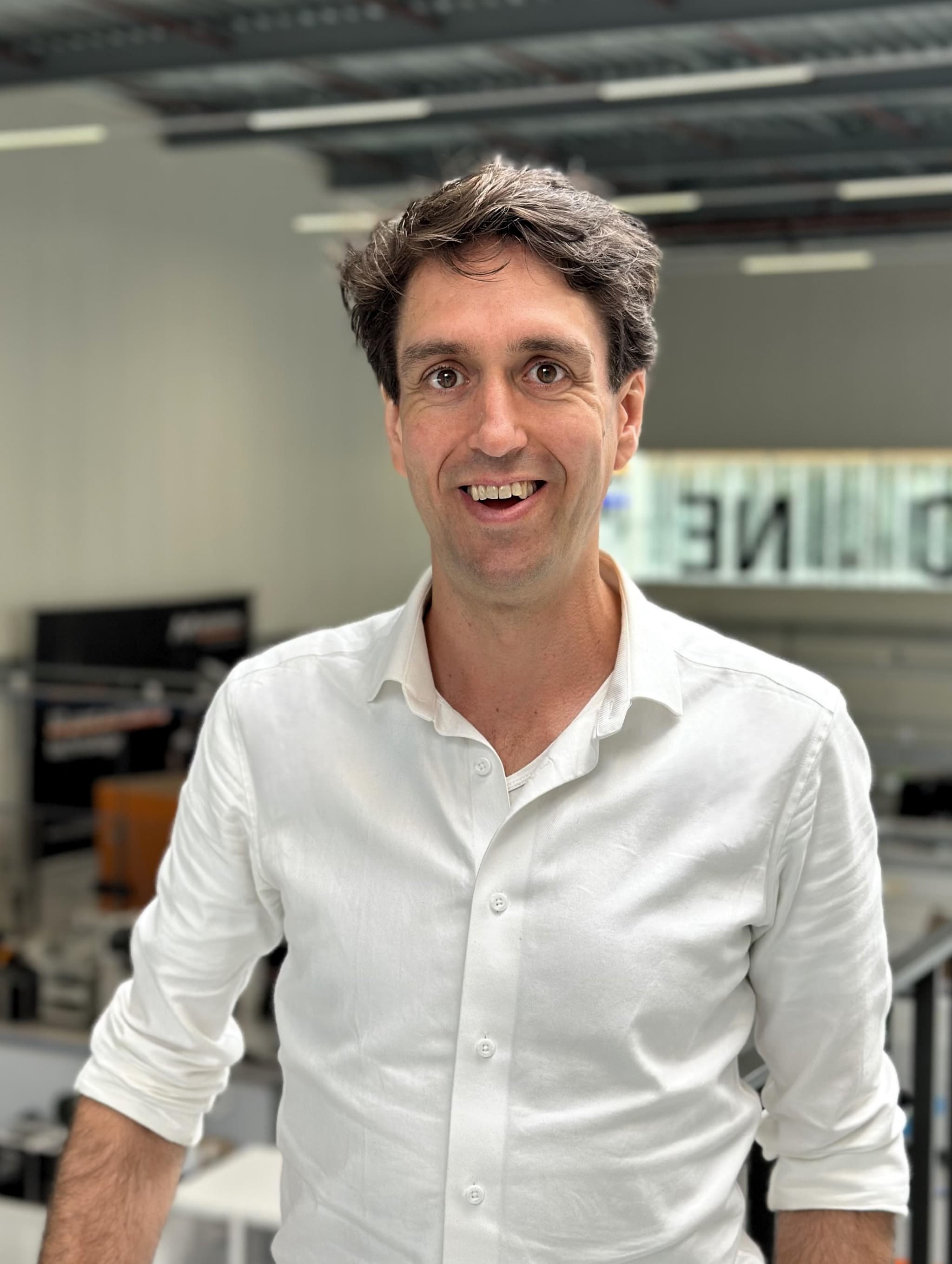
Joran van aart, Amify
A second category focuses on spare parts and obsolescence. In organisations with long-life assets, such as trains, industrial installations or production equipment, certain parts may no longer be available after several decades. On paper, a printed part may be more expensive than the original milled or cast component, but that comparison is too narrow. When a train, production line or installation risks being out of operation for days or weeks, the calculation changes immediately. The real value then lies in shorter lead times and avoiding downtime.
The third application is about tooling. In this case, the final product is not printed, but rather tools for the shop floor: a mould, an alignment aid, a positioning arm or a specialised tool for a technician.
“When someone in a production hall spends half an hour every day aligning a part precisely, a simple printed tool can save a great deal of time,” Van Aart says. “Then it is not about the cost price of that one piece of plastic or metal, but about production efficiency.”
Training is necessary, but not enough
According to Van Aart, companies often start with training. That makes sense, but it is rarely sufficient.
“People return from a course full of enthusiasm. A week later, they are back in their regular work. Three months later, much of that enthusiasm has disappeared.”
Knowledge is therefore a necessary foundation, but without follow-up in processes, decision-making and collaboration, little changes.
Amify, therefore, treats additive manufacturing as a change process. Engineers must learn to recognise different design possibilities. Buyers need to understand when conventional sourcing is no longer the best option. Maintenance teams must be able to identify when a broken part could perhaps be produced locally or more quickly. Managers need to understand the business impact behind an application.
That requires collaboration between disciplines that do not naturally sit around the same table: design, production, maintenance, procurement, quality management and leadership. An innovative application requires different people than a spare-parts challenge, but in every case, the same principle applies: expertise only creates value when it is used at the right moment in the process.
From first success to global scale
Amify works with two types of organisations. The first group sees the potential of 3D printing but has few convincing examples from its own operations. For these companies, the team developed an Additive Boost programme: a process in which engineers work with concrete parts, from identifying opportunities through design, validation, production and use.
“We always focus on business impact for customers, with three goals: reducing costs, improving performance and increasing uptime and the availability of service parts,” Van Aart says. “That creates a strong return on investment, allowing customers to earn back their investment in the Boost programme immediately.”
The approach is deliberately practical.
“About 30 per cent consists of theory; the rest is about doing,” Van Aart explains. “Participants walk through the production hall, the warehouse or towards a machine on the shop floor together. That is where they look for parts and processes in which additive manufacturing can demonstrably make a difference. The goal is not an inspiring presentation, but a series of physical parts with a substantiated business case.” Amify positions the programme as an eight-week, hands-on process for multidisciplinary teams.
The second group of customers is already further along. They have competence teams, industrial printers and proven applications. Van Aart cites manifolds as a recurring promising category in semicon. In the energy sector, impellers for industrial installations can play a similar role. The challenge there is no longer: can we make one good part? The question becomes: how do we turn ten successful applications into one thousand or ten thousand? “That is when change management really comes into play,” Van Aart says. “You want knowledge not to remain with a few people, but to become available across the entire organisation.”
The printed application as an internal campaign
Amify is therefore also launching the Showcase Library. This is a digital environment in which companies can document and share their best applications: what was made, why that choice was made, which design decisions were involved, what the business impact was and what teams learned from the process.
The library can be used publicly as well as in a protected environment for confidential applications. “That matters for companies where designs, production data and customer information cannot simply be shared,” Van Aart says. “For large international organisations, such a digital environment also offers an alternative to endless travel and repeatedly delivering the same physical training sessions.”
Van Aart sees this as part of internal marketing. “Taking printed parts with you and showing them to colleagues works extremely well. People can see: this is not an abstract technology; it is already happening within our own company.” Anyone holding a tangible part in their hands often understands more quickly what a PowerPoint presentation can never fully convey.
Ultimately, Amify’s work is not about one printer, one material or one spectacular application. It is about an organisation learning how to see: looking at a broken part, a slow production process or a complicated design, and asking the right question in time: could this be done differently?
The technical possibilities of additive manufacturing are already here. The next step is making sure that many more people learn to recognise them.