
'Technology should take away complexity, not humanity'
Peter Spijkers explains how Alzheimer.app is bringing AI into dementia care: "We didn't start with AI. We started with people."
Published on October 11, 2026
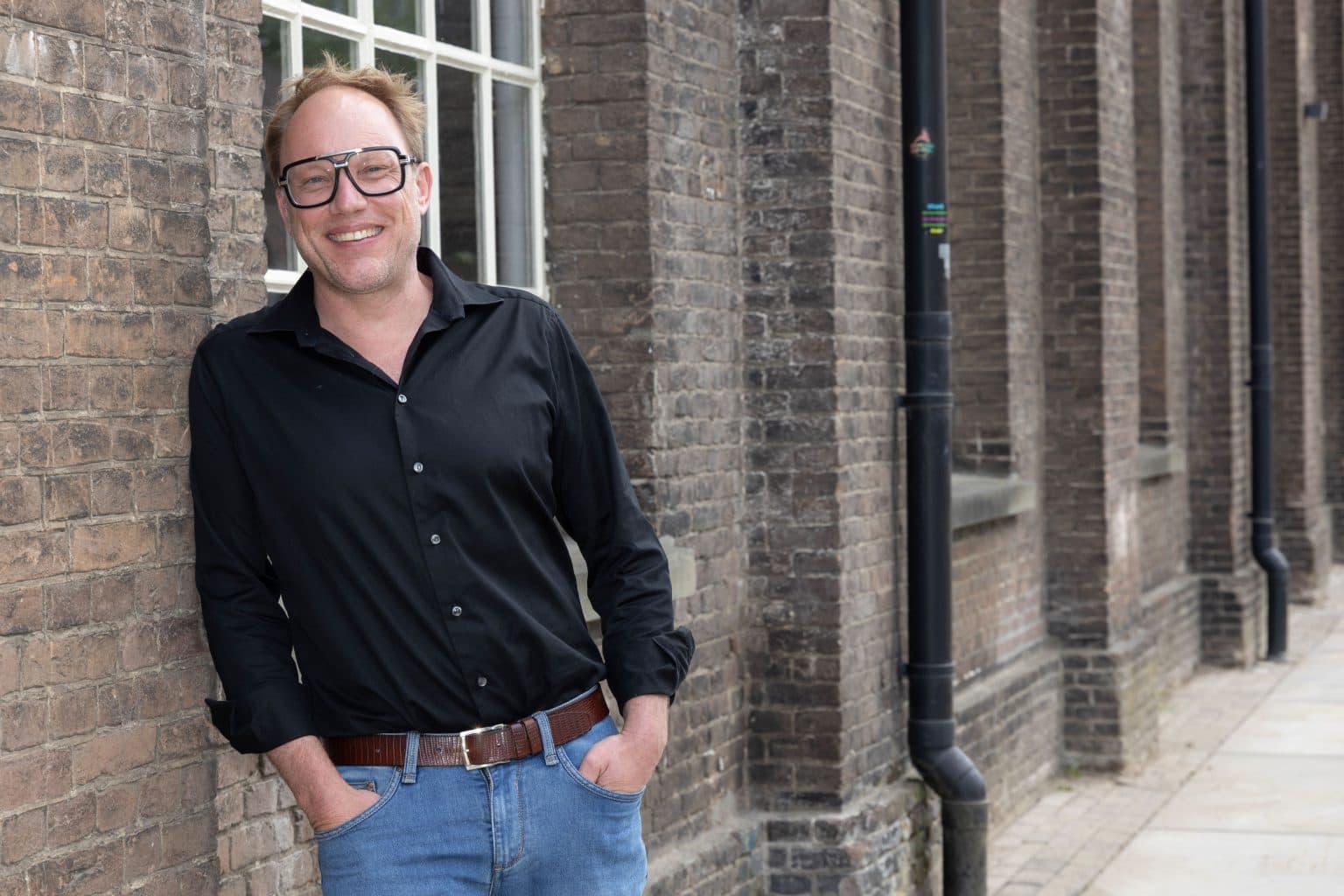
Peter Spijkers, alzheimer.app
Bart, co-founder of Media52 and Professor of Journalism oversees IO+, events, and Laio. A journalist at heart, he keeps writing as many stories as possible.
In the run-up to the grand finale of the AI Pitch Competition on 12 November at the Evoluon in Eindhoven, IO+ is profiling the eight finalists and the wildcard. First up, the wildcard: Peter Spijkers of Beugen BV Groep on Alzheimer.app, an evidence-based assistant designed to support caregivers and families when questions arise in the middle of the night.
Dementia rarely keeps office hours. When confusion sets in, behaviour changes abruptly, or an informal caregiver feels overwhelmed at 2 a.m., professional help is rarely within reach. That is precisely when Alzheimer.app aims to make a difference.
Operating as the wildcard contender in this year’s AI Pitch Competition, the Brabant-based initiative bridges scientific rigour with hands-on residential care. Below, founder Peter Spijkers explains how the platform works, why he abandoned a conventional top-down B2B model, and what it takes to deploy AI responsibly for one of society's most vulnerable groups.
A domain-specific AI layer rooted in daily care
At first glance, a conversational assistant might seem like another iteration of generative AI. However, Spijkers stresses that general-purpose foundation models are ill-suited for the delicate nuances of cognitive decline.
"At its core, our approach combines a large language model with a dementia-specific AI layer that has been trained using scientifically supported articles and knowledge about dementia and dementia care," Spijkers explains. "This enables the system to build on specialised, evidence-based knowledge rather than relying solely on the general knowledge of a large language model."
Crucially, the venture does not operate in an academic vacuum. Based in Hilvarenbeek, the startup maintains a direct link to De Gelukshoeve, their residential dementia care facility.
"Where relevant, dementia care approaches are also applied in daily practice at De Gelukshoeve, giving us a direct connection between scientific knowledge, AI development, and real-world dementia care," says Spijkers. "Our differentiation is therefore not simply the use of generative AI. It is the combination of scientifically supported dementia-specific knowledge, personal profiles, conversation history, real-world care experience, understandable language, and safety mechanisms for a vulnerable user group."
With user consent, the assistant builds a personalised context over time without requiring heavy diagnostic tracking: "The ambition is simple: to provide the right guidance, for the right person, at the exact moment a question or difficult situation arises."
The challenge: Scaling globally while localising culturally
While the underlying infrastructure runs on dedicated servers built to expand computing and storage smoothly, Spijkers notes that the primary bottleneck in healthcare expansion is rarely technical.
"Technical scalability is not our primary challenge. The more important challenge is responsible localisation," he points out. Dementia care norms, family hierarchies, legal frameworks, and social safety nets vary drastically across borders.
"Simply translating Alzheimer.app into another language is therefore not enough. The AI must also understand cultural differences in communication, forms of address, family relationships, caregiving practices, and expectations around dementia and care. In other words, the technology can scale globally, but the quality of Alzheimer.app depends on remaining locally and culturally relevant."
Ethical guardrails and the courage to say "I don't know"
In a healthcare environment, hallucination or misdiagnosis can lead to catastrophic outcomes. The system is deliberately engineered to acknowledge boundaries rather than guess.
"Because Alzheimer.app serves people in potentially vulnerable situations, safety, transparency, and human dignity must be built into the product from the beginning," Spijkers underlines. "The app is not intended to diagnose dementia or replace a doctor, nurse, or other professional. Where the information is uncertain or a situation may be urgent, the safest answer is not to improvise but to acknowledge the limitation and recommend appropriate human support."
A clear case in point is acute behavioural shifts. "One example is a question involving sudden confusion or a rapid change in behaviour," Spijkers notes. "Such symptoms should not automatically be attributed to dementia. The system must recognise that they can require urgent medical attention and advise the user accordingly." Continuous testing across varied demographics and feedback from frontline nurses ensure that stigmatising language and harmful assumptions are caught early.
Pivoting from boardroom push to caregiver pull
The startup’s entrepreneurial trajectory offers an instructive lesson in resisting conventional venture capital playbooks. Early on, prospective investors urged the team to target institutional healthcare buyers directly through top-down B2B contracts.
"In practice, we encountered considerable resistance," Spijkers recalls. "Organisations often felt that their professionals did not need another app and that the knowledge provided by Alzheimer.app was already available within their teams. Our experience suggested something different: at the level of individual caregivers and users, there was still a real need for immediate, accessible, and practical dementia-specific knowledge."
Recognising the disconnect, the team walked away from that investor-led path and chose to bootstrap independent development, putting the end-user first.
"Interestingly, this has now created the opposite movement," Spijkers says. "Adoption is increasingly happening bottom-up. Individual caregivers and other users discover Alzheimer.app, start using it in their daily work, and recognise its value. From there, interest begins to move upwards within healthcare organisations, with professionals themselves asking whether Alzheimer.app can be made available more broadly."
For Spijkers, that vindication highlights the power of grassroots adoption: "Overcoming the hurdle was not about finding a way to push harder from the top. It was about having the confidence to stay independent, remain close to our users, and let genuine user value drive adoption from the bottom up."
Privacy by design: Stripping away unnecessary data
With the EU AI Act and GDPR shaping European tech development, Alzheimer.app views regulatory compliance not as an administrative burden, but as a product design discipline.
"A very practical example is that Alzheimer.app does not need to know exactly who someone is in order to provide personalised support," Spijkers explains. "We do not need a citizen service number (BSN), an exact date of birth, or even a person’s full legal name. In many cases, a preferred name, approximate age or year of birth, and relevant information about the person’s situation are sufficient to personalise the guidance."
Rather than hoarding telemetry data, the philosophy revolves around strict minimisation: "Rather than collecting as much data as possible because it might become useful, we ask what information is actually necessary to provide meaningful support. Particularly in dementia care, regulation encourages us to build a better product: collect only what we need, protect what we collect, and remain transparent about what the technology can and cannot do."
Rooted in Brabant, focused on systemic bottlenecks
Spijkers credits the startup’s location in Hilvarenbeek and the wider Brabant innovation climate with accelerating their feedback loops.
"Brabant is surrounded by universities, knowledge institutions, technology companies, and healthcare organisations, creating an excellent environment for collaboration and innovation," he says. Yet, the living-lab environment of De Gelukshoeve remains their unfair advantage: "We can observe real needs, learn from caregivers, people living with dementia, and their families, and evaluate whether ideas that work in theory also create value in practice."
If there is a missing link in the regional ecosystem, it lies in procurement and clinical adoption: "What is still missing is an easier route from successful innovation to structural adoption. Developing and testing an innovation is possible, but moving from demonstrated value to large-scale implementation and sustainable financing within healthcare remains unnecessarily difficult."
Technology that amplifies human dignity
Looking ahead over the next 5 to 10 years, the ambition is to evolve Alzheimer.app into an adaptive, proactive companion accessible via natural conversational voice interfaces. Yet throughout that roadmap, Spijkers insists on keeping the machine subordinate to human relationships.
"We believe AI becomes powerful when it does not try to replace people, but strengthens them," Spijkers reflects on the broader AI for Good versus AI for Disaster debate. "A caregiver who gets the right information at the right moment can respond with more confidence. A family member who understands why someone with dementia behaves in a certain way may react with more patience and empathy."
"That is why our philosophy is simple: technology should take away complexity, not humanity. If AI gives caregivers and families more knowledge, confidence, and time to actually be there for someone with dementia, then for us, that is AI for Good."
When asked why Alzheimer.app will convince the jury at the Evoluon on 12 November, Spijkers circles back to purpose over hype:
"We believe Alzheimer.app can win because it did not start with AI. It started with people. My starting point has never been: 'How can we build a business around this?' It starts with seeing a real problem and asking: If nothing existed yet, how would we solve this problem in the best possible way? We are not building AI because AI is exciting. We are building Alzheimer.app because dementia is one of the major challenges of our time."
Erasmus Enterprise, BOM, and IO+ organise the AI Pitch Competition, which is supported by the Province of North Brabant. The finals take place during AI Summit Brainport on 12 November at the Evoluon in Eindhoven.