
Tech ecosystem in Q1: a billion in capital but shaky foundations
In the first quarter of 2026, Dutch startups raised €1 billion, but concerns over taxes and early-stage funding are growing.
Published on April 17, 2026

Fabrizio del Maffeo, © Axelera AI

Team IO+ selects and features the most important news stories on innovation and technology, carefully curated by our editors.
The first quarter of 2026 reveals a striking paradox in the Dutch startup sector. While total investment volume rose to a record high, the foundations of the ecosystem are wobbling due to a historically low number of deals and looming fiscal measures.
In the first quarter of 2026, the Dutch startup sector reached a milestone of nearly €1 billion in investments. This amount of €981 million represents a 129 percent increase compared with the same quarter last year. Yet this record figure does not tell the full story about the sector's health. The number of deals fell to 72, the lowest level since the end of 2020. Growth is being driven almost entirely by a handful of very large capital injections into mature companies. Mews, for example, raised $300 million, while Axelera AI secured $250 million. These mega-deals create a distorted picture of the market. While the top end of the market is becoming more mature and attracting large sums of money, activity across the broader ecosystem is shrinking. The 15 percent increase over the previous quarter shows that plenty of capital remains available for proven success. However, dependence on a few large outliers makes the ecosystem vulnerable to fluctuations involving individual players.
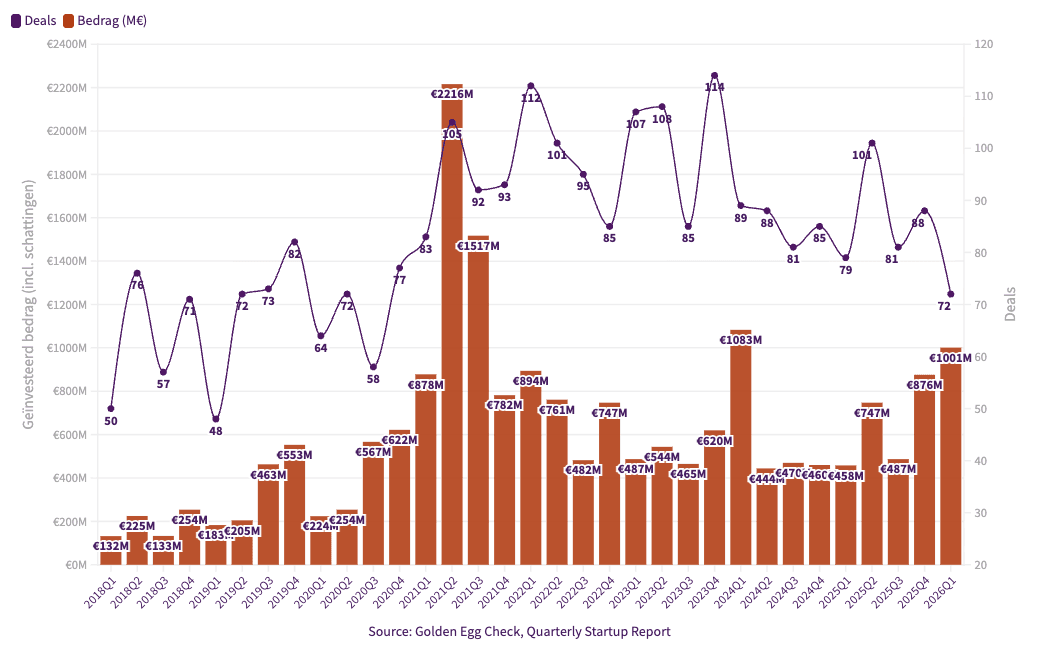
The growing gap between early stage and late stage
The real concern lies at the base of the ecosystem, among early entrepreneurs in the pre-seed and seed stages. Although these early deals still account for 40 percent of total transactions, they represent only 4 percent of invested capital. This contrast is worrying for the future pipeline of innovative companies. Without sufficient early-stage funding, the pool of future scale-ups slowly dries up. Experts speak of a “crack in the foundation” of the Dutch tech landscape. Investor focus is increasingly shifting toward safer Series B rounds and beyond, which now account for 83 percent of total investment volume. This means that new ideas and breakthrough technologies are finding it harder to secure their first round of capital. If this trend continues, the Netherlands risks losing its position as a breeding ground for new technologies. The long-term consequences for economic renewal will be significant if the inflow of new talent stagnates.
Fiscal threat from new Box 3 rules
Alongside the funding gap, a dark cloud hangs over the sector because of proposed tax changes in Box 3. From 2028 onward, the government wants to introduce a 36 percent tax on the annual increase in value of shareholdings in companies. This affects employees and early investors who own shares in unlisted startups. They would then have to pay tax on paper gains they have not yet realized. Because startups often generate no cash flow for years, these shareholders may have no money to pay the tax bill. Michiel Muller of Picnic warns that this would make it impossible to attract international talent with stock options. The Dutch Startup Association sees this as a real risk to retaining Dutch unicorns. Investors such as Robert Gaal say it would make the Netherlands one of the least competitive countries in Europe for tech companies. The fear is that entrepreneurs will move their headquarters abroad to avoid this tax pressure. This undermines the ambition to build a strong national knowledge economy.
Pension funds as new anchor investors
A positive development is the growing role of Dutch pension funds in the financing landscape. Pension fund PME announced it will invest €400 million in Dutch high-tech companies. This strategic move is intended to prevent crucial technology from falling into foreign hands. Funds such as ABP and PGGM are also shifting their focus toward domestic innovation. They are seeking a balance between solid returns for pensioners and supporting the national economy. These capital injections are essential to closing the growth-capital gap that is often filled by American or Asian investors. Alae Laghrich of PME emphasizes that preserving strategic autonomy is a key motivation. By deploying local capital, control over important technologies more often remains within national borders. This is a necessary counter-movement to the trend in which successful companies establish their legal structures outside the Netherlands. The active involvement of these large institutional investors gives the sector a much-needed anchor in uncertain times.
Loss of economic control and autonomy
Despite the high investment figures, a great deal of economic value is leaking abroad. There is a clear trend toward structuring large funding rounds outside the Netherlands. As a result, ultimate value creation and economic control flow to foreign entities. This weakens the Dutch business climate, because the rewards of success are less often harvested domestically. The complexity of Dutch legislation and fiscal uncertainty are pushing companies to choose other jurisdictions. Although the government is making €1.5 billion in R&D funds available, this does not always outweigh the disadvantages of the current climate. Europe’s strategic autonomy is therefore under pressure. If the most promising companies leave once they become large, the Netherlands loses its grip on the technology of the future. It is not enough to grow startups; they must also be given room to scale into global players from here. The current figures show that the capital is available, but the structure needed to retain that capital is showing cracks.
Innovation under pressure
Looking ahead, the Dutch tech ecosystem stands at a crossroads. The focus is shifting from rapid growth to pragmatic, efficient business models. Sectors such as fintech, deeptech, and space continue to perform strongly thanks to their focus on measurable results and sustainability. One example is RIFT, which raised more than €113 million for its innovative energy solutions. OQ Technology also secured €25 million in funding for satellite communications. However, the future of the sector depends on restoring early-stage financing and creating stable tax policy. The public consultation on the new Box 3 rules offers an opportunity to remove the biggest bottlenecks. If government and industry succeed in improving the business climate, the Netherlands can retain its role as an innovation hub. Without these adjustments, the country risks becoming a transit point for ideas that create major value elsewhere.