
Tech and capital available, but founders must bring them together
Amid pitch anxiety and pizza, founders attending OWOW’s Startup Investment Afternoon are searching for that all-important second meeting.
Published on September 21, 2026
Bart, co-founder of Media52 and Professor of Journalism oversees IO+, events, and Laio. A journalist at heart, he keeps writing as many stories as possible.
During OWOW’s Startup Investment Afternoon, founders, investors, corporate representatives and students came together around one central question: how can promising technology also become an investable business? A polished pitch deck helps, but ultimately market knowledge, evidence, and the team behind the startup make the difference.
“I lost my presentation on the way here. So I’m simply going to invite three random people to come up and pitch.” For a moment, the room freezes. It is Friday afternoon, and the founders gathered at OWOW in Eindhoven know only too well what it feels like to face a critical audience without preparation. Then pitch coach David Beckett puts them out of their misery. It is a joke. But the tension created in those few seconds is exactly what his talk is about.
Under pressure, startups must reduce a complex venture to a one-, three- or five-minute story. At the same time, they know that the person on the other side of the table may already have heard four other pitches that day. Brilliant technology alone is not enough. A founder must also explain what problem it solves, who is willing to pay for it and why this particular team can turn the technology into a business.
Bringing different worlds together
That is the essence of the second Startup Investment Afternoon, organized by OWOW Venture Studio and Gerard & Anton. The event brings together worlds that coexist closely in Brainport but do not necessarily find each other: technology and capital, researchers and entrepreneurs, young founders and experienced investors.
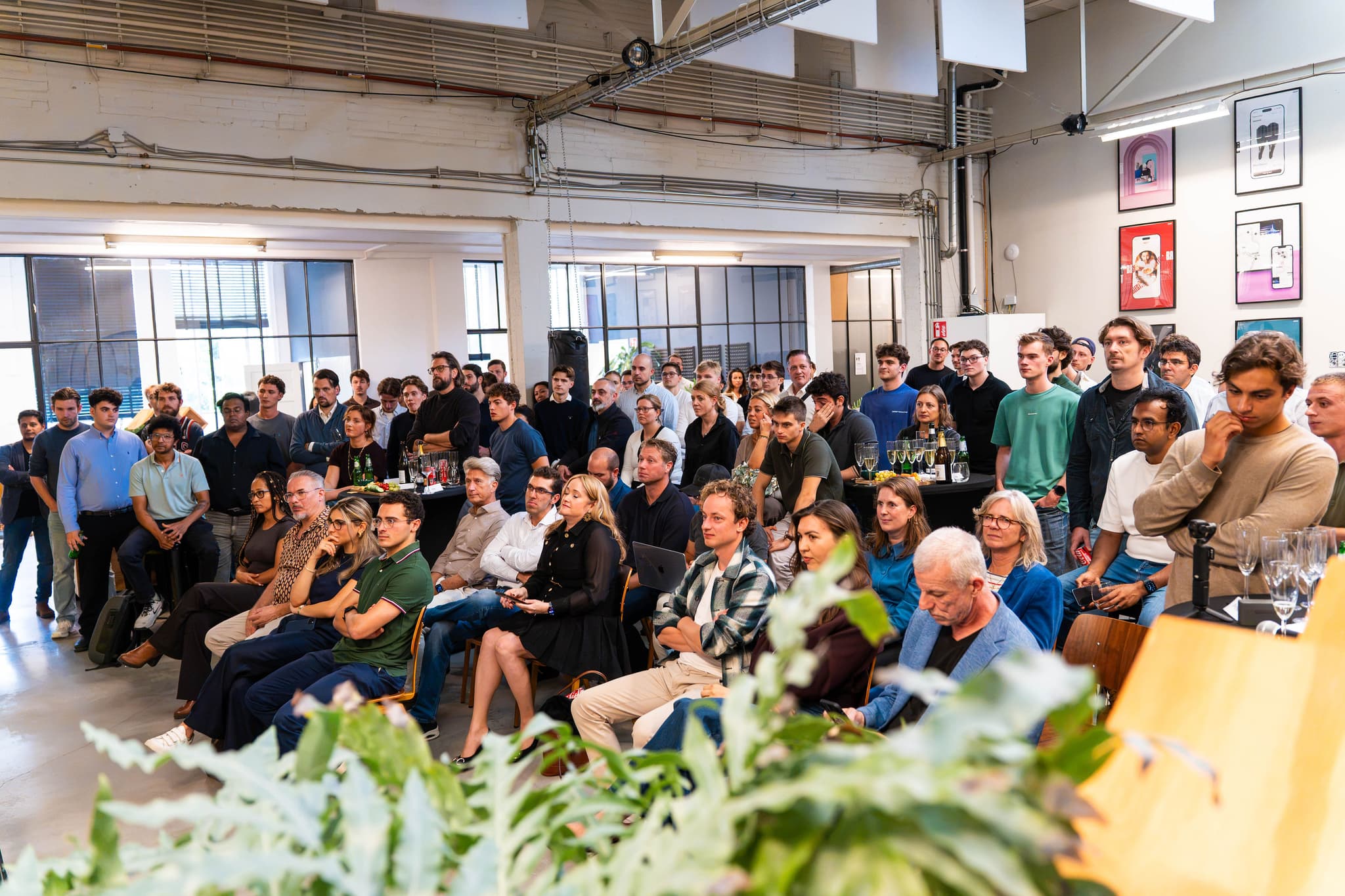
The audience reflects that ambition. Startup founders are raising money now or plan to do so within the next year, alongside investors representing different types of funds and corporate representatives. Former Philips Ventures investor Benno Tieke is there, alongside entrepreneurship students from Tilburg and TU/e students from just around the corner. Advisers, venture builders, and people from the regional startup network also attend.
Co-host Bert-Jan Woertman moves between all these groups with a microphone. He asks who invests, who is looking for funding and who is attending an event like this for the first time. Names, campuses, companies and funding opportunities are constantly being connected. This “connecting the dots” is not a side effect of the program; it is its purpose.
Technology seeks capital
Woertman first places the pitches within the broader Brainport story. Since 2020, 72 deep-tech companies in the region have collectively raised €1.7 billion across 254 funding rounds. In the first half of 2026, 98 per cent of all startup capital invested in Brainport went to deep tech.
The three largest technology domains are semiconductors, health and energy. Since 2020, companies in those sectors have raised €738 million, €501 million and €226 million, respectively. Many founders gained knowledge and experience at Philips, ASML, or NXP, while new companies emerge from institutions including TU/e, TNO, and imec. The TU/e campus, High Tech Campus, Strijp-S and Strijp-T, and the Automotive Campus form recognisable clusters within the ecosystem.
The figures demonstrate the region’s technological strength and its growing flow of capital. But a gap remains between an invention and an investable business. Particularly in deep tech, it can take years to turn a technology into a marketable product, a factory and substantial revenue. Founders must therefore do more than explain their technology: they must also demonstrate that a market exists and that their team can endure the long road to commercialisation.
According to Woertman, that is where events like this prove their value. Brainport has expertise, companies, campuses, investors and support programs. The next step is to connect those elements so effectively that founders know whom to approach—and are sufficiently prepared to make progress once they do.
Not a history lesson
Beckett has coached startups for thirteen years and worked with thousands of teams. According to him, things often go wrong in the same way during the opening minutes. Founders start with the company’s history, then explain in exhaustive detail how their product works, and only much later address why anyone should invest in it.
Investors do not have that kind of time. According to Beckett, one major Amsterdam investor receives approximately 12,000 proposals a year. These lead to around a thousand initial meetings. Only a small fraction ultimately results in an investment.
In the recipient’s mind, a company is quickly placed in one of three categories: interesting, maybe or no. If a founder fails to arouse curiosity within the first two minutes, it is almost impossible to change that judgment later.
The solution sounds deceptively simple. According to Beckett, a pitch must communicate four things: the large, unresolved problem; the solution the startup has built; evidence that the solution works or meets a market need; and why this particular team can execute the plan. “Investors are not primarily interested in products,” he says. “They are interested in opportunities.”
He advises founders not to fill a thirty-minute conversation with a twenty-minute presentation. Start with three minutes covering only the essentials, then ask: what would you like to know more about? This lets the investor decide whether the discussion should focus on customers, technology, market access, or scalability.
Five hundred words a minute
When Beckett asks how many words someone can speak per minute while remaining understandable, estimates fly across the room. Sixty. One hundred and fifty. Two hundred. Someone calls out five hundred. The correct answer is around 150, Beckett says. That leaves little room for digressions.
An introductory email should also be brief. Beckett limits it to five sentences: who are you, what do you want, why are you approaching this particular person, why should they respond and what is the desired next step? A lengthy email accompanied by a 23-slide attachment immediately demands too much from someone with little time to spare.
But amid all the models and structures, Beckett introduces another ingredient. His “golden question” for a founder is: why are you actually doing this?
That is often the moment when a rational conversation changes tone. Founders talk about the frustration, experience or discovery that initially drove them to start. “Especially in a world full of pitches planned and structured by AI, we need to hear why someone believes this matters,” Beckett says. Twenty or thirty seconds of personal storytelling can be more memorable than yet another chart showing market size.
Perfectly uniform AI output
OWOW co-founder Robin Dohmen then shows how profoundly AI has changed investor deck creation. Using a combination of tools including Claude Design & Pitch.com, founders can research markets, analyse competitors, sharpen copy and design presentations. Work that once took days or even weeks can sometimes be completed in a few hours.
But the fastest route rarely produces the best result. Anyone who simply asks an AI system to create a deck for a robotics startup will receive polished slides within minutes—but also a story resembling countless other presentations in an investor’s inbox.
Dohmen therefore sticks to the sequence “script, design, deliver.” First, determine the story; then create the slides; finally, rehearse the presentation. He also distinguishes between a visual deck for a live presentation and a more detailed version an investor can read independently afterwards.
In answer to questions, he generally advises against including a video at the initial stage. Investors want to control their own reading pace and quickly jump to the figures, business model or team. A product video may become useful later in a data room, once serious interest has developed.
In summary, he concludes: AI is no longer an optional extra when creating an investor deck; it is the starting point. However, founders should also focus on what AI does not know and cannot replicate. The “why you” question is a compelling example: why are you the person who can turn this company into a success?
Art and science
Lotte Smit van Ditshuizen of Arches Capital and Meron Mekonnen of LUMO Labs join the investor panel. Audience questions cover AI, impact, intuition, and how investors see through a professionally designed story.
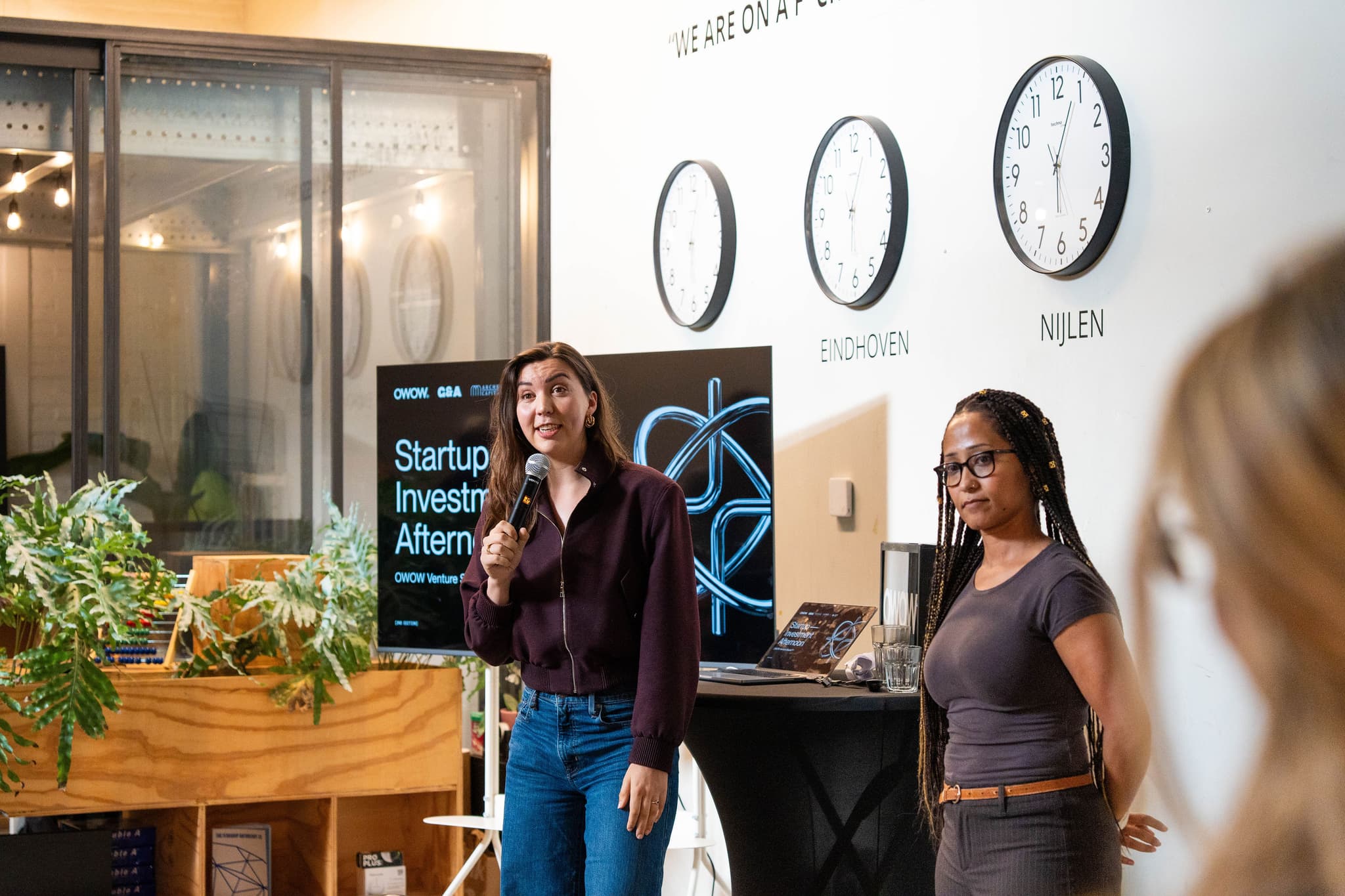
Lotte Smit van Ditshuizen of Arches Capital and Meron Mekonnen of LUMO Labs
Mekonnen says LUMO focuses heavily on the team when assessing early-stage companies. At that stage, forecasts and financial models are inherently uncertain. The founders’ experience, their understanding of the market and their ability to execute therefore carry considerable weight. The impact fund also looks for a distinctive competitive advantage and evidence that customers or partners are genuinely interested.
In deep tech, that evidence does not necessarily have to consist of revenue. Pilots, technical research, partnerships and conversations with potential customers can also demonstrate that a company is making progress. Van Ditshuizen describes investing as a combination of “art and science.” Data, references and due diligence are essential, but experience and intuition remain part of the process.
Social impact is not a universal selection criterion either. An impact fund explicitly assesses it, whereas another investor may focus more strongly on financial returns. Founders must therefore research in advance whom they want to sit down with. Even a strong company can be rejected if its sector, development stage or funding request does not match the fund.
The students’ questions repeatedly bring the discussion back to the fundamentals. How does an investor recognise a story that is too good to be true? How important will gut feeling remain as AI becomes capable of analysing more information ever? And should every startup place social impact at the heart of its business?
For some of the Tilburg students, this is their first entrepreneurship event outside the university. Woertman seizes the opportunity to encourage them to venture into the ecosystem more often: that is where they can make the connections an academic program alone cannot provide.
Getting on the radar early
Benno Tieke adds the corporate investor perspective. He spent ten years at Philips Ventures and emphasises that large companies generally invest only at a later stage. That doesn't mean founders should wait until then to make contact, he says.
“Talk to them early, but don’t expect the corporate to invest at that point,” is his advice. The first objective is to get on their radar. By the next funding round, the investor should remember the company and, above all, see how much progress it has made since the previous meeting.
Bringing a corporate investor on board can offer major benefits, according to Tieke, but it can also hold a company back. That depends on the startup’s intended development and strategic position. Here too, investment readiness involves more than a good deck: founders must understand what type of capital fits their company at each stage.
Drinks, decks and pizza
Drinks are waiting between the substantive sessions. Dohmen announces that OWOW Venture Studio has raised money from eight angel investors and family offices. The money will fund and build around ten ventures. Glasses are raised, but attention quickly returns to the founders and their decks.
There is plenty to discuss. More than 50 presentations were submitted in advance, some deep into the night. Dohmen projects a selection of slides and reviews them on the spot. Too much text, too many colours, an incomprehensible opening slide: the criticism is direct but rarely devastating. A clear image can replace half an explanation. Large figures attract the eye. And an investment ask should explain in a single sentence how much money is being raised, how much runway it will provide and which milestones it will make possible.
When someone asks whether founders should simply be more brazen, Dohmen adds a nuance. “I wouldn’t say: be arrogant. But do be confident.” In his view, European founders often present their achievements more modestly than American entrepreneurs, even though investors want to understand why this team believes it can win.
A tradition?
After the presentations, pizza boxes appear, and groups form as founders, students, corporate representatives, and investors mingle. This is where Woertman’s “connecting the dots” continues in practice. A student can approach an investor, a founder can ask Tieke how a corporate would view their technology, and a startup with a half-finished deck can discover that very evening where its story gets stuck.
At the end, Woertman observes that two editions are enough to call something a tradition. He asks Dohmen whether OWOW wants to participate again. The answer is yes: there and then, OWOW and Gerard & Anton agree to hold a third Startup Investment Afternoon.
That continuation reflects the afternoon’s most important conclusion. Brainport has technology, talent and an increasing amount of investment capital. But an ecosystem only works when the people behind those elements find one another. None of the pitches made this Friday afternoon resulted in an immediate investment. The event does produce the conversations that must come first, which could ultimately lead to that one crucial second meeting.