
'Talk to strangers': curiosity is where every startup begins
From student to founder: curiosity was at the center of an evening that brought together alumni from universities in North Brabant.
Published on April 15, 2026
.jpg&w=2048&q=75)
© TU/e - Bart van Overbeeke

Mauro swapped Sardinia for Eindhoven and has been an IO+ editor for 3 years. As a GREEN+ expert, he covers the energy transition with data-driven stories.
“As engineers, we are often trying to develop solutions to problems that might not exist. But people are those who can inspire you best. Talk to strangers, and you’ll find inspiration to develop truly impactful ventures,” stated Marijn van Aerle. He is one of the co-founders of Avendar, a startup using AI to prevent crime, and one of the speakers at Alumni Startup Night.
The event, held on Monday evening in the Eindhoven University of Technology (TU/e) auditorium, drew hundreds of alumni from TU/e, Tilburg University (TU), the Jheronimus Academy of Data Science (JADS), and TIAS Business School.
Van Aerle's words perfectly matched the evening’s riddle: Curiosity Connects. Through the evening, former students, now startup founders, inspired fellow alumni with their stories of entrepreneurship. Blending Tilburg’s alumni business background with Eindhoven’s graduates' technical knowledge.
Downscaling before building
The path to entrepreneurship is never straight. Neople’s cofounders, Menno Zevenbergen and Hans de Penning, also shared their experience on stage. The company is automating customer support for e-commerce and retail brands.
As an AI researcher, Zevenbergen gained access to OpenAI models in 2021 — a year before ChatGPT's mainstream launch — and, with his fellow cofounders, came up with the idea of developing a digital co-worker. Yet, in times when AI was not as widely understood as today, the team had to rethink its vision.
"We had the big idea of developing a colleague who works in your team. But to make it work, we had to make it smaller and more tangible, moving towards perfecting a customer support bot. You have to downscale before you can actually build," explained De Penning.
Translating acquired experience into another field
Avendar's founders had previous startup experience. Van Aerle and Thijs Bronnenberg previously founded fintech firm Floryn. That knowledge proved instrumental in understanding what it takes to turn technology into something that operates in high-stakes, regulated environments.
Their technology, used by the Municipalities of Amsterdam and The Hague and the Police, helps investigators make sense and better use of all the information at their disposal – including emails, pictures, and audio recordings. “Police officers are often equipped with the worst software possible, and they still do a lot of manual work. We want to change that,” said Bronnenberg.
With the looming implementation of the European AI Act, challenges grow. The unstable geopolitical scenario did the rest. The conversation in their market has shifted: clients now want to know not just whether the technology works, but where it is hosted, who controls it, and what governance is built in.
“The questions are becoming: how do we implement AI safely, with proper security guardrails?" Van Aerle said. That shift — from capability to trustworthiness — has become Avendar's competitive position.
A new pre-seed fund for budding entrepreneurs
In an effort to further stimulate entrepreneurship, North Brabant is adding yet another piece to the puzzle. On May 8, Pre-seed XL fund, an investment vehicle supported by the TU/e University Fund and accelerator HighTechXL, will launch, aiming to support “almost blindly.” HighTechXL’s CEO, John Bell, and TU/e University Fund director Ton Backx illustrated the initiative as part of the program.
Bell, who has supported tens of deeptech startups through HighTech XL over the past six years, named the central problem plainly: the earliest-stage founders have no access to capital. Nobody spends money on ideas that haven't proved themselves yet, which means the most fragile period of a company's life is also the least supported. The new fund is designed to change that.
Backx framed the University Fund's role in structural terms: it exists to do things the university itself is too constrained to do. Where formal grant mechanisms are too slow, too risk-averse, or simply unavailable, the fund can step in — backing new research directions, early ventures, and ideas that don't fit existing categories. "We can stimulate things that can't be done other ways," he said. Alumni interested in supporting the fund or connecting with the researchers behind it were directed to the alumni office as the point of contact.
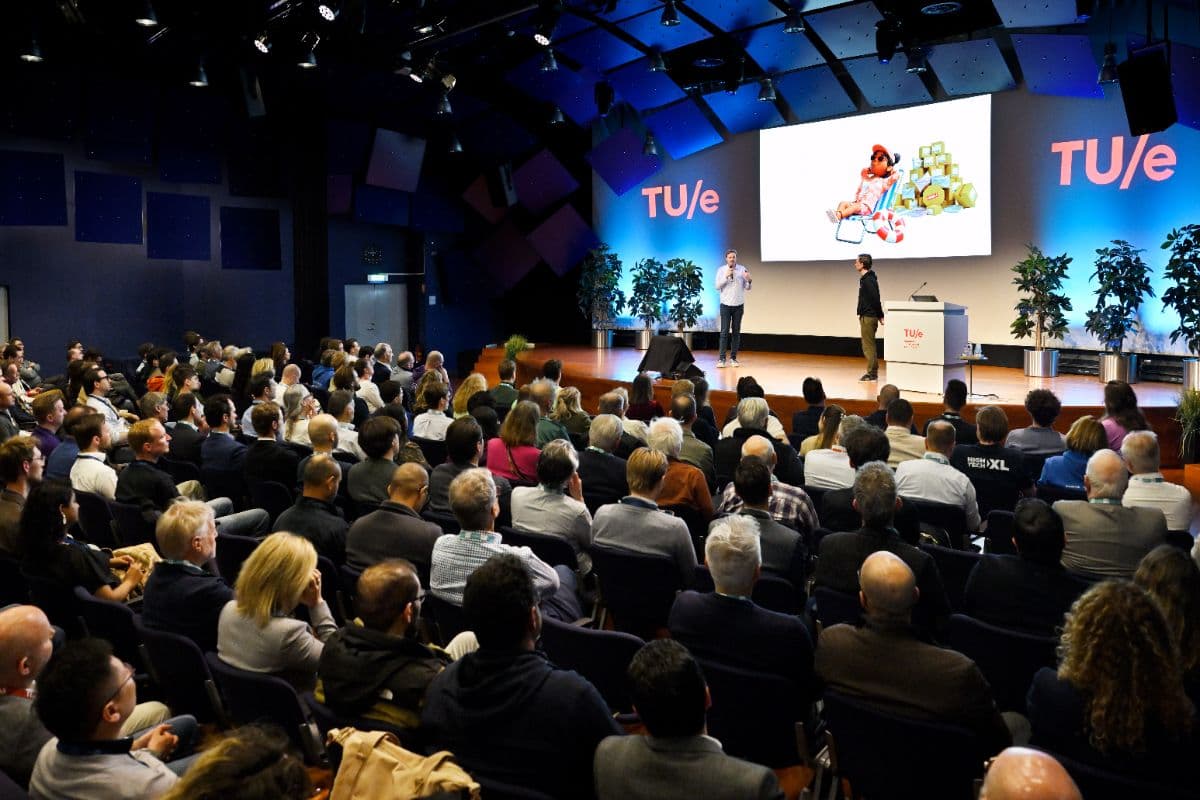
A moment of the evening - © TU/e - Bart van Overbeeke
Universities as the starting point
What role can universities play? According to TU/e rector magnificus Silvia Lenaerts, an essential one. The evening hosts, Linn Smetsers and Pablo Vega, challenged her and TU’s vice-rector Antoinette de Bont with a few statements.
Questioned about the impact of universities and startups, Lenaerts underscored how universities meaningfully contribute through education, research centers, and the knowledge they create for society.
De Bont was sharper on the second statement, that universities add noise to an already crowded startup support ecosystem. "It's a challenge," she said. "We often make things too complex. Why can't students just use our infrastructure?" She committed to doing more and to making the path simpler.
Both rectors agreed with the third statement — that you cannot learn innovative thinking in a lecture hall, only in a startup — and the agreement felt genuine rather than performative. De Bont reflected that finishing a degree creates an illusion of competence: you start a company and immediately discover everything you don't know. "You really need to talk to people. Who is going to pay for this? What is the knowledge I'm missing?"
Lenaerts echoed her: "You don't learn truly innovative thinking in lecture halls. You learn by doing — and by being allowed to fail and stand back up."
Before the evening gave way to drinks, eleven more founders took the stage for sixty seconds each. Either pitching their idea or seeking help, they certainly sparked the audience's curiosity and possibly led to more impactful, driven ventures.