

Team IO+ selects and features the most important news stories on innovation and technology, carefully curated by our editors.
Solar Team Eindhoven, a student team from Eindhoven University of Technology, has completed the first field tests of its solar-powered ambulance, Stella Juva, in Kenya. According to the students, the ambulance generated more solar energy during medical operations than it consumed. “This shows that Stella Juva can operate entirely independently, without relying on an electricity grid or fuel.” To test whether healthcare could be provided entirely using solar power, the team travelled to several remote field locations in Kenya.
Stella Juva was developed by 23 students to make medical care accessible to people in remote areas where reliable infrastructure, electricity, and fuel are unavailable. In this way, Solar Team Eindhoven aims to accelerate the transition towards a more sustainable future while also making a social impact. The team collaborated with the international health organisation Amref Health Africa to develop the vehicle.
Unlike a traditional ambulance, Stella Juva brings healthcare directly to people. The solar-powered ambulance generates energy through solar panels on its roof and extendable panels on the sides of the vehicle, which can be deployed on location. This energy is sufficient both to power the vehicle and to operate medical equipment.
Challenging terrain
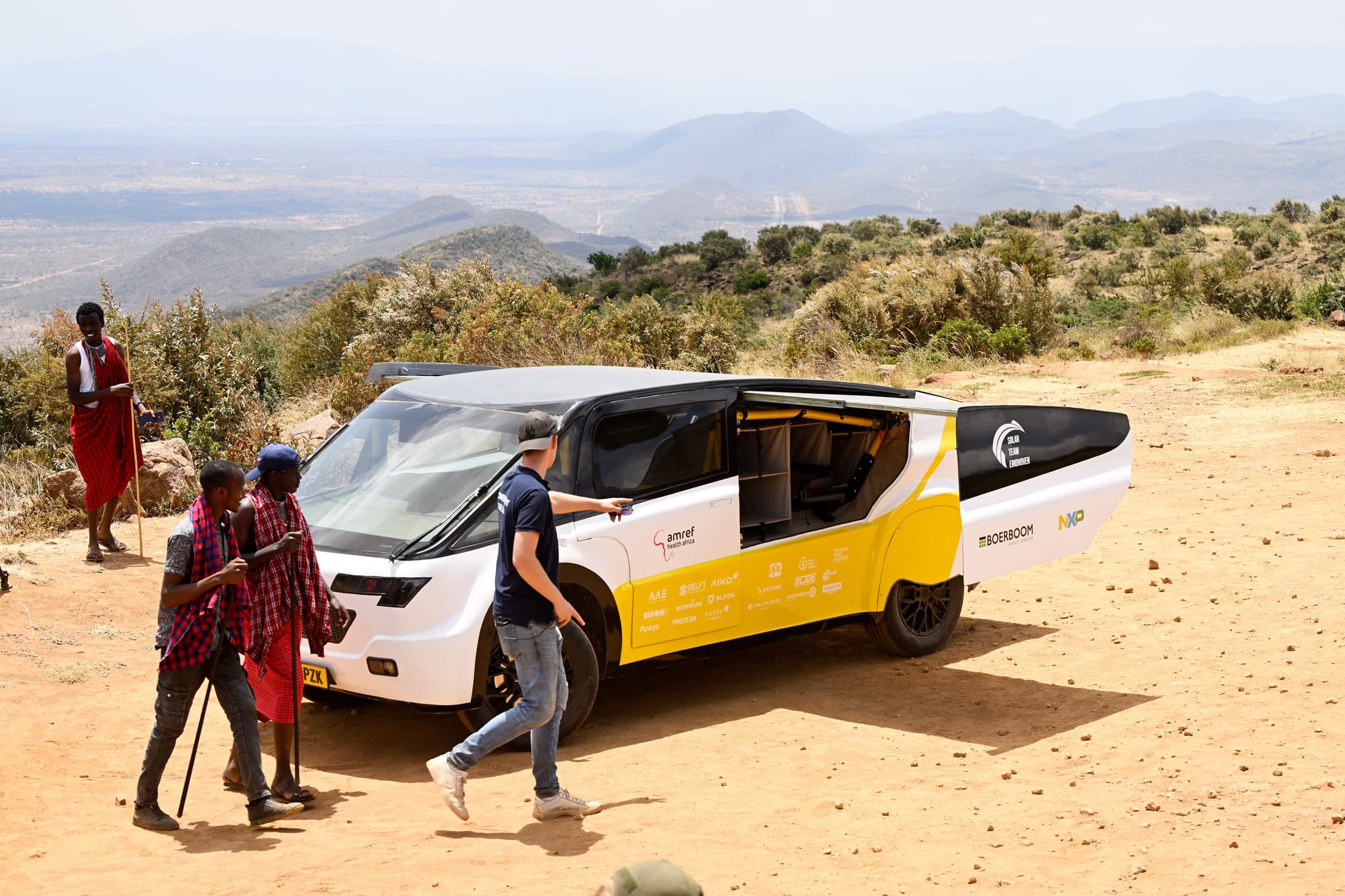
The team tested Stella Juva at several field locations around Narok in Kenya. The solar-powered ambulance has been approved for use on public roads, allowing it to travel on both paved and unpaved roads under conditions similar to those in which the vehicle will ultimately be used. On one occasion, the team spent six hours travelling along challenging roads to reach a remote field location in Mosiro.
The team covered more than 800 kilometres in total. Stella Juva successfully completed the demanding test drives. Apart from a broken track rod, which was replaced within half an hour, the vehicle encountered hardly any problems on the rough terrain.
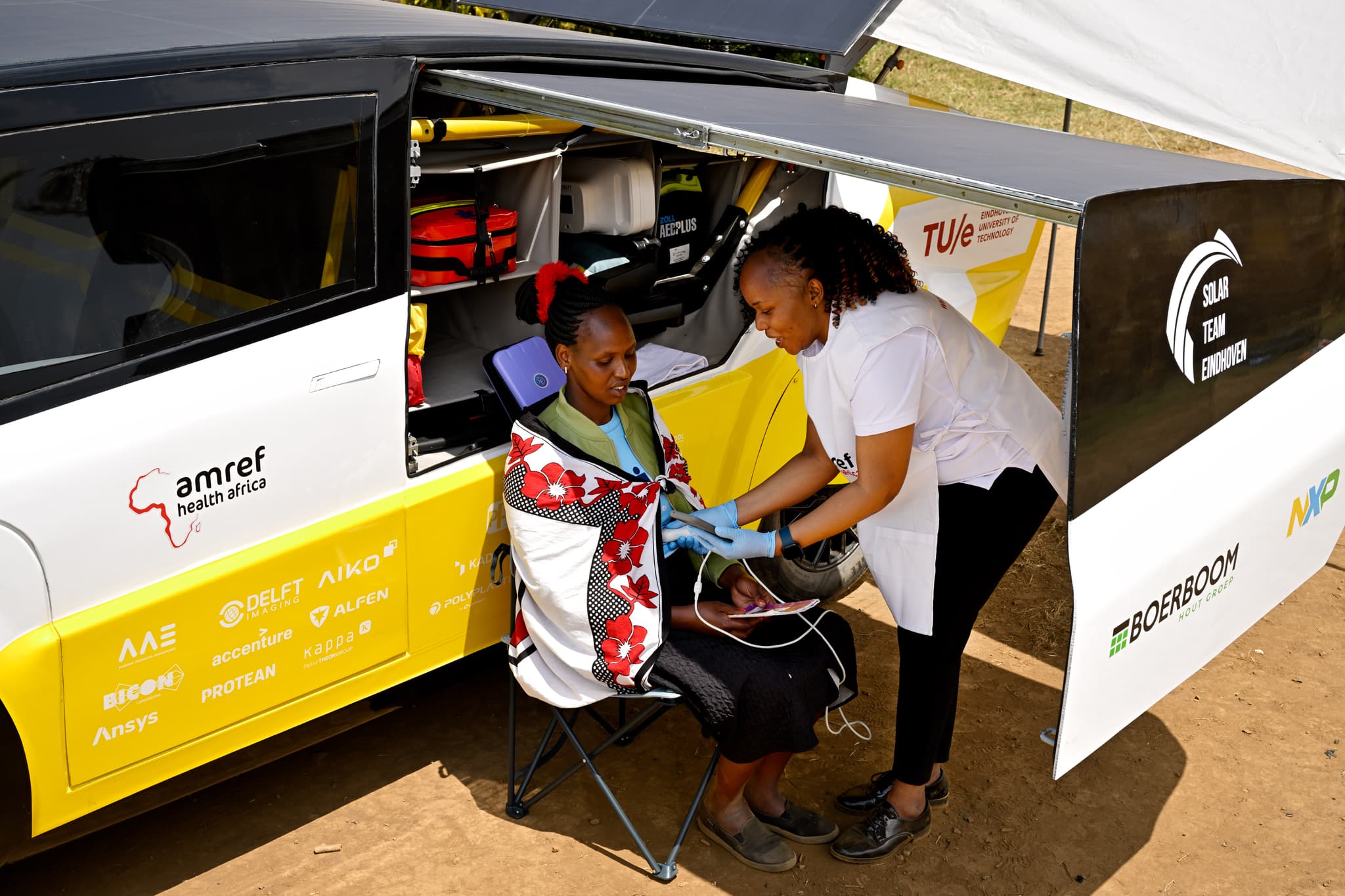
Stella Juva in Kenya © Bart van Overbeeke
Solar-powered capacity for medical care
Stella Juva is equipped with medical equipment that health organisations urgently need in remote locations. The solar-powered ambulance carries an X-ray machine, an ultrasound scanner, an automated external defibrillator (AED) and refrigeration equipment for vaccines, among other devices. During a two-day test conducted with Amref Health Africa, the solar-powered ambulance proved capable of providing medical care to approximately 200 people. While stationary, Stella Juva generated more solar energy than the medical equipment consumed. This allows the ambulance to operate independently of external energy sources, ensuring that healthcare professionals can continue using its medical equipment at all times.
“It is incredibly exciting for the team to see Stella Juva’s potential in practice,” says team manager Mathijs van Gerven. “Not only for driving sustainably, but also for providing assistance entirely independently. This could make a real difference, particularly in remote areas where energy is often scarce.”
During the field test, healthcare professionals from health centres that collaborate with Amref Health Africa tested the medical equipment inside Stella Juva. “Now that we have seen what Stella Juva can do in practice, we see enormous potential for remote communities. This could truly be a game changer,” says Geoffrey Sadera, maternal and child health project manager at Amref Health Africa.