
Students pitch big ideas at the Erasmus University Challenge
Big ideas met real-world impact at the Erasmus University Challenge Grand Finale.
Published on January 23, 2026
© Erasmus University Challenge

Mauro swapped Sardinia for Eindhoven and has been an IO+ editor for 3 years. As a GREEN+ expert, he covers the energy transition with data-driven stories.
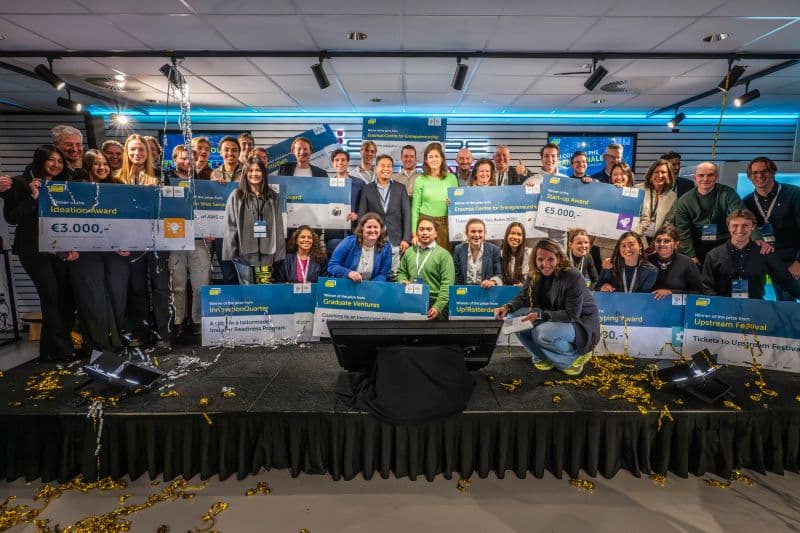
From biodegradable glitter to nitrate-cleaning technology, students at Erasmus University Rotterdam proved that bold ideas can spark real change at this year’s Erasmus University Challenge, which awarded its winners yesterday.
The Erasmus University Challenge is a contest in which students from Erasmus University Rotterdam pitch their innovative ideas. After weeks of workshops and coaching, during which students refine their ideas, structure a business model, and learn how to pitch, selected finalist teams took part in the Grand Finale, held at Rotterdam Excelsior Stadium’s lounge.
The contest is organized by the Erasmus University of Rotterdam and Erasmus Enterprise, the academic institution’s entrepreneurial community. Students at all levels are encouraged to participate and present their solutions to real-world problems, turning them into actual products.
How does the Erasmus University Challenge work?
Students can apply to compete in three different tracks:
- Ideation. This category is for concepts at the very early stage. A concept for a mobile app, or an early sketch of a circular product, is an example. The focus is on sharpening an idea to solve a real-world problem and validating whether it actually addresses a need.
- Prototyping. Contestants of this category need to have already developed a minimum viable product (MVP). This track caters to students who have already moved past the concept phase and need to test, refine, and validate their prototypes.
- Startup. Participants in this category are teams ready to launch their products to market. Contestants have already established a company around their idea and now need to seek investors and partners to kickstart their journey.
The winners
11 out of the 120 teams that applied to be part of the competition made it to the Grand Finale. Uosis won the ideation category prize, worth €3,000. The students aim to disrupt the skincare industry with products made from freeze-dried fruits, vegetables, and herbs.
SeaSpark triumphed in the prototyping category, receiving a €4,000 prize. The team developed fully biodegradable, seaweed-based glitter. Current glitters, used in toys, clothing, and makeup, release microplastics into the environment, polluting water bodies and other ecosystems.
The €5,000 startup award went to SolPhyX. They developed a solution to tackle nitrate pollution in soil and water. Their innovative powder can naturally remove this pollution, closing the nutrient loop.
The audience also had a say and could vote for their favorite. Startup FlexWheels clinched the €1,000 audience award. The company pitched an innovative city bike rental system for students.
Awards are not over. All runners-up also received prizes, including invitations to exclusive CEO dinners, mentorship hours, and consultancy sessions. No one went home empty-handed.
More than a student challenge
Over the course of these four editions, a community has grown around the contest. The university, partner companies, and government organizations now form a tight-knit network that fosters connections, enables continuous idea exchange, and stimulates new forms of collaboration.
“Partners see a great value in being part of our ecosystem. Not only can they tap into the creativity of students, but they can also connect, leading to new collaborative projects,” highlights Ernst Hoestra, CEO of Erasmus Enterprise.
The manager notes how the quality of pitches has improved through the years, with students focusing on tangible societal problems. At the same time, he praises the high level of coaching.
“It is rewarding to see students taking the tips from senior entrepreneurs at heart. It is not a coincidence that the level of mentorship we provided to OASYS NOW—a personalized health startup that won the contest in 2022, ed.—then led them to triumph at Slush’s startup competition.”
Learning new skills is what matters the most
In addition to the pitching sessions and the award show—interspersed with a Q&A session, during which judges could pose questions to the finalists—there were other inspiring moments for budding entrepreneurs.
Annelien Bredenoord, president of the Erasmus University executive board, also gave a welcoming address. The president caught the spirit of the sportive venue, bringing to the students’ attention a lesson about failure—an essential part of learning, especially in entrepreneurship.
“As one of the most successful tennis players ever, Roger Federer played over 1500 games, winning around 80% of them. Yet, he only won 54% of the points he played in all these games. Failure is inevitable, yet one can still excel and reach grand goals. Don’t be afraid of it,” she stated.
Fenna Zandvliet, a former Erasmus student and now a serial entrepreneur, also brought her experience to the stage and shared a meaningful message with students. “Don’t take ‘no’ as an answer. In your entrepreneurial path, you’ll receive more ‘no’s than yeses’. Be sure to keep trying and persevere,” she suggested.
Organizers are already gearing up for next year’s edition. Giving students a place to challenge themselves and learn is the primary aim. “I’m still happy, even though they will never become entrepreneurs,” said Hoestra. “The challenge is first and foremost a learning experience that aims to equip students for their careers better.”