
Stroke simulation platform inSteps secures €450K funding
A Dutch medtech startup just landed €450K to replace animal testing with AI-powered virtual patients for stroke devices.
Published on July 23, 2026
© inSteps

Team IO+ selects and features the most important news stories on innovation and technology, carefully curated by our editors.
inSteps, a spin-out of Amsterdam University Medical Center, has secured a €450,000 convertible loan to further develop its AI-driven computer simulation platform for developing thrombectomy devices — used to remove blood clots from the brain. The loan came from regional innovation fund Innovatiefonds Noord-Holland.
The funding addresses a pressing medical need. Stroke is the second most common cause of death in the European Union, affecting 1.1 million people annually and causing hundreds of thousands of deaths. In the most severe cases, clinicians use thrombectomy devices to remove blood clots from the brain. Developing these devices, however, is expensive, slow, and heavily reliant on animal models that poorly predict how a device will actually perform in the human body.
Developing thrombectomy devices faster
inSteps aims to close that gap with a platform that combines finite element modeling with generative AI. The system simulates how thrombectomy devices interact with realistic vessel anatomy and blood clots across thousands of synthetic patients, generated from one of the largest stroke databases in the world. This allows manufacturers to virtually test their designs in clinically realistic scenarios, quickly identify the most promising design directions, and iterate faster — without the cost and long timelines of physical experiments. An AI emulation layer cuts simulation times from days to minutes.
"Our mission is to get better thrombectomy devices to patients faster," said Thomas Kerbusch, CEO and co-founder of inSteps. "With this funding, we can further develop our technology into a platform that helps manufacturers worldwide speed up their development process and increase their chances of success in clinical trials."
According to the company's website, the platform integrates four core modules: AI-generated synthetic vessel and thrombus anatomy, a finite element model of the thrombectomy procedure itself, an AI emulation layer that accelerates those simulations, and a module for predicting clinical trial outcomes, including cerebral perfusion restoration and clinical outcome scores. The underlying research has been supported by the European Union's Horizon 2020 program and the INSIST consortium.
Scaling the platform
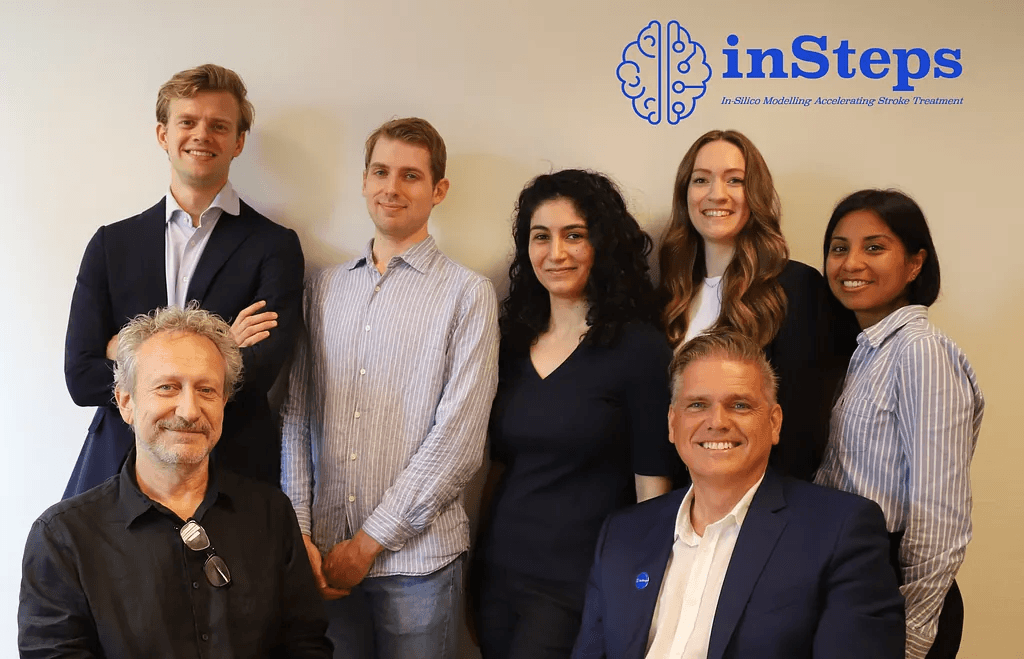
Founded in 2023 by Dr. Thomas Kerbusch, Prof. Dr. Henk Marquering, Dr. Praneeta Konduri and Dr. Nerea Arrarte, inSteps grew out of more than a decade of academic research conducted across several research consortia.
With the new financing, inSteps will take the next step toward commercializing the platform, focusing on advanced modules for synthetic thrombus heterogeneity and AI emulation of the thrombectomy procedure — scaling the technology from an academic proof-of-concept into an industrial-ready product.
Ludolf Stavenga, fund manager at Innovatiefonds Noord-Holland, called in-silico platforms an important part of the future of medical research, noting that the technology could significantly accelerate R&D processes and, eventually, support more personalized care in hospitals.
Innovatiefonds Noord-Holland is an initiative of the Province of Noord-Holland together with the University of Amsterdam, Vrije Universiteit, Hogeschool van Amsterdam, Amsterdam UMC and Sanquin. It supports entrepreneurs in the province by financing proof-of-concept-stage innovation through convertible loans.