
Stellar Space Industries takes aim at Very Low Earth Orbit
The Noordwijk-based SME reveals its bold plan for air-breathing electric propulsion - enabling satellites to fly lower and more sustainably.
Published on December 12, 2025
Jerre Sweers, CEO of Stellar Space Industries © Nadia ten Wolde

Bart, co-founder of Media52 and Professor of Journalism oversees IO+, events, and Laio. A journalist at heart, he keeps writing as many stories as possible.
At the Blue Magic Netherlands event in Eindhoven, the room expected a familiar defense-tech narrative: sensors, drones, data fusion, the usual constellation of innovation buzzwords. What they got instead was something far more orbital.
“At Stellar Space Industries, we are developing a satellite technology that enables station keeping in Very Low Earth Orbit. This gives satellites the ability to operate at altitudes where you could, quite literally, detect faces on the ground from space,” said Jerre Sweers, CEO of Stellar Space Industries, as he introduced his company’s mission.
Very Low Earth Orbit © Stellar Space Industries
Based on the NL Space Campus in Noordwijk, the Netherlands, right next door to ESA-ESTEC - “a good neighbour to have if you’re a smaller company,” Sweers joked - Stellar is developing one of Europe’s most ambitious new space technologies: Atmosphere-Breathing Electric Propulsion (ABEP).
When scaled into production, this propulsion system will allow satellites to operate for years in Very Low Earth Orbit (VLEO) - altitudes between 160 and 450 kilometres - a region traditionally off-limits due to extreme drag. The reward? Ultra-sharp imaging, low-latency communications, and more responsive constellations for Dual-Use applications.
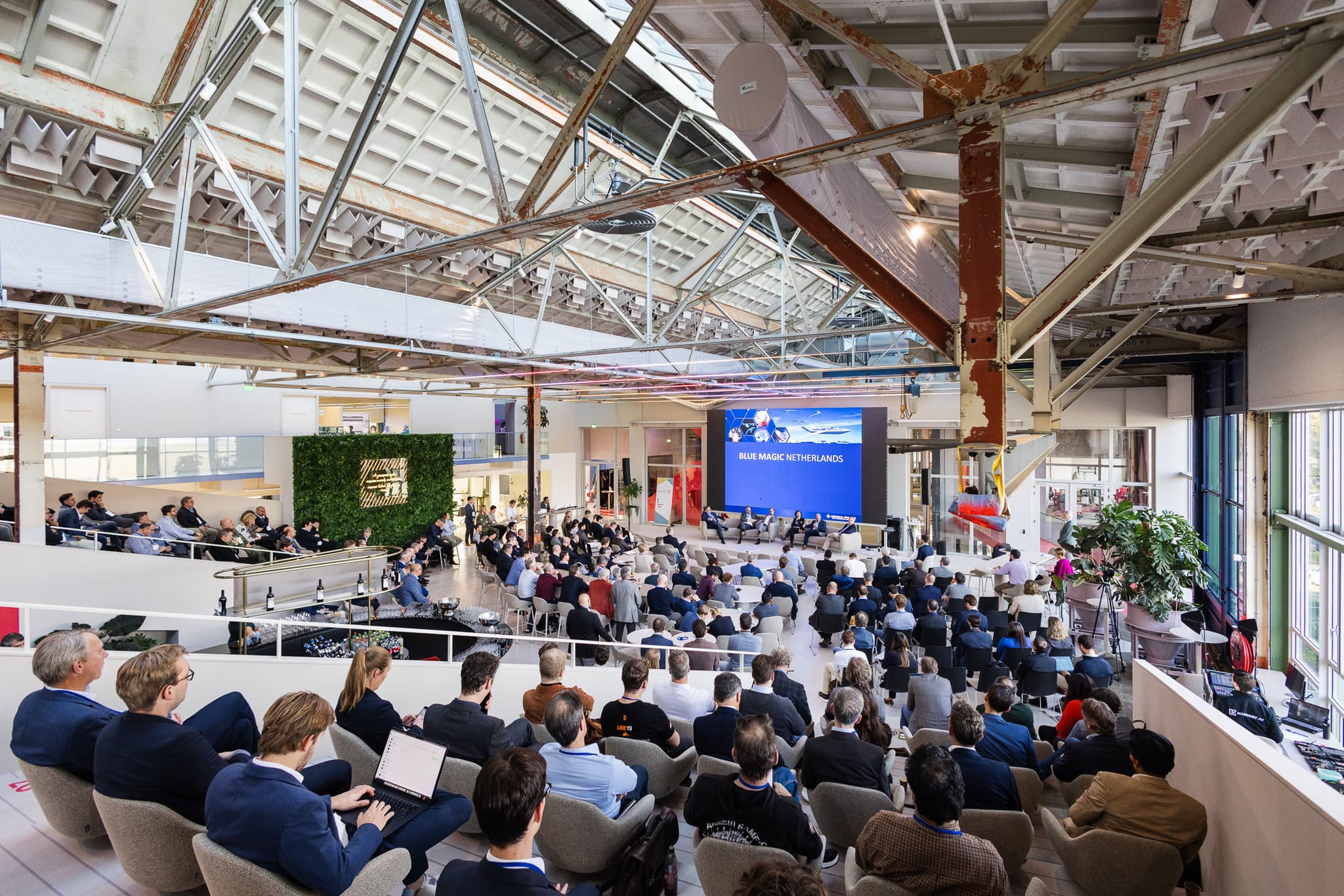
Blue Magic Netherlands
Read our stories about this event, focused on innovation in the defense industry.
Why VLEO Matters Right Now
VLEO has long been considered an orbital no-go zone. Fly too low, and the atmosphere drags you down in weeks. Fly higher, and you lose the exquisite resolution and rapid connectivity advantages that modern missions increasingly demand.
“We see a huge potential to use payloads to their full capability when flying this low,” Sweers explained. “At these altitudes, we can achieve sub-meter-resolution imagery and communication links strong enough for ordinary smartphones to connect directly to a satellite, without relying on ground antennas, because the power and link budgets become ideal.”
The dual-use value is impossible to overlook. High-grade Earth-observation for defense or disaster response, fast and secure satcom, and more sustainable operations, because VLEO satellites naturally deorbit within weeks or months, reducing long-term debris risks. Stellar has other ideas about these differentiators: ultra-high resolution imaging, lower launch costs, high maneuverability, and “resilient and redundant defense constellations” that can dynamically redistribute coverage.
Jerre Sweers, CEO of Stellar Space Industries © Nadia ten Wolde
Turning the atmosphere into fuel
To make VLEO viable, Stellar is betting on a breakthrough in propulsion. Traditional satellites must carry large onboard propellant tanks to counter drag. But in VLEO, the atmosphere itself contains enough residual particles to serve as fuel, if you can collect and ionize them efficiently.
Stellar’s ABEP system does precisely that: Collect incoming molecules through an engine-less air intake, compress and hold them in small integrated tanks, ionize the rarefied gas using a proprietary electrolysis-based electric thruster, and accelerate the ions to generate continuous thrust that offsets drag.
“Erosion is not an issue for our Electric Propulsion system because the gases never physically touch internal components,” Sweers said. “That lets us use rarefied atmospheric gases as propellant and preserve the lifetime of the system and the satellite.”
A diagram on Blue Magic’s big screen shows the full flow - intake, compressor, storage, flow control, and electric propulsion - effectively transforming the atmosphere from a threat into a resource.
Current thrust ranges between 5 and 10 milliNewtons, with a target of 20 mN and higher as electronics efficiency improves. It’s modest by terrestrial standards, but in continuous operation, it’s enough to keep a +100-kg-class satellite aloft indefinitely.
Why Stellar isn’t interested in CubeSats
Unlike many emerging propulsion startups, Stellar is not chasing the CubeSat market.
After extensive mission analysis, Sweers concluded that “the space is simply too small” to integrate the entire ABEP system while still hosting meaningful payloads. Instead, Stellar focuses on satellites weighing 150 kilograms or more, a class they believe offers “more value and better output in the end”.
To support full-scale testing, the company is building a new 2-meter-diameter, 3.5-meter-long vacuum tank for satellite-level simulations, part of a significant internal investment reinforced by the Netherlands Space Office, Dutch government, and ESA technical support.
For Stellar, ESA’s involvement is more than funding. “Each stage validated by ESA is a stamp of approval for us and for the space industry,” Sweers said.
A roadmap to orbit and a call for partners
Stellar has already reached TRL 4–5 and plans to advance to TRL 5-6 within the next 6-12 months. Stellar has mapped a path toward commercial readiness by 2030. From here, the company is actively looking for strategic partners: satellite builders, payload providers, and Strategic investors who want to take part in the first in-orbit demonstration.
“For now, we’re humble. We focus on the technology first. But later, with partners, we might have the ambition to become a full Satellite manufacturer for the VLEO market.”
Stellar owns the full IP for both propulsion and intake systems, positioning itself as a future supplier of high-value components or, eventually, full satellite platforms.
If ABEP matures as planned, VLEO could become a new operational layer of space, a zone where satellites can fly lower, collect richer data, operate more sustainably, update more frequently, and at lower launch costs.
“We’re pushing the technology forward as fast as possible,” Sweers concluded. “We’re looking for partners, clients, and strategic investors to accelerate this technology.”