
Speed of adoption is the new military advantage
The battlefield doesn't wait for procurement cycles. NATO's best defense startups pitched to close that gap.
Published on May 22, 2026
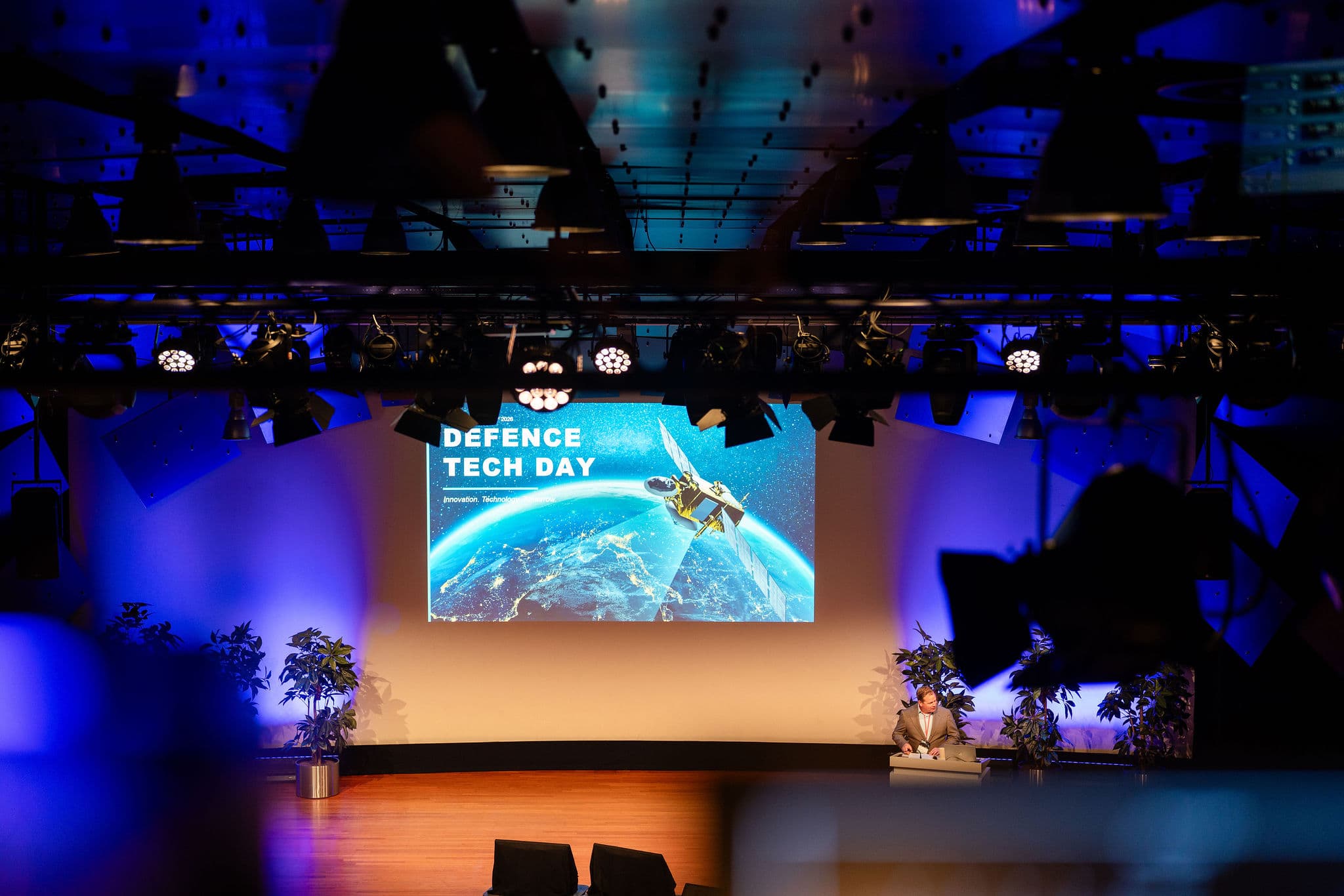
© Nick Bookelaar

Mauro swapped Sardinia for Eindhoven and has been an IO+ editor for 3 years. As a GREEN+ expert, he covers the energy transition with data-driven stories.
Three minutes and ten seconds. That was exactly how long each startup had to make their case on stage at Defense Tech Day 2026 in Eindhoven. When the clock ran out, the microphone cut off, and the next founder stepped up. A deliberate choice by the organizers — and a fitting metaphor for the day's central argument: in defense technology, if you're not fast enough, you're irrelevant.
The event, jointly organized by NATO DIANA (Defense Innovation Accelerator for the North Atlantic) accelerators The Gate Brainport and Belgium's Ignity, brought together startups from both countries' 2026 DIANA cohorts to pitch to military officials, defense industry players, and investors. One message ran through the keynotes, pitches, and conversations: innovation only matters when it arrives in time.
The fastest to adopt are the winners
Lieutenant General Ludy Schmidt, Vice Chief of Defense of the Netherlands, opened with a sobering assessment of the threat environment. Drawing on Dutch intelligence reporting, he told the audience that in 80 years there has never been such sustained pressure on national security from so many directions simultaneously — Russia's war in Ukraine, destabilization campaigns inside EU and NATO borders, China's more assertive posture, instability from the Middle East to Africa.
But pace came up again in his speech. He invoked the OODA loop — the observe-orient-decide-act cycle developed by strategist John Boyd — and pointed out that modern warfare is increasingly a competition over who can complete that cycle faster. "Those forces that adapt fastest gain the advantage." And then came the challenge: "The real question is whether we can adapt fast enough to this new reality. Security will not always depend on military strength alone — but on our ability to innovate faster than our adversaries."
Buying more of the same, faster, does not solve the problem. What is needed is speed across the entire innovation chain — from idea to prototype to operational deployment.
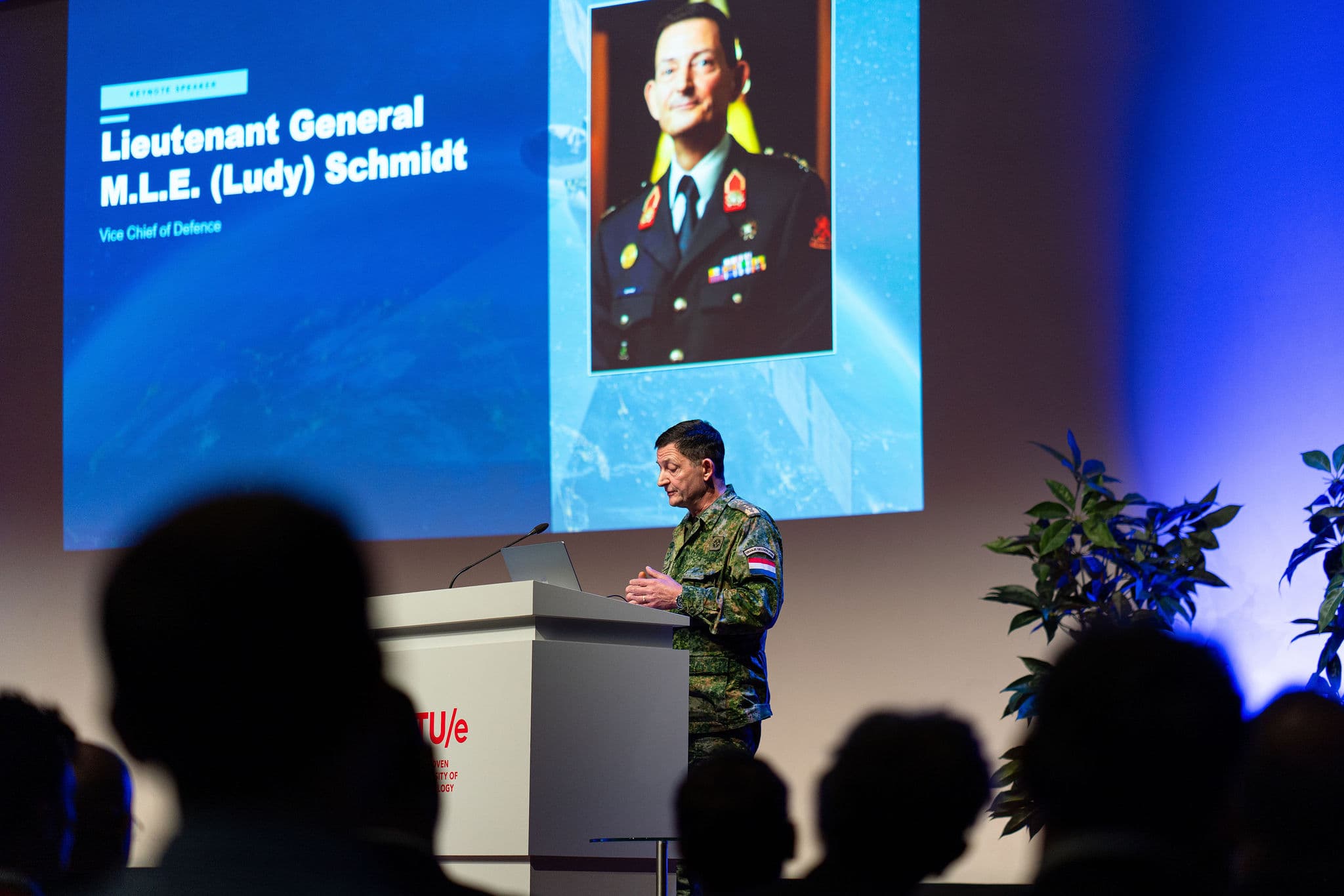
Lieutenant General Schmidt - © Nick Bookelaar
Speed that reaches the front line
Brigadier General Steven Lauwereys, Chief of Belgium's Organization for Defense Innovation and Defense Industry, also stepped on the stage and pushed the argument further. He pointed to the evidence already visible in Ukraine: small drones upgraded every week with direct battlefield feedback, autonomous systems reshaping how units organize themselves in real time. "On today's battlefield, the teams that test, learn and iterate fastest tend to win."
But he offered a sharp qualifier. Speed in the lab does not count. "Innovation only matters when it reaches the operational environment. If it's not at the front line on time, it's not useful."
This is where many defense tech startups run into the wall. Military procurement cycles are long while technology evolves in weeks. Lauwereys was candid: the defense establishment has to change. Governments and armed forces need to take risks and stop waiting for requirements to be perfectly defined before engaging with new technology. "Our operational requirements may not always be fully defined. Your technologies may not yet be fully mature. But if your solutions can create operational advantage, we need to explore them."
Startups racing the clock
DIANA is an initiative by NATO to help defense tech startups across the alliance develop dual-use technologies. The program runs across 16 alliance countries, offering startups a six-month program to grow their companies. Among the 22 startups that pitched during Defense Tech Day are C2GRID and Vidoc.
C2Grid is building an AI-powered common operational picture — turning the flood of battlefield data into actionable intelligence fast enough to matter. "In Ukraine, a target that would have taken months to develop a few years ago is now developed in minutes," explained Heiti Kruusmaa, co-founder of the Estonian company. "Western militaries are still operating in hours, sometimes days. We're trying to close that gap."
Their system ingests visual and thermal drone footage, compresses it into 3D battlefield models, and runs machine-assisted analysis using a single GPU — lightweight enough to deploy in the field. Their advice to fellow founders was rooted in that same urgency: "The military is not looking for novelty. They need something reliable, fast, and easy enough for any soldier to use under stress," he added.
Vidoc sees the speed problem from a different angle. With AI models now capable of autonomously exploiting software vulnerabilities — not just finding them — the window between a flaw existing and being attacked has collapsed. "The economics of hacking are getting much better," said founding engineer Jakub Sienkiewicz. "It's becoming accessible to anyone."
Their tool continuously scans source code, finding weaknesses before adversaries do. In defense, where software underpins everything from communications to weapons systems, the argument is simple: the defender has to be faster than the attacker.

C2GRID's Daniil Rõbnikov pitching on stage - © Nick Bookelaar
Innovation to keep our society safe
Both companies credited the DIANA program with compressing years of navigating an opaque ecosystem. "Procurement takes time," said Sienkiewicz. "But we are much closer to understanding it now."
General Schmidt had put it plainly: "Technology still depends on human ingenuity. I am asking for your ingenuity to challenge us, to help us innovate faster, to help us build the technological edge that will protect our societies."