
Solarduck aims at stubborn problem: reliable power far from shore
SolarDuck and MARIN receive €3.2 million in RVO funding to develop a floating power hub for subsea and remote offshore infrastructure.
Published on June 26, 2026
© SolarDuck

Team IO+ selects and features the most important news stories on innovation and technology, carefully curated by our editors.
Far offshore, electricity is rarely simple.
Subsea installations, monitoring systems, carbon capture projects and oil and gas infrastructure all need power, communications and control. Yet the further those assets lie from shore, the more complicated and expensive that becomes. Long subsea cables and umbilicals are costly to install and vulnerable to damage. Local diesel generation remains common but entails emissions, fuel logistics, and maintenance requirements.
SolarDuck wants to place the power source closer to the problem.
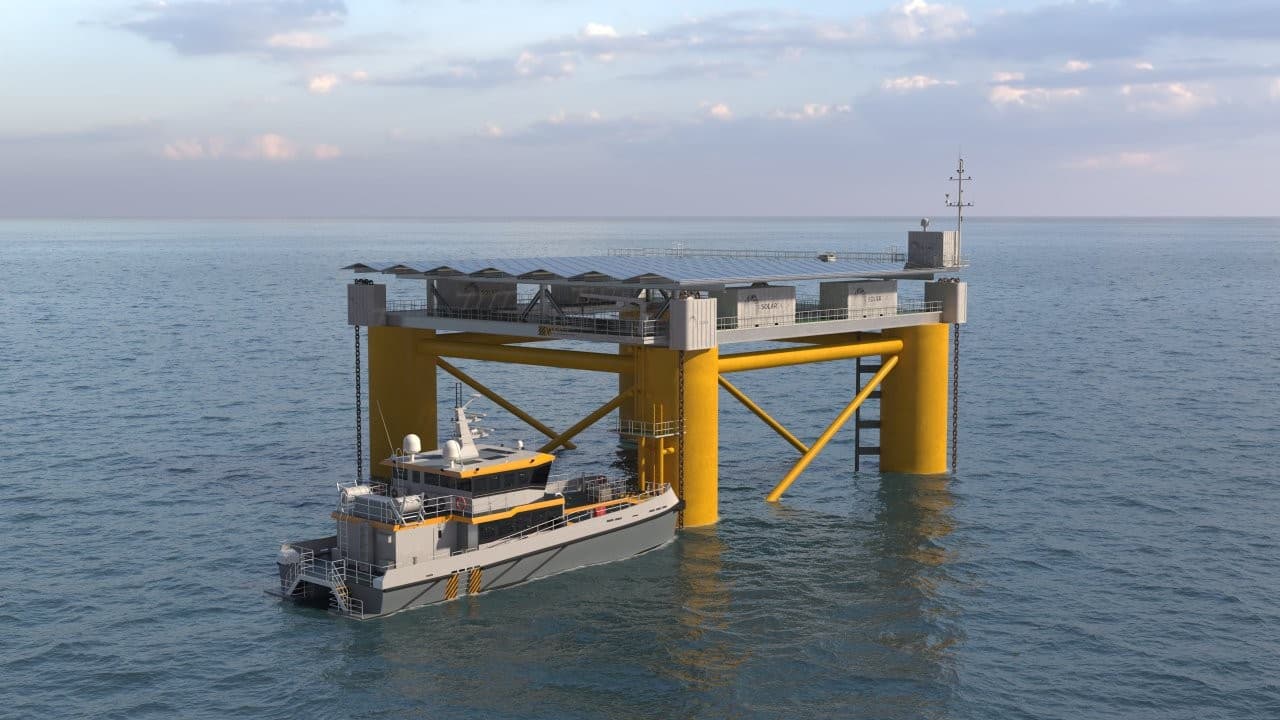
The Dutch-Norwegian offshore solar company and maritime research institute MARIN have received a €3.2 million subsidy from the Netherlands Enterprise Agency, RVO, for the Steady Seas research programme. Together, they will develop the basic design of SolarDuck’s Offshore Floating Power & Utility Hub: a floating platform that combines solar generation, energy storage, communications, and other utilities for remote offshore assets.
A platform instead of a cable
The proposed hub is intended as a redeployable offshore power station. Rather than relying on shore-based electricity, it would generate renewable power directly near subsea systems or remote installations.
That could be particularly relevant for carbon capture and storage, offshore monitoring and subsea tie-back projects. In these cases, the infrastructure required to deliver power can become a significant contributor to the project's overall cost and complexity.
SolarDuck believes its platform could reduce the need for long cable connections, vessel movements and diesel-powered generation. That would not only cut emissions but could also improve the business case for offshore projects that are currently difficult or expensive to develop.
“As offshore energy activity moves further from shore, the need for reliable in-field power is becoming increasingly important,” SolarDuck says. “The Offshore Floating Power & Utility Hub is designed to offer an alternative: a redeployable offshore platform that generates renewable power where it is needed.”
Built on North Sea experience
Steady Seas builds on SolarDuck’s earlier Merganser project, a floating solar demonstrator in the Dutch North Sea. The new programme will use data and lessons from that project to develop a platform specifically designed for single-platform offshore applications.
SolarDuck leads the system design and integration. MARIN will study the platform’s hydrodynamic behaviour through simulations and basin tests. The research will examine mooring, motion, structural loads, wave response and the interaction between the floating hub and subsea infrastructure.
“Steady Seas allows us to take the lessons learned from building and testing Merganser in the North Sea and apply them to a design tailored for single-platform offshore applications,” says Don Hoogendoorn, CTO of SolarDuck. “The technical challenges of powering assets far offshore are significant, from mooring and motion behaviour to integration with subsea infrastructure. This programme gives us the means to engineer and validate robust answers before the solution is deployed at sea.”
For MARIN, the project underlines that offshore floating solar needs to be treated as a serious maritime system, not simply as solar panels at sea. “Within Steady Seas, MARIN will investigate the impact of the topology on behaviour and hydrodynamic coefficients,” says William Otto of MARIN. “It will also assess the impact of extreme wave conditions on structural loading, including wave build-up beneath the platform.”
Towards real offshore deployment
The subsidy covers the research and validation phase. SolarDuck’s next ambition is to bring the concept into real offshore operations through Joint Industry Projects with industry partners. Those demonstrations will have to prove that the platform can reliably generate power, support communications and help control remote assets in demanding offshore conditions.
That is the larger promise behind Steady Seas. The offshore economy is moving further from land, while its systems are becoming more connected and electricity-dependent. SolarDuck and MARIN are working on the possibility that, instead of extending another cable to shore, some of that infrastructure can be powered from a floating hub above the waves.