
Smarter and smarter? The added value of tech in outdoor sports
Outdoor sports enthusiast Susan van Weperen discovered new technology at ISPO.
Published on November 16, 2026

When I head into the mountains, I prefer to carry as little as possible. Other than good shoes, food, and drinks, I don’t really need anything else. Still, during ISPO—an international trade show for the sports and outdoor industry in Amsterdam—I discovered that some technological innovations can also offer benefits to outdoor enthusiasts.
The outdoor world is becoming increasingly technical. Sports watches track every movement, and clothing manufacturers are developing new ways to regulate body temperature. Not every development appeals to me personally in the same way. I don’t need to constantly know how fast I’m walking or how much force I’m exerting with every step.
Still, there are innovations that do offer practical added value. I discovered this during my visit to ISPO, where I saw how new technologies can help outdoor enthusiasts prepare for unexpected situations and provide a little extra support along the way.
A first aid kit that tells you what to do
Anyone who, like me, enjoys trail running, biking, or hiking in remote areas knows that an accident can happen at any moment. A scrape or a fall can happen in the blink of an eye. But what do you do if someone is seriously injured?
At the SURVIVAL booth, I spoke with Mike Todd. He told me more about the compact first-aid kit and its smart organization with color codes and icons, which helps you find what you need faster. The kit also comes with an app that explains step by step how to respond in various situations. The inspiration for the design came from the developer’s own experience: when his son was injured and bleeding in a minor accident, it proved difficult to quickly find the right supplies.
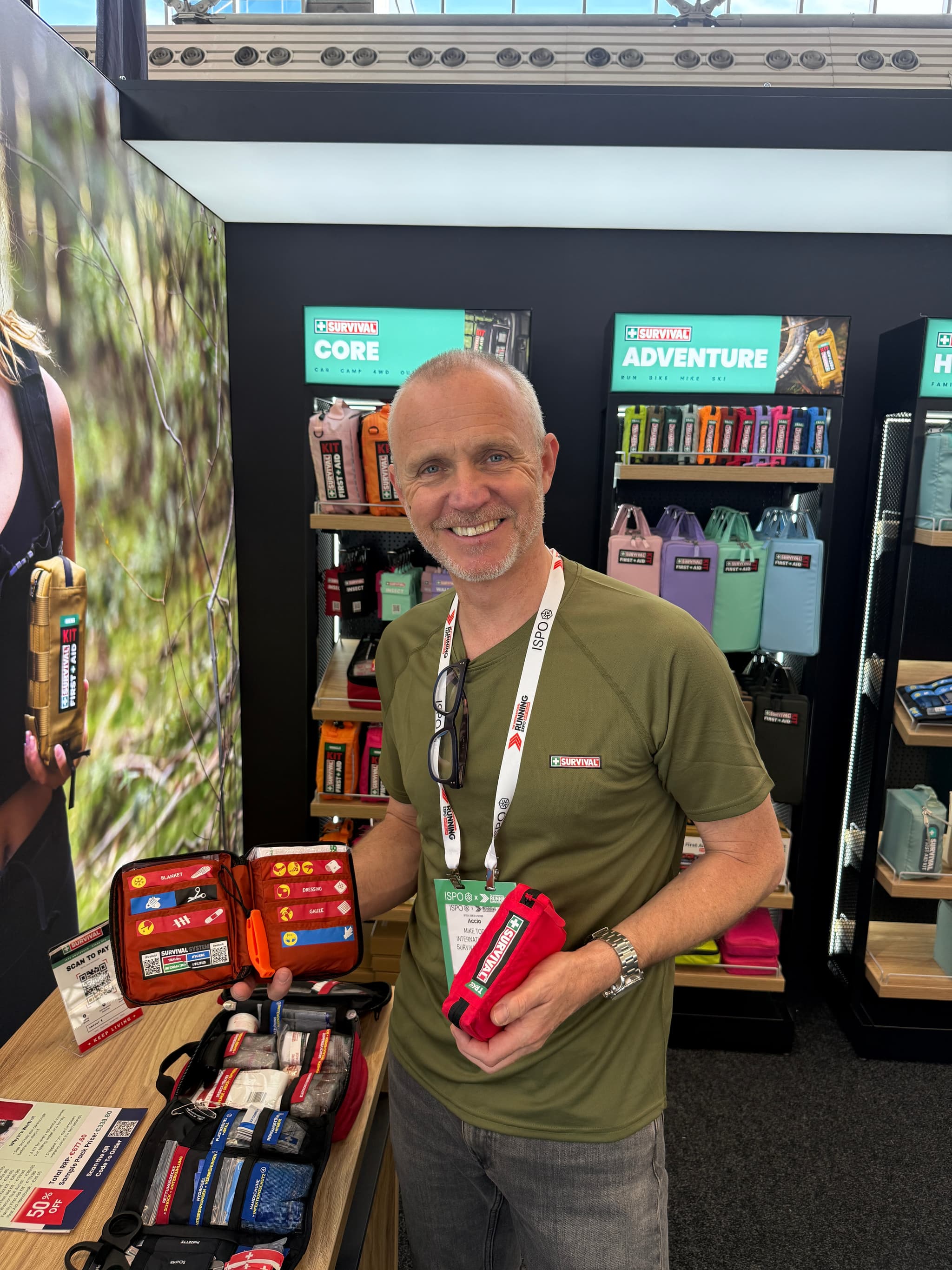
A special first aid kid
When you’re out in the mountains alone or with a small group, it can be reassuring to know that you’re not entirely on your own. Of course, an app is no substitute for first-aid knowledge or professional help, but it can provide guidance when you have to act under stress.
Hitting the road with music
When I go running or biking alone, I sometimes enjoy listening to music or a podcast along the way. At the same time, I want to be able to hear what’s going on around me.
I also stopped by the Shokz booth. There, I learned about their open-ear headphones, which are designed so you can listen to music without completely blocking out your ears. Instead of blocking out ambient sounds, they remain audible. That seems especially nice to me when you’re out on your own.
This seems like a practical advantage, especially during long bike rides or runs. You don’t have to choose between listening to music and staying in touch with your surroundings. It might not be an indispensable part of my gear, but it’s an innovation whose added value I can appreciate.
Cooling is becoming increasingly important
During long trail runs and bike rides, I notice just how decisive temperature can be. Especially when you’re out for hours with little shade, heat can significantly affect how comfortable you are while exercising.
It’s not surprising that the focus on cooling is growing. Due to climate change, heat waves in Europe are becoming more frequent and more intense. As a result, organizers of running and other outdoor sports events must also take hot conditions into account. Especially in competitions where participants are active for hours on end, heat can pose a significant challenge.
At the Ultra Cool Tech booth, the conversation also centered on the growing demand for cooling. During a conversation with founder Chris Blomfield-Brown, I learned more about the development of cooling products for athletes. The demand for better cooling technology came, in part, from the world of cycling. For example, the company received requests to develop new ways to keep cyclists cool during the Tour de France. The product line now includes cooling vests, towels, caps, and headbands. Some products primarily provide a cooling sensation, while others help dissipate heat or offer active cooling.
I find the cooling vests particularly interesting for athletes who are active for long periods of time. During an ultratrail or a long bike ride, such an extra aid can be welcome when temperatures rise significantly. I definitely see added value in this, though it remains important, of course, to adjust your pace and plans in extreme heat. A cooling vest doesn’t, of course, make exercising in extreme heat risk-free.
Does everything have to be smarter?
After my visit to ISPO, I’ve started to view the role of technology in outdoor sports a little differently. I still love the simplicity of being outdoors and don’t feel the need to track every movement or carry a new gadget for every activity. But I also see that technology isn’t just about more possibilities. A first-aid kit that provides reassurance when something goes wrong, headphones that let you hear ambient sounds, or a cooling vest that helps you better tolerate the heat while exercising: perhaps the real progress isn’t in even better athletic performance, but in innovations that make outdoor sports more accessible and safer.
Personally, I prefer to head out with as little gear as possible, but I’m happy to make an exception for innovations that truly add value along the way.