
Smart wound-monitoring patch wins Biomaterials Hackathon 2026
The jury highlighted the project’s strong combination of medical relevance, market potential and technological feasibility.
Published on March 21, 2026

Team IO+ selects and features the most important news stories on innovation and technology, carefully curated by our editors.
A smart biosensor patch that enables doctors to monitor surgical wound healing remotely has won the Biomaterials Hackathon 2026 in Brainport Eindhoven. The concept, called WoundReCoverE, was selected as the winning idea by the jury after three days of intense collaboration between young innovators from across Europe and beyond.
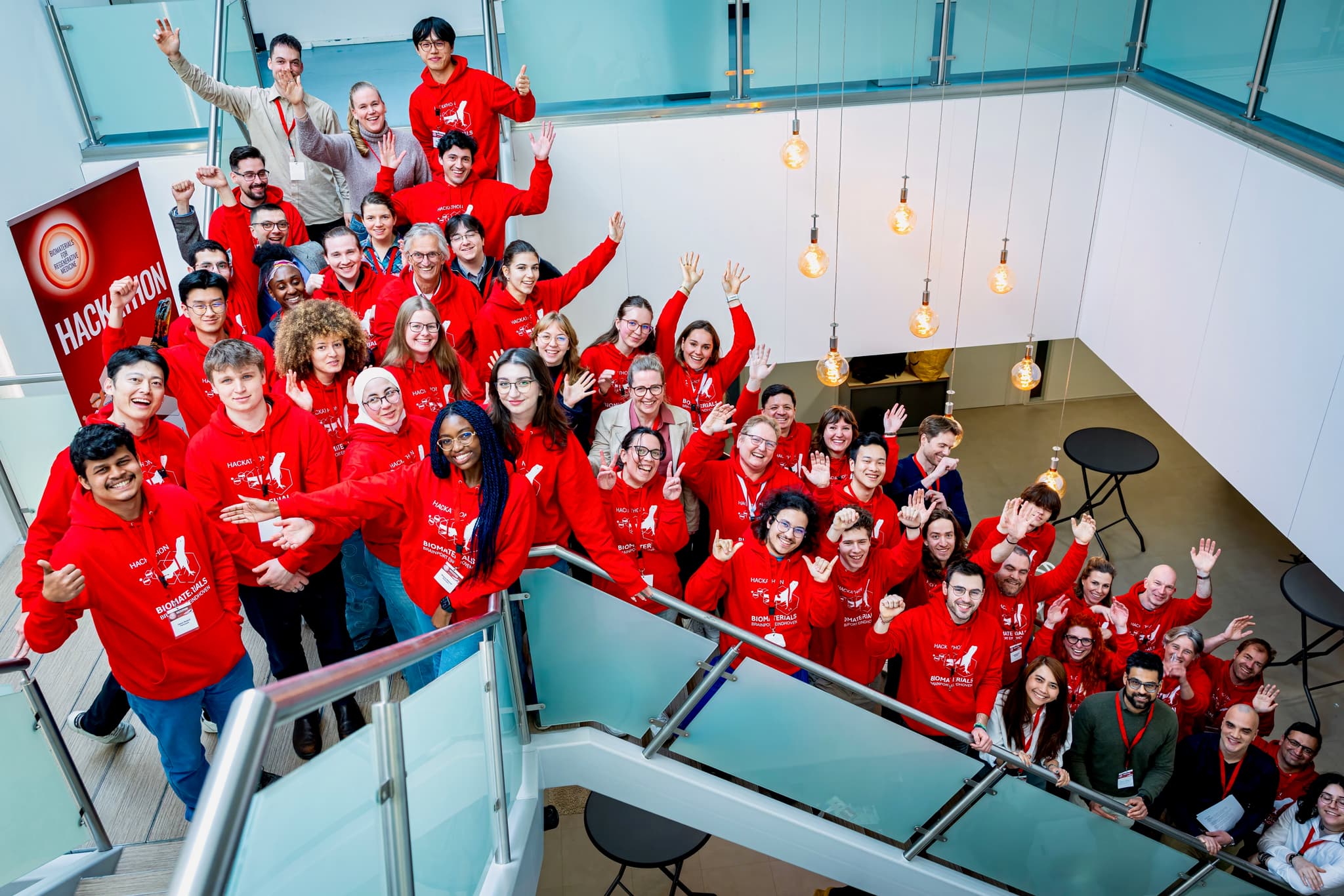
During the hackathon, 41 participants from nine countries worked in interdisciplinary teams to design new healthcare solutions based on advanced biomaterials.
The winning team developed a smart biosensor patch that continuously monitors wound recovery, enabling doctors to detect complications earlier and allowing patients to recover safely at home. The system combines existing sensors with reusable electronics and a mobile application, creating a scalable solution for postoperative monitoring.
Feasibility
Post-surgical wound care remains a major challenge for healthcare systems. Many follow-up visits prove unnecessary, while complications such as infections are often detected too late. By shifting monitoring from the hospital to the patient’s home, the solution aims to improve outcomes while reducing pressure on healthcare staff.
The jury highlighted the project’s strong combination of medical relevance, market potential and technological feasibility.
“We felt this concept targets an important market with clear added value,” the jury said. “The technology appears simple at first, but as you develop it you realise it will become much more challenging. That is exactly what makes it an exciting innovation.”
Entrepreneurship as a driving force
The hackathon was designed not only as a scientific challenge but also as an exercise in entrepreneurial thinking. Participants were encouraged to translate biomaterials research into solutions that could realistically reach patients and healthcare systems. According to the jury, this entrepreneurial mindset is essential for turning scientific ideas into real-world impact.
“Innovation is a rollercoaster,” the jury noted during the closing remarks. “One day, you think the idea will never work, the next day it suddenly does. That is the essence of entrepreneurship. Even if you fail, you should enjoy the ride.”
The second prize went to HeartLink, a minimally invasive monitoring system for heart failure patients based on continuous measurement of BNP biomarkers – substances released into the bloodstream when the heart is under stress. The third prize was awarded to OvaSense, a wearable patch designed to help detect ovarian cancer at an early stage.