
'Shift from car-dominated neighborhoods to residential areas'
GroenLinks–PvdA in Eindhoven wants to launch a “major clean-up” of polluting companies through a new future fund.
Published on March 7, 2026
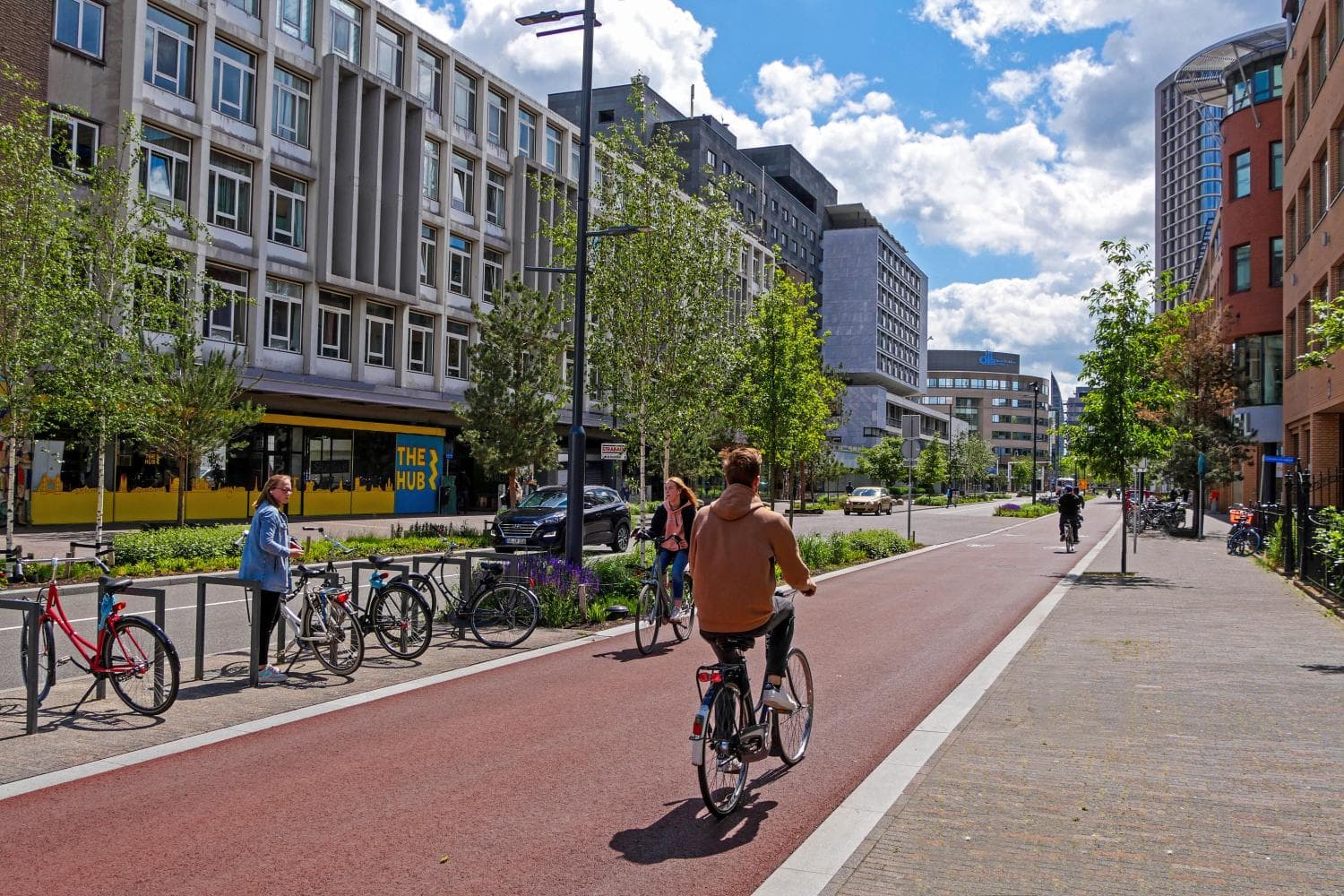
Green city? Eindhoven Vestdijk in 2020. © gemeente Eindhoven

Team IO+ selects and features the most important news stories on innovation and technology, carefully curated by our editors.
A climate deal for every district, the phase-out of the fossil industry, millions invested in a future fund, and quick improvements for residents’ health. Taken together, the proposals presented by GroenLinks–PvdA Eindhoven in the run-up to the municipal elections are far from modest. The party is calling for a “major clean-up” of the most polluting companies in Eindhoven. Among other measures, it proposes a relocation premium for the city’s asphalt plant and the transformation of car-dominated neighborhoods into residential areas.
“We see that the ten largest polluters in Eindhoven are responsible for a disproportionate share of all CO₂ emissions,” says Lotte Meerhoff, city councillor for the party and the initiator of the plan. “At the same time, the climate, nature, and the health of residents are under pressure. We cannot accept that. It is time for a major clean-up of the big polluting companies.”
Green industrial policy
The party proposes five measures, one of which is described as “green industrial policy.”
Eva de Bruijn, the party’s group leader in the city council, explains: “Eindhoven is a city where we are building the future. Major polluters have emitted enormous amounts in the past and have had a disproportionate impact on their surroundings. That has to change. If we do nothing, our city will become further unbalanced.”
The party wants to require companies to operate sustainably, with strict enforcement and fines for noncompliance.
“There is no place for the fossil industry in residential areas in Eindhoven,” De Bruijn says. “On our initiative, a future fund has been established that we will fill with millions of euros. With this, we aim to facilitate the departure of old fossil-based industries and make room for the sustainable economy of the future.”
Health concerns
According to Meerhoff, residents living near heavy industry spend an average of more than €145 extra per year on healthcare.
“Recently, a grandfather told me that he doesn’t let his grandchildren play in the garden because you can smell the emissions outside,” she says. “That is simply not healthy. Every resident of Eindhoven has the right to clean air.”