
Scientists crack a fundamental law of energy transfer
Dutch researchers pushed back the limit on how far energy transfer between particles can happen without "spilling" radiation.
Published on May 27, 2026
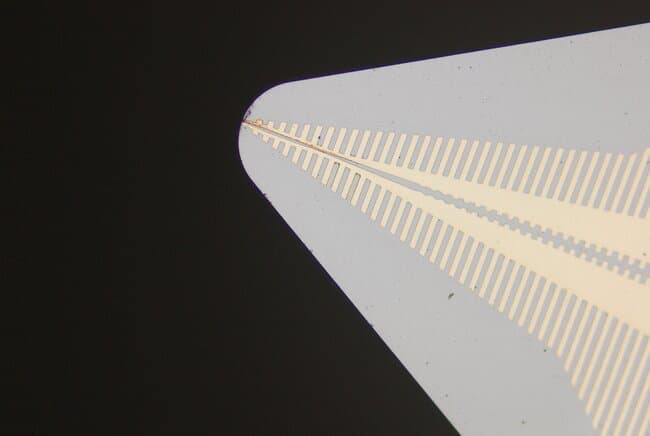
© Jie Ji - TU/e

Team IO+ selects and features the most important news stories on innovation and technology, carefully curated by our editors.
Scientists at Eindhoven University of Technology (TU/e) have achieved something long thought impossible: pushing back a fundamental limit on how far energy can be transferred between particles without "spilling" radiation. The findings, published today in the journal Science Advances, could reshape technologies from quantum computers to cancer diagnostics.
Whenever a molecule absorbs energy — from light, heat, or a chemical reaction — it usually loses that energy almost immediately, either as heat through vibrations or as a photon, a tiny packet of light. Most energy transfer in nature and technology is wasteful in exactly this way. There is one exception. In Förster resonance energy transfer (FRET), energy jumps directly, without radiation. An example of this phenomenon is photosynthesis in plants. FRET, however, only works over extremely short distances of roughly a few nanometres — about ten thousand times thinner than a human hair.
The TU/e team — Professor Jaime Gómez Rivas, postdoctoral researcher Jie Ji, and graduate researcher Wouter Holman — has now extended this effective range to a few millimeters. In the world of molecules, that is a giant leap, comparable to a person jumping 200 kilometers from Amsterdam to Brussels.
A giant leap
Their key insight was to harness a phenomenon called bound states in the continuum, or BICs. These are electromagnetic waves that, due to a precise cancellation effect, remain completely trapped on a surface and radiate no energy outward. They are present, but invisible to the outside world, and remain intact for an exceptionally long time.
To exploit this, the researchers built a flat surface of microscopically small gold rods on glass, arranged in a highly precise pattern. Energy introduced at one point of this surface travels — hop by hop through the vibrating gold rods — to a detector two millimeters away, all without leaking radiation into the surrounding space.
Another striking feature is that the transfer is strongly direction-dependent, determined by the orientation of the gold rods: along one direction, energy travels effortlessly over the full two millimeters, while in the perpendicular direction it fades after only a fraction of that distance. That built-in directionality could allow future devices to route energy flows much the way circuits guide electrical current.
Making the difference for tens of applications
The implications of this discovery could disrupt tens of technology use cases. Direct applications include ultrasensitive sensors capable of detecting single biological molecules with unprecedented precision. In medicine, that means earlier and more accurate detection of disease markers in blood or tissue.
In the longer term, the technique could be used to couple many molecules into "supermolecules" that behave uniformly and coherently — potentially changing how chemical reactions occur and opening new possibilities for chemistry. The researchers also point to promising applications in quantum communication and solar energy.