
QuiX Quantum hits photonic error mitigation milestone
QuiX Quantum demonstrates a below-threshold error mitigation protocol, a vital step toward scalable quantum systems.
Published on April 6, 2026
© Quix Quantum

Team IO+ selects and features the most important news stories on innovation and technology, carefully curated by our editors.
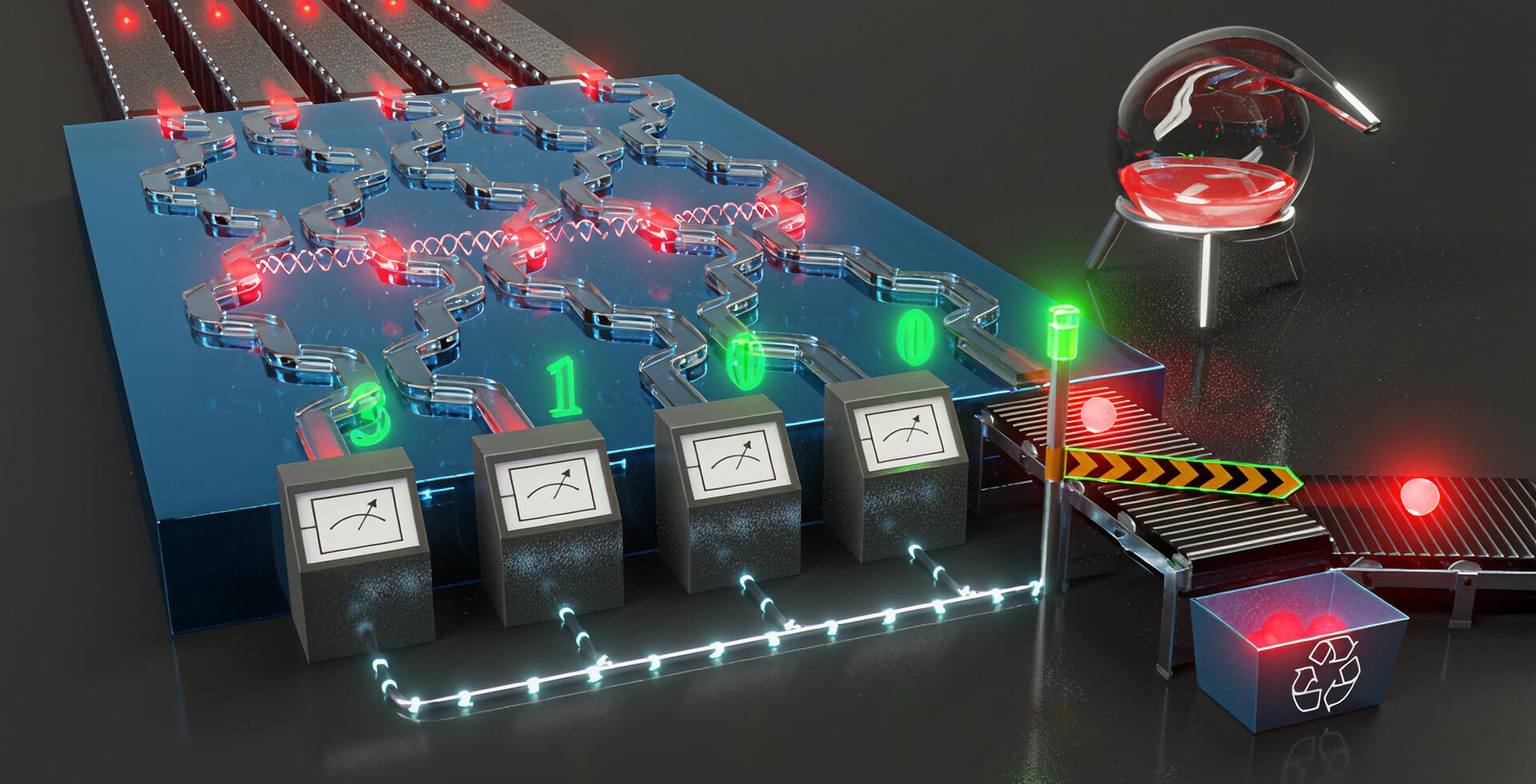
The primary obstacle to functional quantum computing is noise. In most current systems, the process of correcting errors often introduces more instability than it resolves. QuiX Quantum recently announced a significant technical breakthrough by demonstrating 'below-threshold' error mitigation on a photonic quantum processor. By using a specialized photon distillation gate, the company improved the quality of quantum information without disrupting the computer's primary operations. This achievement, conducted on the BiaTM Cloud Quantum Computing Service, marks the first time a photonic architecture has proven it can remove more errors than it creates. This milestone shifts the conversation from theoretical potential to the practical engineering required for fault-tolerant quantum machines.
The mechanics of photon distillation
The breakthrough centers on a 20-mode programmable photonic processor and a novel distillation gate. In photonic quantum computing, information is carried by light particles, or photons. For these systems to perform complex calculations, the photons must be 'indistinguishable,' meaning they possess identical physical properties. Even minor variations in photon quality lead to computational errors. QuiX Quantum, in collaboration with NASA’s Quantum Artificial Intelligence Laboratory and academic partners in Twente and Berlin, implemented a distillation protocol designed to filter out these inconsistencies.
This gate serves as a quality-control mechanism, isolating high-fidelity photons to ensure more reliable data processing. The demonstration is unique because it maintains the computer's operational flow while performing mitigation. Historically, error correction methods were too resource-intensive to run alongside active computations. By achieving this 'below-threshold' status, QuiX Quantum proves that photonic systems can manage internal noise while remaining functional. This capability is essential for transitioning from experimental prototypes to reliable, high-performance hardware. The project received critical support from the Netherlands Ministry of Defense through the Purple NECtar initiative, highlighting the strategic importance of this technical leap for national and regional technological sovereignty.
Quantifying the error reduction
The performance data from the demonstration provides a clear look at the efficiency of the new protocol. QuiX Quantum reported a 2.2x reduction in errors related to photon indistinguishability. More importantly, the system achieved a 1.2x net reduction in total operational error. While a 1.2x improvement may seem modest, it represents a critical 'break-even' point in quantum physics. In previous attempts, the hardware required to fix errors was so complex that it introduced more noise than it removed. Surpassing this threshold suggests that the architecture is finally becoming efficient enough to support scaling. However, technical analysis indicates that this 1.2x reduction is highly sensitive to the input state's specific noise profile.
Residual phase noise and inefficiencies at the detector level still remain as significant hurdles. Peer reviewers have noted that, while the methodology is sound, its generalizability across different operational environments remains under evaluation. The current success is tied to the specific 20-mode architecture used in the test. To maintain these gains, the company must ensure that the distillation gates can handle diverse noise types without losing efficiency. This data-driven approach allows engineers to pinpoint exactly where the photonic circuit loses fidelity, providing a roadmap for future hardware iterations.
Strategic impact on hardware scalability
One of the most significant implications of this breakthrough is the reduction of physical hardware requirements. Building a universal, fault-tolerant quantum computer currently requires a massive number of photon sources to create a single 'logical' qubit. This overhead is one of the biggest barriers to commercialization. QuiX Quantum’s data suggest that their error-mitigation protocol could reduce the number of photon sources required per logical qubit by a factor of 4.
Reducing the hardware footprint by 75% would drastically lower the cost and complexity of building large-scale systems. It would also simplify the cooling and power requirements for the overall architecture. In the race for global competitiveness, the ability to do more with less hardware is a decisive advantage. This efficiency makes the photonic approach more viable compared to trapped-ion or superconducting qubit methods, which face their own unique scaling challenges. By reducing the physical resource overhead, QuiX Quantum is positioning its technology as a more sustainable path toward the thousands of qubits needed for practical applications such as cryptography and materials science. This focus on resource efficiency aligns with the company's broader goal of delivering a universal photonic quantum computer, supported by its recent € 15 million Series A funding round.
Scaling challenges and the lab-to-fab transition
Despite the success of the 20-mode processor, scaling to larger systems presents formidable engineering obstacles. Moving from 20 modes to 100 or more modes introduces exponential increases in photon loss rates. In a photonic circuit, every additional component or 'mode' provides another opportunity for a photon to be absorbed or scattered. Maintaining the efficiency of a distillation gate becomes significantly harder as the system grows.
The high physical resource overhead of managing these losses could offset some of the gains seen in the smaller-scale demonstration. Furthermore, current detector-side inefficiencies remain a bottleneck that the distillation gate cannot fully resolve. Industry roadmaps suggest that these gates are currently in a 'lab-to-fab' transition phase. This means the technology is moving from controlled laboratory experiments to standardized manufacturing processes. Experts project that commercial integration of these fault-tolerant protocols into universal systems will likely occur between 2029 and 2030. During this period, the industry must focus on improving the precision of integrated photonics and reducing the 'on-chip' loss of light. The success of the 20-mode test proves the concept, but the next five years will determine if these protocols can survive the rigors of industrial-scale manufacturing and real-world deployment.
Strategic autonomy
The demonstration by QuiX Quantum reinforces the Netherlands' position as a potential leader in the global quantum ecosystem. By collaborating with international entities like NASA and local academic institutions, the company has created a robust framework for innovation. This breakthrough could result in a move toward strategic autonomy in a critical technology sector. As quantum computing nears commercial relevance, the ability to manufacture and operate these systems independently becomes a matter of national security and economic stability. The involvement of the Netherlands Ministry of Defense underscores this point, as quantum-resistant encryption and advanced modeling are high-priority defense capabilities.
Looking forward, the company is focused on its 2026 goal of delivering a universal photonic quantum computer. While the full integration of below-threshold error mitigation may take longer, the current milestone provides the necessary validation for investors and partners. The company's recent leadership appointments, including a new Chief Commercial Officer and board members, suggest a shift toward market readiness. As the industry moves toward the end of the decade, the focus will remain on refining these error-correction protocols to ensure they are robust enough for the most demanding computational tasks in hydrology, logistics, and beyond.