
Pressure on ASML share price due to postponement of TSMC order
TSMC postpones ASML’s extremely expensive high-NA EUV machines until 2029. What does this mean for the chip sector?
Published on April 27, 2026
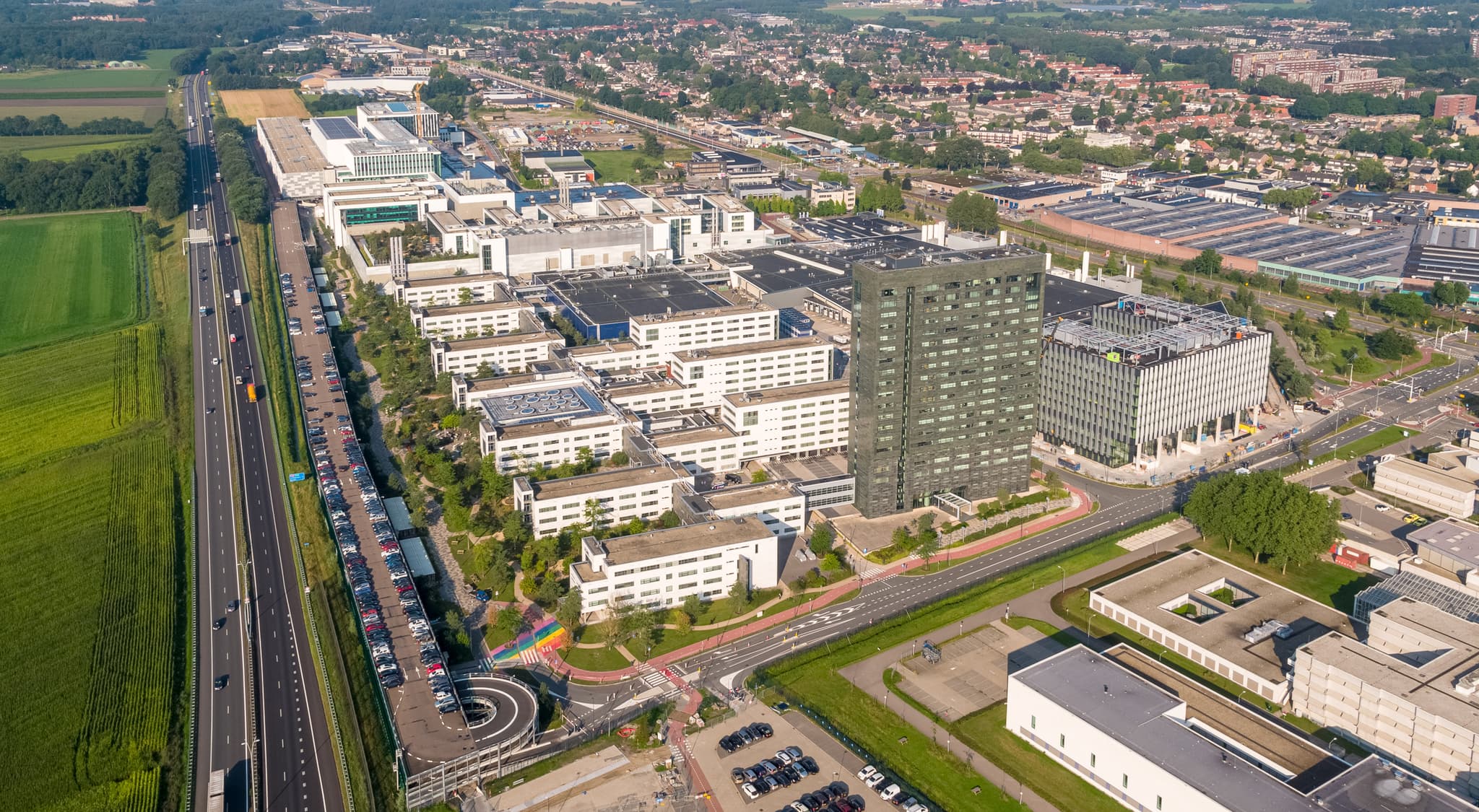
ASML Campus Veldhoven

Team IO+ selects and features the most important news stories on innovation and technology, carefully curated by our editors.
On April 23, the chip sector woke up to a sharp price drop at ASML. The share of the Veldhoven giant fell by 3.3 percent in a single day. The direct reason was an announcement by TSMC, one of the company’s most important customers. The Taiwanese chip manufacturer has decided to postpone adopting the latest generation of lithography machines.
This concerns the so-called high-NA EUV systems, which are considered essential for the next generation of superchips. TSMC is now choosing to deploy this technology on a large scale only around 2029. This decision exposes the tension between technological ambition and economic feasibility in the global semiconductor industry.
The sky-high price of innovation
The core of the problem is simply the price of the new hardware. A single high-NA EUV machine from ASML currently costs more than 350 million euros. Converted, that is more than 410 million dollars per device. Kevin Zhang, an important executive at TSMC, indicated that the machines are currently too expensive for profitable mass production. TSMC is critically examining the cost per chip produced. The current generation of EUV machines is already costly, but the switch to high-NA requires an even larger investment.
For ASML, this means that the expected billions in revenue from these new systems will arrive later than planned. The company from Veldhoven had hoped that the industry would switch more quickly to the new standard. Economic reality, however, forces TSMC to pause. They first want to extract maximum value from their existing machine park before investing billions again. This postponement creates uncertainty among investors who had counted on a faster growth spurt in revenue.
Smart alternatives for the short term
Meanwhile, TSMC is not standing still and has developed technological alternatives. They state that they can still manage for the coming years without the new high-NA machines. For their so-called A14 node, which operates at 1.4 nanometers, they rely on process optimizations. TSMC uses advanced nanosheet architectures for their transistors. According to the company, this technique offers up to 15 percent higher performance or 30 percent lower energy consumption. They achieve this result without purchasing the newest machines.
In addition, TSMC is experimenting with advanced packaging techniques such as CoWoS and 3D-IC to increase chip density. Through these smart innovations, they can postpone the necessity of the very latest lithography for a while longer. For the European chip sector, this is a relevant signal. It shows that process innovation is not always dependent on the newest hardware. Still, the question remains how long TSMC can maintain this strategy before the physical limits of the current machines are reached. For now, however, the focus seems to be entirely on maximizing the current EUV fleet.
Competitors choose a different path
Remarkably, TSMC’s competitors are following a very different course. While the Taiwanese are waiting, parties such as Intel and Samsung are fully committing to high-NA EUV. Intel has already put the Twinscan EXE:5200B machine into use for the development of its 14A process. They want to use this to recapture their lost technological lead over TSMC. Samsung has also not stood still and received its first high-NA machine at the end of 2025. They are planning a second machine for the first half of 2026 to strengthen their 2nm production lines. Even SK Hynix had already installed such a system in September 2025 for the production of advanced memory.
This creates an interesting dynamic in the market. TSMC is betting on efficiency and cost control, while the competition is betting on early adoption of the latest technology. If Intel’s strategy succeeds, this could shift the balance of power in the chip world. For ASML, this spreading of risk is good news. Although its largest customer is slowing down, other giants continue investing in the future of lithography.
Impact on ASML’s long-term vision
The postponement by TSMC has direct consequences for ASML’s financial targets. The company is aiming for annual revenue of 60 billion euros in 2030. Analysts see the current postponement as a temporary setback, also called a “timing headwind.” It does not mean demand is disappearing, but that the peak in revenue is moving backward. ASML must now adapt its strategy to bridge this period. The focus will likely shift more toward sales of the current generation of EUV systems and their maintenance.
ASML must also continue its R&D efforts to increase the productivity of the high-NA machines. If the machines can produce more chips per hour, the price of 350 million euros becomes easier to justify for TSMC. Pressure on the engineers in Veldhoven is therefore increasing. They must prove that the new technology is not only technically superior, but also economically profitable. The market is now looking critically at the results of the coming quarters to see whether other customers follow TSMC’s example.
The role of the AI revolution
Despite the delay at TSMC, overall demand for chips remains unprecedentedly high. This is mainly due to the continuing boom in artificial intelligence (AI). AI chips require the most powerful hardware, which keeps demand for ASML’s current EUV machines robust. Suppliers in the lithography chain are therefore reacting cautiously to the news from Taiwan. They do see slower growth for specific high-NA components, but the underlying demand remains stable. For European strategic autonomy, this is an important point. ASML remains the only supplier in the world of these crucial machines. Whether TSMC buys them in 2026 or 2029, they cannot avoid Dutch technology. The postponement also gives European industry a little more time to optimize the supply chains for these complex systems. The semiconductor market is always cyclical and subject to political and economic shifts. The current postponement is a reminder that even the most advanced technology must bend to the laws of economics.