
Precision technology: laser communications and Einstein Telescope
The 25th Precision Fair shows how Dutch high-tech expertise finds its way into satellite links, measuring instruments and amusement rides.
Published on October 25, 2026
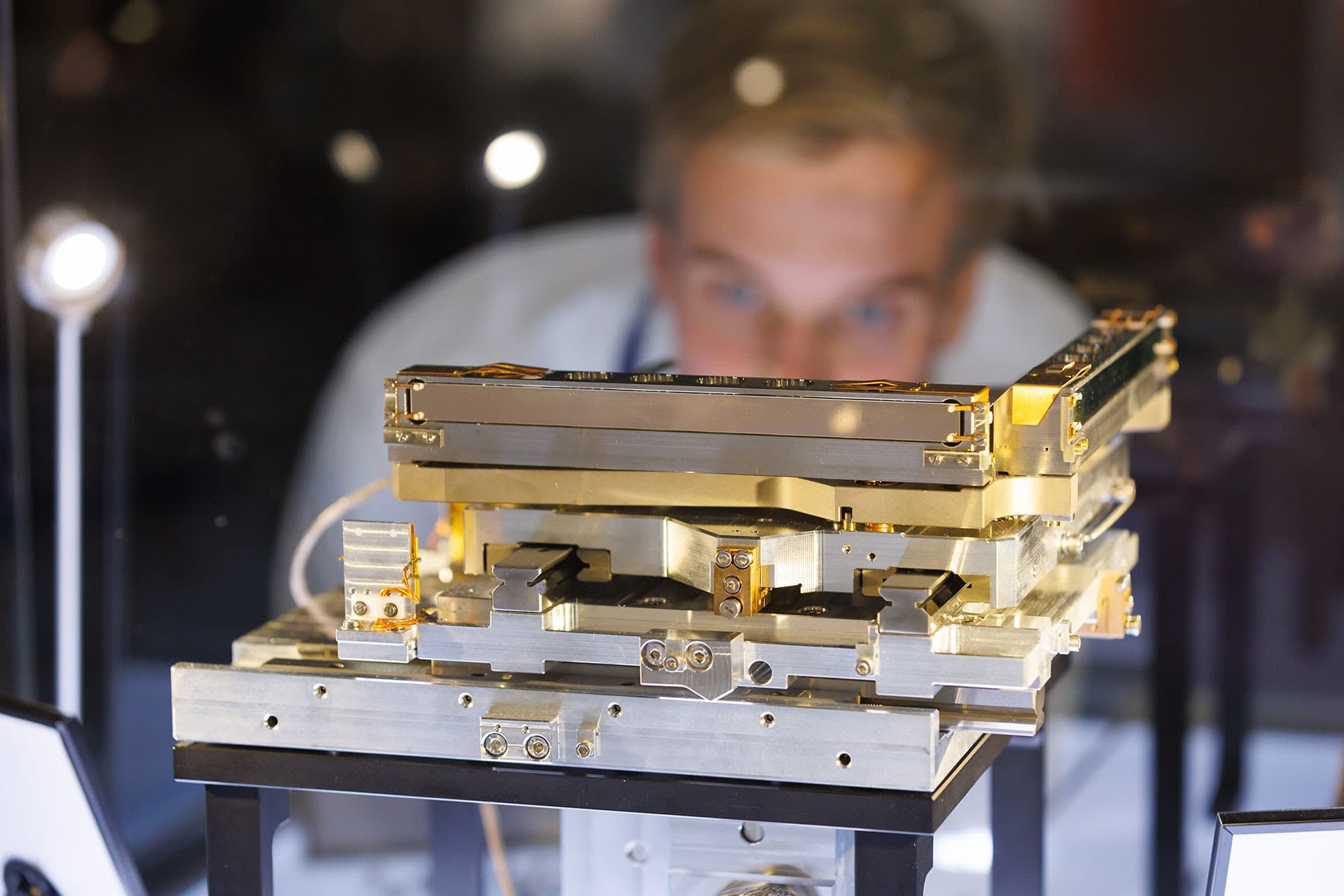
© Precisiebeurs / Mikrocentrum

Team IO+ selects and features the most important news stories on innovation and technology, carefully curated by our editors.
Maintaining a laser link between a moving aircraft and a satellite 36,000 kilometres above Earth requires optics, mechanics and control systems to work together almost perfectly. It is one of the applications taking centre stage at the 25th Precision Fair, held on 18 and 19 November at the Brabanthallen in ’s-Hertogenbosch. The Einstein Telescope, artificial intelligence and new motion systems also illustrate the growing range of applications for precision technology.
According to organiser Mikrocentrum, the anniversary edition will bring together more than 400 exhibitors and over 6,500 professionals. A common thread throughout the programme is a development affecting the entire high-tech industry: systems are becoming more complex, while tolerances are becoming ever tighter. This calls for closer collaboration among specialists in fields such as mechatronics, photonics, measurement technology, and software.
Keeping a laser on target across 36,000 kilometres
One highlight is UltraAir, the laser communications terminal developed jointly by TNO and Airbus. During test flights in December 2025, the system established a link between an aircraft and a geostationary satellite. It transmitted data at 2.6 gigabits per second for several minutes without any bit errors. The results were announced in February 2026.
The main technical challenge lies in keeping the connection stable. The aircraft moves and vibrates, while the atmosphere also disturbs the laser beam. The terminal must locate the satellite, keep tracking it and make continuous corrections to keep the narrow beam on target.
During a keynote on 19 November, TNO project manager Sjoerd van Kuijk will explain the optomechatronic solutions developed to achieve this. The technology could support high-speed data connections for both civil and military aviation.
Big Science calls for ultra-precise manufacturing
Scientific research infrastructure also relies on the precision industry. Projects featured at the fair include the Einstein Telescope: the planned underground observatory for detecting gravitational waves.
Albert van Dorssen will discuss upcoming subprojects and the technological challenges they involve. Such projects matter to specialist suppliers because scientific ambitions must be translated into components and systems that can be manufactured, assembled, and tested.
Another example is LISA, ESA’s future space observatory for gravitational waves. Gabby Aitink-Kroes of SRON will present the measurement technology behind the observatory’s ‘eyes’. At its core is an extremely sensitive detector that converts changes in laser light into electrical signals. The presentation will show the optomechanical precision required to reliably measure picometre-scale changes.
The precision behind an amusement ride
Applications extend beyond aerospace, semiconductors and scientific instruments. Together with ride manufacturer Vekoma, MTA Group will present technology for a dark ride system: an attraction in which passengers travel in vehicles through an indoor environment.
Using a rail unit, the companies will demonstrate how motion, positioning and control come together. In a joint keynote, they will explore the system's engineering. Here, too, the interaction between mechanics, electronics and software is essential: individual components must work together to produce predictable movement.
The AI Experience area will focus on AI applications in engineering and high-tech manufacturing. Visitors can explore AI's role in design, production, and measurement.
Making room for new companies and engineers
The Precision Fair will also host fifteen startups and young engineering teams in its Next Generation Area. The Dutch Precision Week International Lounge aims to support connections between the Dutch precision technology network and international companies and delegations.
The anniversary also highlights the longevity of some industry relationships. According to the organiser, ten exhibitors, including Ceratec, ZEISS, Demcon, Renishaw and IBS Precision Engineering, have participated in every edition since 2001.
Over that quarter-century, demands on accuracy, stability and system integration have continued to grow. The programme shows what this means in practice: from a laser beam that must stay on target across tens of thousands of kilometres to a motion system that carries passengers through an attraction.
The Precision Fair takes place on 18 and 19 November 2026 at the Brabanthallen in ’s-Hertogenbosch. The fair is open from 10:00 to 17:00 on both days. Admission is free for professionals upon registration.