
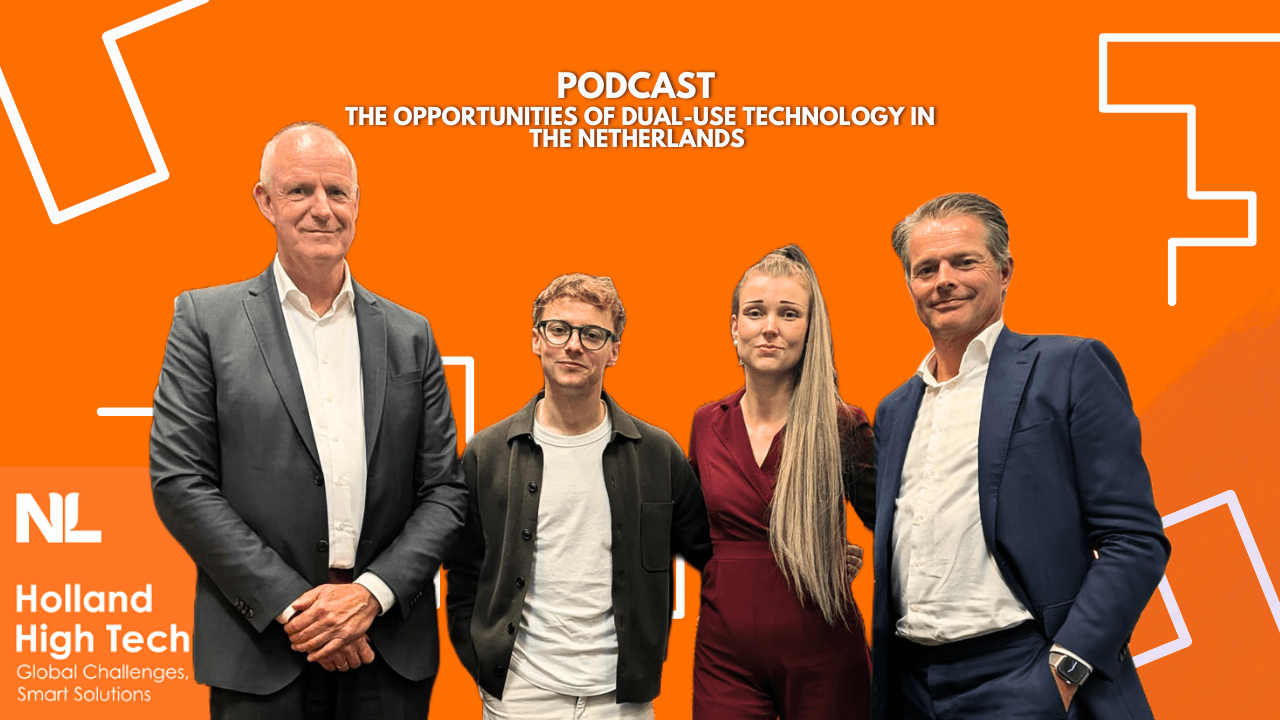
Podcast: The opportunities of dual-use tech in the Netherlands
In this three-part podcast series, we speak with leading experts about the state of the high-tech sector in Europe.
Published on July 22, 2026
Our DATA+ expert and Editor-in-Chief, Elcke Vels, explores AI, cyber security, and Dutch innovation. Her "What if..." column imagines bold scenarios beyond the norm.
The world is changing rapidly. Geopolitical tensions and shifting power dynamics make it clear that high-tech is becoming increasingly important. Technology that was once developed primarily for commercial applications now also plays a strategic role in defense and security. So-called dual-use technology is currently the focus of much attention. During the Holland High Tech Networking Event, podcast host Elcke Vels spoke with Hans Büthker, CEO of Neways Electronics International, a board member of Holland High Tech, and involved with Invest-NL, about the opportunities and challenges surrounding dual-use technology in the Netherlands.
External Content
This content is from youtube. To protect your privacy, it'ts not loaded until you accept.
Listen to the episode on Spotify.
What exactly does Neways Electronics International do?
“We develop and manufacture complex electronics for the semiconductor industry, defense, and the medical sector.”
So you focus, among other things, on the defense market. How important is that market to you right now?
“We’re dealing with geopolitical changes. That also means that, as a company, you have to think carefully about where you focus your efforts. In the Netherlands, we have a strong ecosystem of technology companies. Fortunately, you see tech companies increasingly asking themselves: if I can apply my technology in the commercial sector, can I also use it for defense? That’s exactly what Neways has done. We’ve built a capability system: a network of knowledge, production capacity, and infrastructure needed to develop and scale up technology in Europe successfully. ”
What’s on the agenda for Neways in the near future?
“We work closely with our customers and grow alongside them. Together, we develop new solutions, in which our broad application knowledge and technical expertise play a key role. Drawing on that knowledge, we ultimately bring innovations to production. We do this not only in the Netherlands but also in other European countries, such as Germany, the Czech Republic, and Slovakia.”
In addition to your role as CEO of Neways, you’re also involved with Holland High Tech. Can you tell us a bit about that?
“For me, Holland High Tech is an incubator for new technology. The Netherlands has identified specific innovation areas to invest in. The strength of Holland High Tech lies primarily in connecting companies, knowledge institutions, and other stakeholders in those fields. We bring people, resources, and expertise together around key innovation areas. This approach works well: it leads to exciting innovations and new startups.
When developments prove successful, the Netherlands wants to continue investing in them and help them grow further. To that end, the Deep Tech Fund by Invest-NL, among other initiatives, was established in the Netherlands.”
How important is collaboration between the government, companies, and research institutions in developing dual-use technology?
“Dual-use technology involves a lot of regulations: what’s allowed and what isn’t? What does the government think about it? All sorts of agreements and permits are required if you want to use certain technology for defense purposes.
You also have to deal with things like end-user statements. These examine where your technology ultimately ends up. For example, if you’ve developed a chip, you sometimes have to determine exactly how it will be used. There are all kinds of rules, procedures, and processes for that.
Many companies don’t know enough about this yet. That’s still a significant challenge. Collaboration between the government, businesses, and research institutions is crucial in this regard.”
You’re also chair of the investment committee at Invest-NL. What exactly does that role entail?
“Proposals come in from the deep tech sector. These are prepared by what’s called the deal team. Ultimately, the investment committee decides whether or not to invest in a company.”
What important lessons have you learned in that role?
“One of the things I’ve learned is that it’s not just about money. People often think: if I have a pile of money, then I can keep investing. But we also look very carefully at other aspects: is there a market? Is the technology good enough? Do we understand the supply chain? How can a company scale up? Then you have to think about machinery, production capacity, growth, the supply chain, financing, and contracts with suppliers. It’s also about the people: about leadership. All those factors together determine a company’s success. Companies make fantastic inventions. But you have to be able to scale.”
Do you have a message for the reader?
“We need to realize that high-tech is part of our country’s infrastructure—just like energy and housing. The high-tech industry is a driver of success, as described in the Wennink Report. More and more people are realizing that we need high-tech and that it’s essential.
So: think in terms of capability systems. We need to bring together different components, knowledge, and stakeholders, accelerate progress, and ensure that the right people and resources are available to make these developments possible.”
Sponsored
This story is the result of a collaboration between Holland High Tech and our editorial team. IO+ is an independent journalism platform that carefully chooses its partners and only cooperates with companies and institutions that share our mission: spreading the story of innovation. This way we can offer our readers valuable stories that are created according to journalistic guidelines.
Want to know more about how IO+ works with other companies? Click here