
Photon Bridge raises €10 million to tackle AI's laser shortage
The Eindhoven startup landed €10 million for its technology that enables light-powered connections in data centres.
Published on October 21, 2026
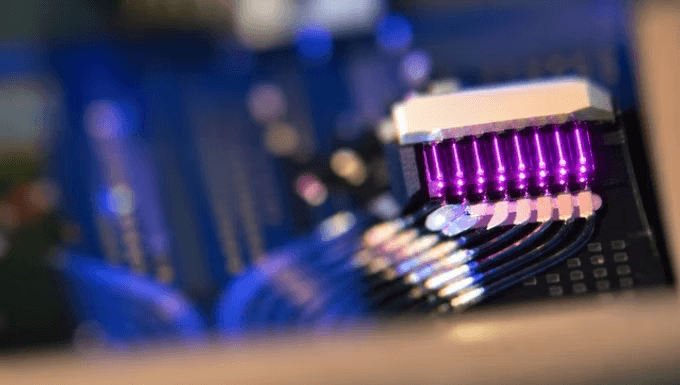
© Photon Bridge

Team IO+ selects and features the most important news stories on innovation and technology, carefully curated by our editors.
Dutch startup Photon Bridge has raised €10 million to solve a problem most people have never heard of: the world may soon run short of the tiny lasers that AI depends on. Two new investors, the Amadeus APEX Technology Fund and 360 Capital, co-led the round. Existing backers Innovation Industries, Faber and the Brabant Development Agency (BOM) also increased their stakes.
Why AI needs lasers
Modern AI runs on enormous clusters of specialised chips. As clusters grow to hundreds of thousands of processors, the chips constantly need to swap data. Much of that traffic still travels through copper wires, which are reaching their limits.
Light is the answer. Optical connections carry far more data, faster and with less energy. So data centres are moving them closer and closer to the chips themselves, a design known as co-packaged optics. Every one of these optical links needs a light source: a laser.
But today's high-power lasers come from a supply chain built for telecom and undersea cables, where volumes are small. AI could turn the laser from a niche part into something that must be mass-produced like a computer chip.
Many small lasers instead of one big one
Photon Bridge's idea is easy to picture: instead of building one ever more powerful laser, it combines the light of several weaker ones. Think of lighting a room with a few ordinary bulbs rather than one extremely bright lamp.
Weaker lasers are less sensitive to tiny manufacturing flaws, so fewer of them are thrown away during production. The company says its platform can deliver many colours (wavelengths) of light through a single fibre, at up to 40 milliwatts each. It can also be produced at several different chip factories, so customers are not tied to one supplier.
The second trick is in the assembly. Normally, a laser chip must be lined up with nanometre precision, which requires expensive robots. Photon Bridge uses a small, flexible connection that works like a tiny spring, letting the chip settle into the right spot by itself. Standard factory equipment can then do the job. In a previous interview with IO+, co-founder Rui Santos has compared the process to clicking together LEGO bricks.
Built for mass production
CEO Paul Marchal says AI is changing how computing infrastructure is built, and that moving data between processors is becoming a key limit on performance. "The industry will soon need millions of these laser sources every year," he said. Instead of ever harder-to-build single lasers, the company solves this through design.
Ion Hauer of APEX Ventures called lasers the next bottleneck created by the AI boom. Cesare Maifredi of 360 Capital said that at millions of units a year, manufacturing yield becomes essential.
The new money will speed up product development and testing with customers. The company plans to deliver its first samples in 2027 and prepare for volume production from 2028. It will also grow its team in Eindhoven.