
Philips wins up to $33.7M US grant for robotic stroke care
Philips has won up to $33.7M from US health agency ARPA-H to build AI-enabled robotic tech for remote, automated stroke treatment.
Published on August 27, 2026
© Philips

Team IO+ selects and features the most important news stories on innovation and technology, carefully curated by our editors.
Philips announced it has been awarded up to $33.7 million from ARPA-H, the U.S. government's health innovation agency. The money will help develop AI-enabled robotic technology aimed at making advanced stroke treatment available to more patients, regardless of their location.
The award falls under ARPA-H's Autonomous Interventions and Robotics (AIR) program, part of the Advanced Research Projects Agency for Health within the U.S. Department of Health and Human Services. Philips will lead the project alongside academic partners Johns Hopkins University and Boston University, with additional clinical input from Dr. J Mocco, chair of neurological surgery at Weill Cornell Medicine. The work is being led on Philips' side by Dr. Ileana Hancu.
The project targets a persistent gap in stroke care. In the United States alone, roughly 335,000 people a year are eligible for thrombectomy, a minimally invasive procedure that can reverse the effects of a stroke if performed quickly. Yet, only about 12% of eligible patients actually receive it, and more than half of Americans live over an hour from a hospital equipped to perform it. Globally, fewer than 3% of patients eligible for mechanical thrombectomy get the procedure, even though stroke remains the world's second-leading cause of death.
Combining tech for patient care
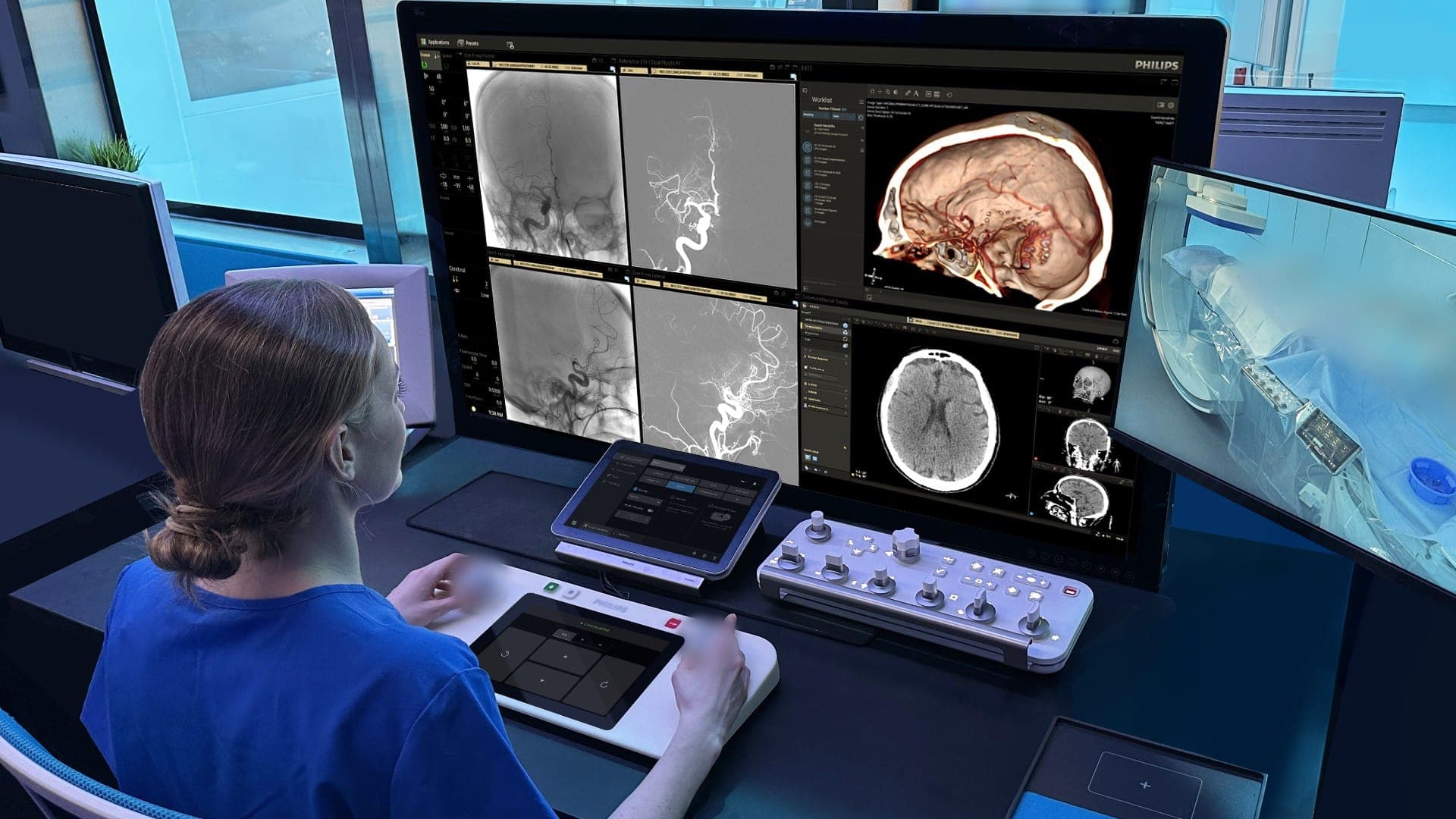
Philips plans to address that gap by building on its Azurion image-guided therapy platform, combining imaging, robotics, AI-driven automation and smart interventional devices to support remote-assisted and increasingly automated endovascular procedures. The funded work covers technology for endovascular navigation, robotic device control, image-based procedural guidance, workflow automation and remote intervention, all designed to operate under expert clinical supervision rather than replace it.
"This ARPA-H program accelerates our long-term vision for image-guided intervention," said Bert van Meurs, Chief Business Leader Image-Guided Therapy at Philips, adding that the goal is to make specialist-level care less dependent on geography or staffing constraints. Betsabeh Madani-Hermann, Philips' head of research, said the effort builds on years of prior work in image-guided and robotic procedure automation.
Within the collaboration, Johns Hopkins will focus on autonomous device navigation, led by mechanical engineering associate professor Axel Krieger, while Boston University will develop steerable catheters under the direction of associate professors Tommaso Ranzani and Sheila Russo. Dr. Mocco, who is also serving as a clinical collaborator on the project, said robotics could both sharpen precision in endovascular stroke procedures and extend specialist expertise to patients through remote-assisted care.
Building on image-guided therapy expertise
Philips frames the award as an extension of its existing footprint in image-guided therapy, where it says more than 20,000 of its systems are installed in over 80 countries, treating a patient somewhere in the world roughly every second. The company, which also has more than four decades of experience running public-private research partnerships, positions the ARPA-H funding as a step toward an interventional suite that eventually merges robotics, AI automation and connected devices into a single clinical workflow.
Philips cautioned that the technologies remain under development and that any future clinical or commercial use will depend on regulatory clearance.