
Perovskite solar panels: will Europe seize the opportunity now?
Ten years after the disappearance of the silicon industry, Europe must ensure that perovskite does not become another Chinese industry.
Published on December 3, 2025
Our DATA+ expert and Editor-in-Chief, Elcke Vels, explores AI, cyber security, and Dutch innovation. Her "What if..." column imagines bold scenarios beyond the norm.
Ten years ago, Europe allowed the entire industry for silicon solar panels, which now cover our roofs, to leak away to Asia. Now there is another opportunity: perovskite. But we need to move quickly — the next two years will be crucial. “Perovskite has extremely interesting properties. China and India know that too. Time is running out,” warns Tjark Tjin-A-Tsoi, CEO of TNO, during Solar Flexible. During this event, key players from the solar community gathered at the Brainport Industries Campus, where more than 50 companies in the high-tech manufacturing industry and three educational institutions are located.
About ten years ago, it seemed a rational choice to leave the production of silicon solar panels to China. We in Europe would continue to innovate, collect patents, build machines, fund research, and leave the ‘simple manual labor’ to other countries. But in recent years, China has not only built factories, but also accumulated a huge knowledge base. An entire industry. China accounts for more than 80% of solar panel production.
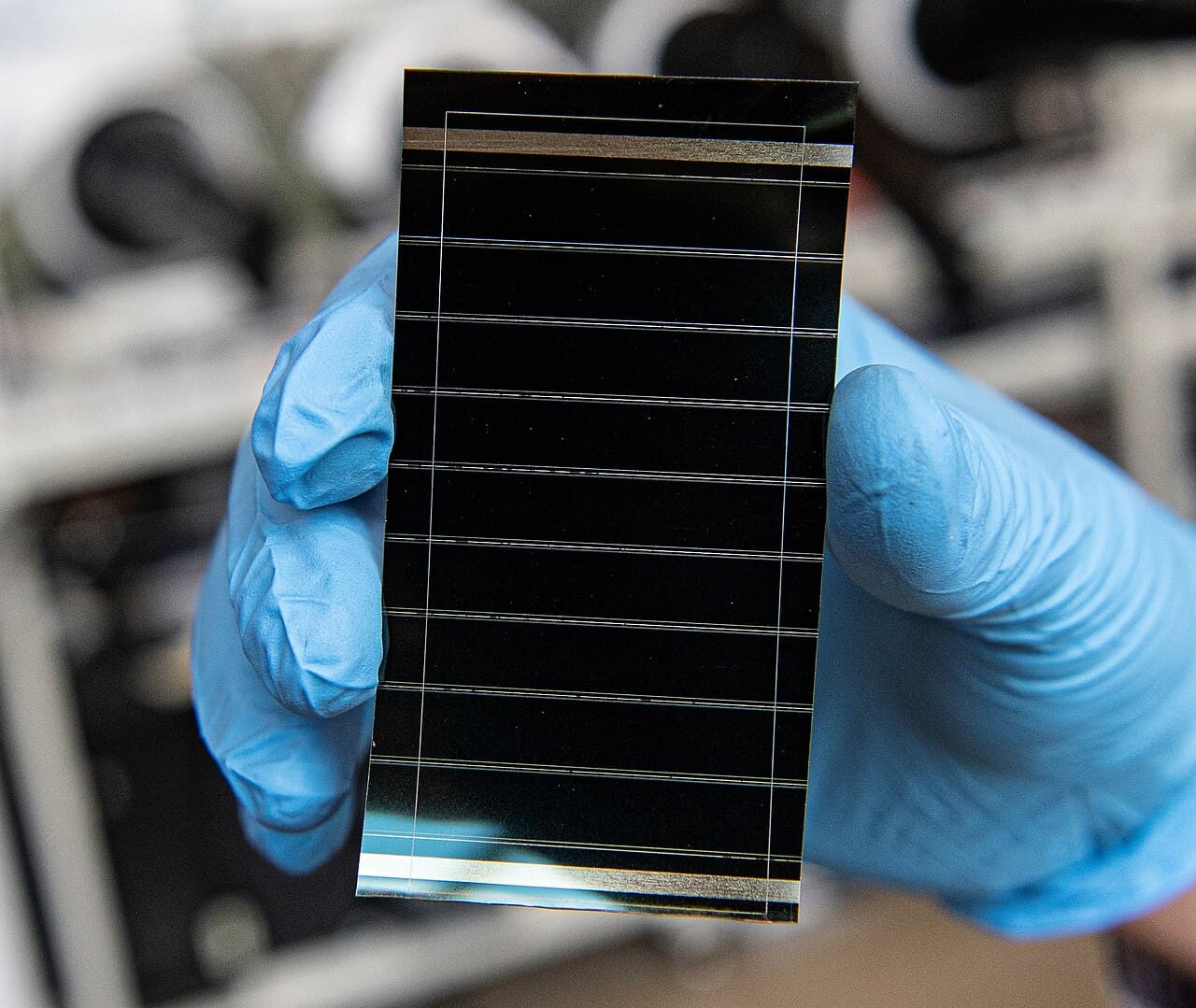
With the emergence of perovskite – ultra-thin, lightweight solar films that are cheap to produce and have a much lower carbon footprint – Europe is once again at a crossroads. The material opens the door to solar energy in facades, roofs, vehicles, and noise barriers: virtually any surface can become an energy carrier with perovskite. Will Europe choose to take the lead this time, or will we become dependent on China in this area as well? During Solar Flexible, leading experts, policymakers, and industry leaders discussed the conditions for future success.
‘Too dependent, on all fronts’
According to Tjark Tjin-A-Tsoi, CEO of TNO, the situation surrounding solar cell innovation is comparable to defense. “We have made ourselves far too dependent on all fronts. This also applies to industry. That is why it is crucial that we learn to manufacture products in the Netherlands again, thereby building a new industrial base in Europe.”
If it were up to the CEO, Europe would seize its opportunity to become a leader in the field of perovskite. “Perovskite films are thin, light, and have a much lower carbon footprint. They are quick and cheap to produce. These are extremely interesting properties. China and India know this too — they are working just as hard on it. Time is running out.”
Opportunities for Europe
According to Sjoerd Veenstra, a researcher at TNO, there are opportunities for Europe. We have to contend with high energy prices in Europe. “But the energy consumption for producing perovskite is relatively low. So that's an advantage.”
But what about labor costs? Aren't they, like energy prices, sky-high in Europe? According to the researcher, we should therefore focus primarily on automated assembly lines. “We can go for mass customization: each module is specifically adapted to a building or surface, but still produced efficiently on a single smart line.”
According to Veenstra, we can certainly use perovskite panels in Europe to achieve our sustainable energy goals. The Netherlands faces a considerable challenge in the field of solar energy. The national PV target, or rather, the growth we need to achieve in solar energy, is 200 GWp by 2050. By way of comparison, in 2020, there were only 18 km² of solar panels; by 2030, this is expected to increase to 200 km², and by 2050, it will rise to at least 1,250 km². A realistic scenario is to make the most of roof surfaces, minimizing the impact on the landscape. “Perovskite solar panels, which can be easily integrated into facades, roads, and roofs, will come in handy. Let's roll up our sleeves and make this happen.”
Niche applications
Then it was the turn of Bas van Kreeke, CEO of SolTech Energy. His company focuses on solar energy and offers glass solar solutions for facades and roofs, so that the built environment is better utilized without covering meadows.
According to him, perovskite is not a replacement for silicon, but is particularly interesting for applications in specific niches. “At the moment, silicon is still the standard for equipping buildings with PV. It requires enormous investments and a lot of time to obtain certification. The fire safety and lifespan of perovskite also need to be further investigated. That is why we are focusing on silicon for buildings for the time being, while exploring new applications for perovskite.” He cites an application in agriculture as an example. “In a project with imec, we are investigating how light can be selectively filtered to accelerate the growth of certain crops in agri-PV, for example.”
The panel discussion also came to the conclusion that Europe would do well to focus on niche applications. Wim Sinke took part in the discussion. He is the figurehead of the Dutch solar energy sector and a former professor at the University of Amsterdam and researcher at TNO. “Perovskite does not yet have a track record when it comes to reliability. That is why it is wise to first introduce the technology in markets where it can prove itself. It is better to look for what silicon cannot yet do.”
Production line for PV semi-finished products
It didn't stop at just talking. During the event, the Mass Customization Line was demonstrated publicly for the first time: a research line developed by TNO at the Brainport Industries Campus that enables customization and large-scale application of flexible solar films. It comes as no surprise that this is happening at BIC. Sustainable energy and projects related to this theme are central to the campus. For example, BIC is fully powered by sustainable energy. The solar panels on the roof generate approximately 2.1 MW.
During the tour, one of the visitors asked whether the material used in the pilot line was perovskite. The TNO tour guide replied: “No, if this were perovskite, we would be in all the newspapers tomorrow. For the time being, we are still working with silicon, but who knows what the coming years will bring.” Perovskite is promising, but the material and production are still experimental. Large-scale, reliable production is not yet feasible, as was also made clear to visitors to the event at BIC.
“The eagerness. The hunger.”
However, the next two years will be decisive. Europe can once again watch as a crucial energy technology is scaled up elsewhere—or choose to take control itself.
A strong industrial base that scales up quickly, combined with Europe's existing highly educated workforce and a focus on niche applications, can make this possible. Tjin-A-Tsoi concludes: “And the eagerness. The hunger. We need to rediscover that in Europe.”