
People-led, AI-powered: Philips scales AI across 1,300 engineers
Inside Philips’ 18-month AI Accelerator: why patching old habits creates new bottlenecks, and how to hand the keys to the engineers.
Published on November 22, 2026
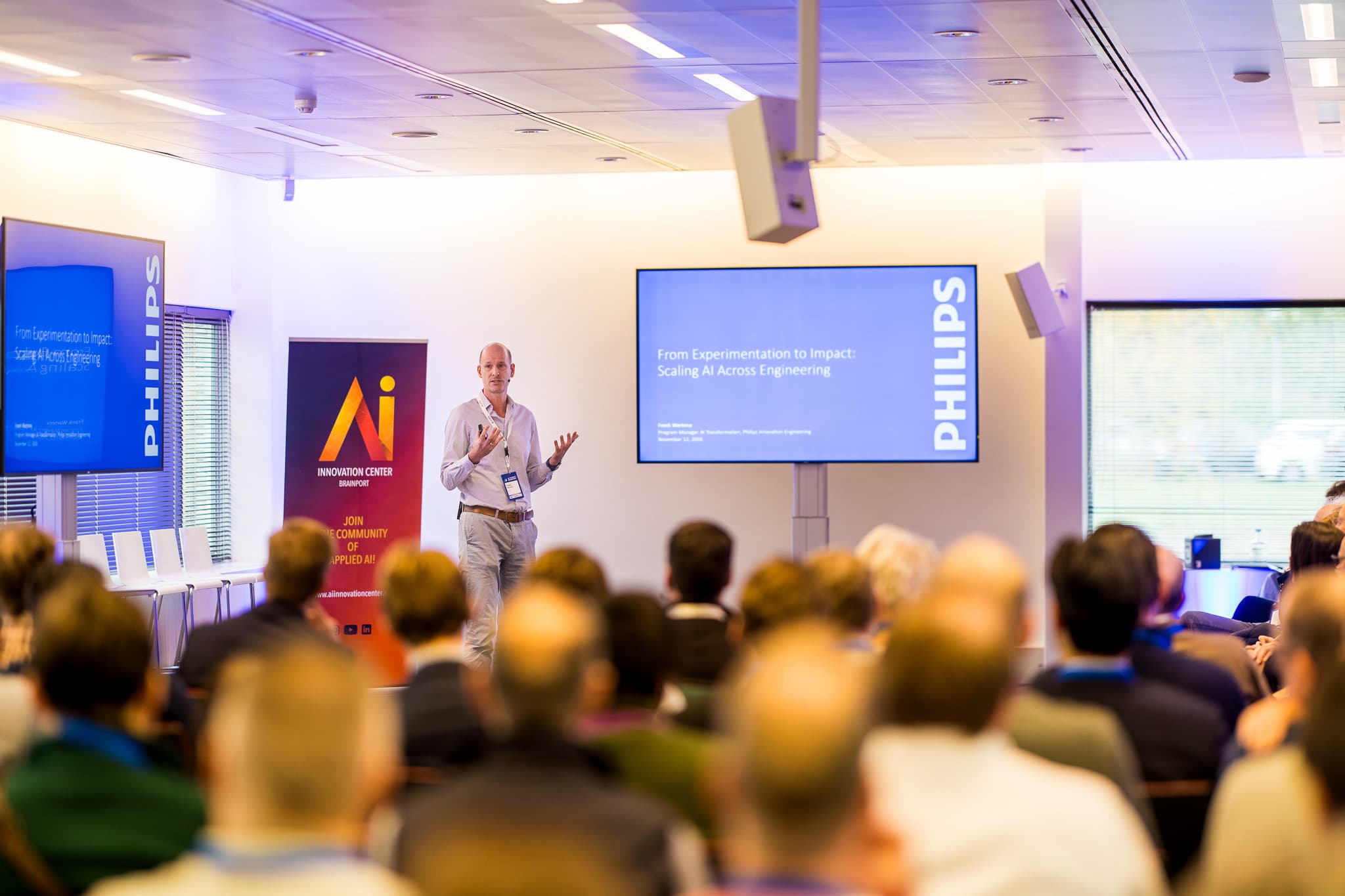
Frank Wartena, Program Manager AI Transformation at Philips, © Twycer
Bart, co-founder of Media52 and Professor of Journalism oversees IO+, events, and Laio. A journalist at heart, he keeps writing as many stories as possible.
Imagine an AI generates a complete engineering design for a medical product. As the engineer responsible for patient safety and product quality, what do you actually need to know before you can say "yes" and move forward?
That fundamental question sits at the heart of the AI transformation at Philips. Speaking at the AI Implementation Track during the AI Summit Brainport in Eindhoven, Frank Wartena, Program Manager for AI Transformation in Innovation Engineering at Philips, pulled back the curtain on how the health-tech giant is moving beyond isolated experiments to scale AI across a workforce of more than 1,300 engineers.
Operating under the motto "People-led, AI-powered," Philips has spent the past 18 months running an internal AI Accelerator. Rather than treating AI as a simple productivity plugin, Wartena argues it must be approached as a strategic capability that forces companies to rethink how hardware, systems, and software are built from the ground up.
The danger of patching old workflows
Many organisations fall into the trap of identifying a slow step in their process and throwing AI at it. According to Wartena, merely accelerating existing steps is a mistake. "If you just patch the parts, you are still creating and keeping the same bottlenecks," Wartena warned the audience. Instead, teams must step back, look at the end-goal and inputs, and redesign entire workflows end-to-end. In that redesigned loop, AI takes over the heavy lifting, exploring options, drafting designs, and executing implementation, while the human engineer stays firmly in control, setting constraints, making critical judgment calls, and verifying outcomes.
Three pillars and 30+ MVPs
Because AI capabilities are evolving every week, traditional change management, where a company maps out a fixed three-year destination, no longer works. To stay agile, Philips built its AI Accelerator around three core pillars:
- Capability building: Upskilling engineers through training programs and hackathons so they can apply AI effectively and responsibly.
- Enablement: Providing safe, enterprise-ready access to tools from partners like Microsoft, OpenAI, and Anthropic, alongside governed product data.
- Workflow redesign: Running dedicated workshops to help teams strip down and rebuild how they work.
Over the last year and a half, this approach has produced more than 30 Minimum Viable Products (MVPs). The most promising ones are now scaling into full production:
- Circularity at scale: Every Philips product requires a recyclability assessment based on its Bill of Materials. Previously, engineers spent hours manually copying and pasting material types and weights in Excel. An internally built AI tool now automates the assessment and actively recommends design changes to make products easier to recycle.
- Smarter requirements: Writing clear, compliant system requirements is notoriously difficult. Philips built an AI assistant that checks requirements against rulebooks and guidelines in real time, speeding up drafting while raising overall quality.
- Goodbye to PDF data entry: When integrating components from external suppliers, engineers used to manually transcribe chip pin layouts from dense PDF datasheets into electronic design systems. AI now extracts that pin data automatically.
Ditching the ivory tower
Perhaps Wartena’s biggest takeaway is organisational: transformation cannot be dictated by a central ivory tower. The AI Accelerator itself is a small central team with a dedicated budget to fund experiments. However, a network of "AI ambassadors" and catalysts embedded directly in engineering departments drives adoption. Because workflows often cross departmental boundaries, true redesign requires stakeholders across the value chain to sit down together and rethink how they hand off work.
For leaders still waiting for the AI landscape to settle down before making their move, Wartena had a simple piece of advice: stop waiting. "There is no point in waiting, because you can wait forever," he concluded. "Start with what is available now, give your teams the room to experiment, and let them own the change."