
OPT/NET uses AI to protect the infrastructure society depends on
At Blue Magic, OPT/NET showed that managing infrastructure becomes incredibly complex: “That makes it a primary target for hostile actors.”
Published on January 10, 2026

Seva Matselyukh, co-founder and business development director of OPT/NET, at Blue Magic Netherlands. © Nadia ten Wolde

Bart, co-founder of Media52 and Professor of Journalism oversees IO+, events, and Laio. A journalist at heart, he keeps writing as many stories as possible.
"At first glance, modern infrastructure looks more robust than ever. Networks are digitized, systems are interconnected, and data flows in real time. But according to Seva Matselyukh, co-founder and business development director of OPT/NET, Critical infrastructure operators are grappling with information overload. “The management and assurance of critical infrastructure has become incredibly complex,” he told the audience at Blue Magic Netherlands. “And that makes it a primary target for hostile actors.”
During his presentation, Matselyukh sketched a picture that felt uncomfortably familiar: power grids under pressure, telecom networks exposed to cyberattacks, drones flying in increasingly complex airspace, and operators forced to make decisions based on fragmented, incomplete information. The result is a growing gap between what systems can do and what humans can realistically oversee.
OPT/NET, a Dutch company developing mission-critical AI platforms, aims to close that gap.
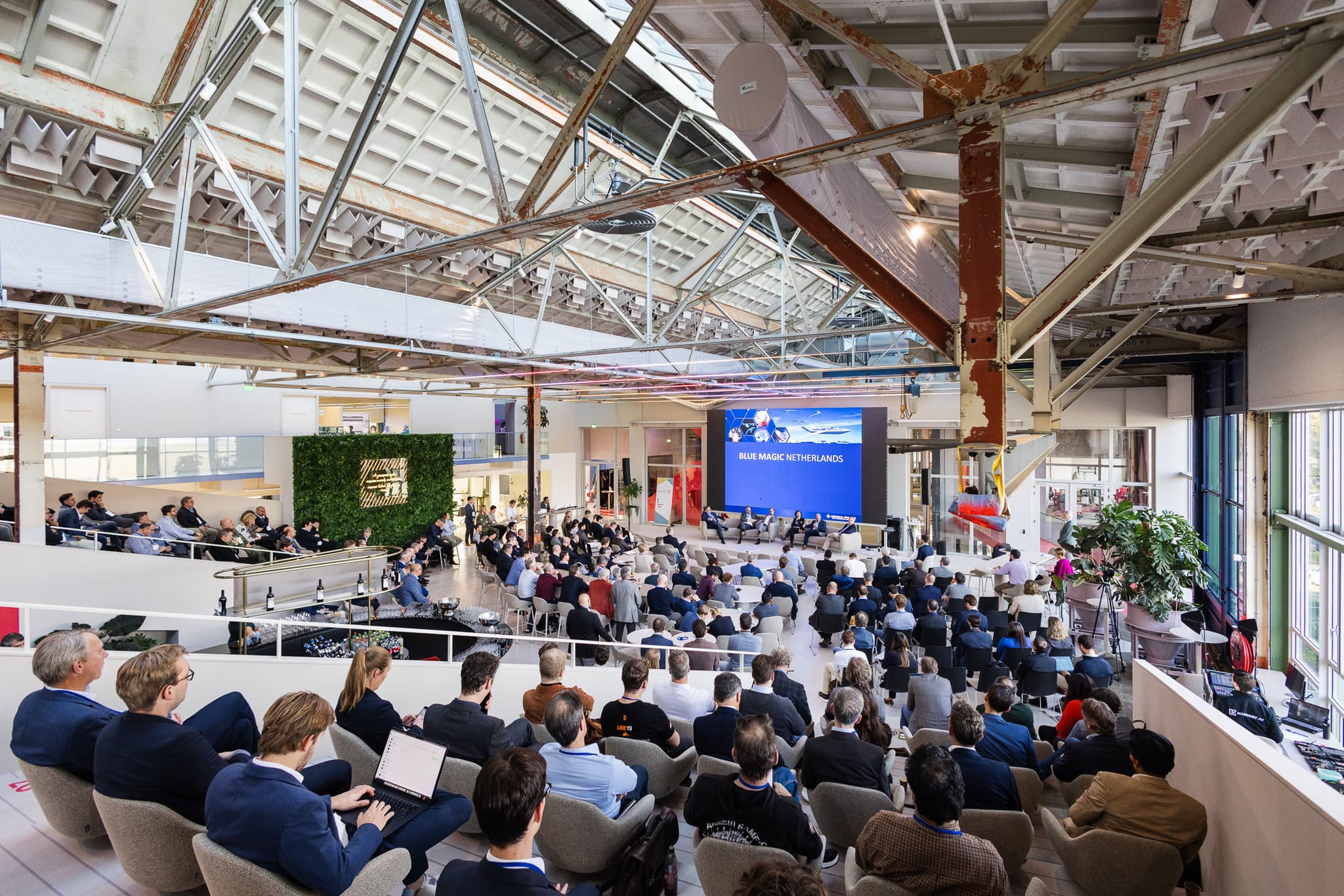
Blue Magic Netherlands
Read all our stories from the Blue Magic Netherlands event here.
A perfect storm for critical infrastructure
Operators of critical infrastructure are facing an unprecedented combination of challenges. According to Matselyukh, threats are multiplying across multiple fronts. “There’s cyber risk, physical sabotage, electronic warfare, and natural hazards,” he explained. “And the impact of a single failure is growing every year.”
At the same time, infrastructure itself is becoming more complex. Energy systems, telecom networks, transportation and defense platforms increasingly depend on vast streams of data flowing between interconnected subsystems. The classic “three Vs” of big data - volume, velocity, variety - now define daily operations.
But human operators still sit at the center of decision-making. “The problem,” Matselyukh said, “is that people are often working with only twenty percent of the full picture.” Data is siloed, systems don’t speak the same language, and cross-domain effects remain invisible. A disturbance in one network can cascade into another before anyone realizes what is happening.
Add to that the pressure of time. Decisions often need to be made in seconds, not hours. And as societies become more dependent on digital infrastructure, the consequences of getting it wrong grow exponentially.
From reactive monitoring to AI-native operations
OPT/NET’s answer to this challenge is an AI-native approach to infrastructure management. Instead of building tools that simply visualize data or trigger predefined alerts, the company focuses on real-time interpretation of complex systems. “What we see today is that operators are overloaded with alerts,” Matselyukh said. “They spend their time collecting information instead of making decisions.”
The company’s core platform, OptOSS AI, is designed to change that. It ingests massive streams of telemetry data (logs, sensor readings, metrics, network signals) and analyzes them in real time. Within seconds, it can identify both known and previously unseen anomalies.
Importantly, it does not rely on static training datasets. “We’re not just repeating patterns we already know,” Matselyukh explained. “The system is designed to detect behavior it has never seen before.”
This is done using a layered approach: unsupervised machine learning, large language models, and domain-specific algorithms working together. The result, he said, is comparable to a real-time CT scan of an infrastructure system. “You suddenly see what’s happening inside; not just that something went wrong, but how and where.”
Seva Matselyukh, co-founder and business development director of OPT/NET, at Blue Magic Netherlands. © Nadia ten Wolde
From data to decisions
Where OptOSS AI focuses on analysis, the second platform, Monitored AI, translates those insights into operational awareness. Monitored AI provides a three-dimensional, map-based visualization layer that turns raw data into a coherent operational picture. It can integrate satellite imagery, sensor data, and system telemetry into what OPT/NET calls a “digital reality” of infrastructure.
The goal is not automation for its own sake, but decision support. “We don’t replace humans,” Matselyukh emphasized. “We support them.”
Operators remain responsible for decisions, while AI highlights anomalies, correlations and risks that would otherwise remain hidden. This human-in-the-loop philosophy is crucial, especially in defense, energy and public safety applications.
From telecoms to drones and dark vessels
OPT/NET’s technology is already being applied in several high-impact domains. One example is telecom infrastructure. By analyzing network telemetry in real time, the platform helps operators detect service degradation, security incidents or cascading failures before customers are affected. The company works with major telecom operators in Europe.
Another application lies in drone operations. In a project developed with partners including CGI and Amazon, OPT/NET provided real-time monitoring of drone swarms. The system tracks position, sensor data and anomalous behavior, enabling operators to oversee complex operations without manually monitoring dozens of data streams.
Perhaps the most striking example came from maritime security. In a project supported by the Dutch police and the European Space Agency, OPT/NET used satellite radar data combined with AIS signals to detect so-called “dark vessels” — ships that deliberately switch off their tracking systems. “When a vessel appears on radar but not in AIS data, that’s a red flag,” Matselyukh said. “Our system can spot that instantly.”
The entire use case, he noted, was built in just one month on top of the existing platform.
Why OPT/NET is different
According to Matselyukh, what sets OPT/NET apart is not just technical performance but also its architectural philosophy. Data does not need to be centralized. Insights can be shared without exposing raw information, which is critical for defense and security environments. AI workloads are tiered so that only essential data is processed with heavy models, keeping systems efficient and scalable.
And while the company is often compared to Palantir, Matselyukh frames the ambition more modestly. “Think of us as a small Dutch Palantir,” he said with a smile. “But one focused on flexibility, efficiency, and real-time decision support.”
Seva Matselyukh, co-founder and business development director of OPT/NET, at Blue Magic Netherlands. © Nadia ten Wolde
A growing role in Europe’s security ecosystem
Founded in 2018, OPT/NET builds on years of research collaboration with leading AI institutes. The company is now expanding its role in European defense and infrastructure programs, including participation in EDF projects such as MARTINA, led by the Dutch Aerospace Centre (NLR).
There, OPT/NET contributes to satellite data processing and visualization for defense and security applications.
At Blue Magic, Matselyukh hinted at further announcements and new industrial partnerships, including collaborations linked to European defense initiatives. “Our systems are built for environments where failure is not an option,” he concluded. “And unfortunately, those environments are becoming more common every day.”
In a world where infrastructure is increasingly digital - and increasingly vulnerable - OPT/NET’s message was clear: resilience will not come from more data, but from a better understanding of it, in time to act.