
Opstand.ai: Authors protest against AI training
Authors demand control and fair compensation for their work used in AI.
Published on September 29, 2026
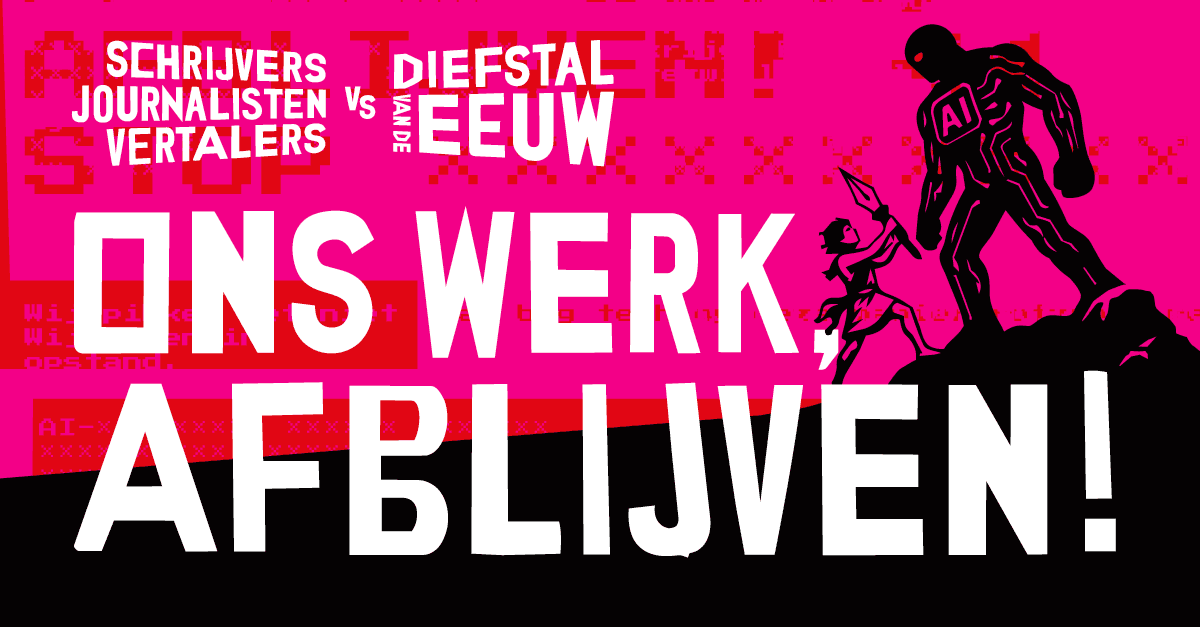
The Dutch Association of Journalists (NVJ), Stichting Lira and the Dutch Authors’ Association (Auteursbond) are protesting today at Meta’s Dutch headquarters in Amsterdam. With the action, which is part of the new Opstand.ai campaign, the organisations want to draw attention to the use of copyrighted texts to train AI models.
“Writers, translators and journalists make a living from their work, from their books,” says Noor van der Heijden, communications adviser at the Auteursbond. “They should have received compensation for the use of their work, and they now have to compete with systems that have been created using their own work.”
Control and compensation
According to the organisations, the current system is not sufficiently equipped to deal with the use of copyrighted material for AI training. “We want authors to have and retain control over what happens to their work,” says Van der Heijden.
According to her, this involves three things: creators must be able to decide whether their work is used for AI training, they must be able to receive compensation for such use, and AI companies must be transparent about which works they use for their models.
Copyright debate
A broader legal question is whether copyrighted works may be used without permission to train AI models. According to Van der Heijden, AI companies invoke, among other things, the exception for Text and Data Mining (TDM). Under certain conditions, this exception permits the automated analysis of texts and data. One requirement is that there must be lawful access to the works being used. Rights holders can also explicitly reserve the right to use their work for TDM.
“It has not yet been established whether, and to what extent, this exception also allows for the training of generative AI models,” says Van der Heijden. “In our case, we also argue that Meta used works from illegal shadow libraries. In our view, there can be no question of lawful access in such circumstances. Ultimately, the court will have to rule on this.”
Collective agreement
According to Van der Heijden, a collective arrangement is necessary because individual writers, journalists and translators find it difficult to negotiate agreements with large technology companies on their own.
With the protest, the organisations want to highlight three demands: transparency, control and fair compensation. According to the organisations, the action marks the start of a broader campaign concerning the way AI companies deal with copyrighted work.