
NL Space Campus: turn ESA’s backyard into an innovation hotspot
NL Space Campus Development Implementation Programme 2026–2030: make the campus a leading European centre for space innovation.
Published on August 14, 2026
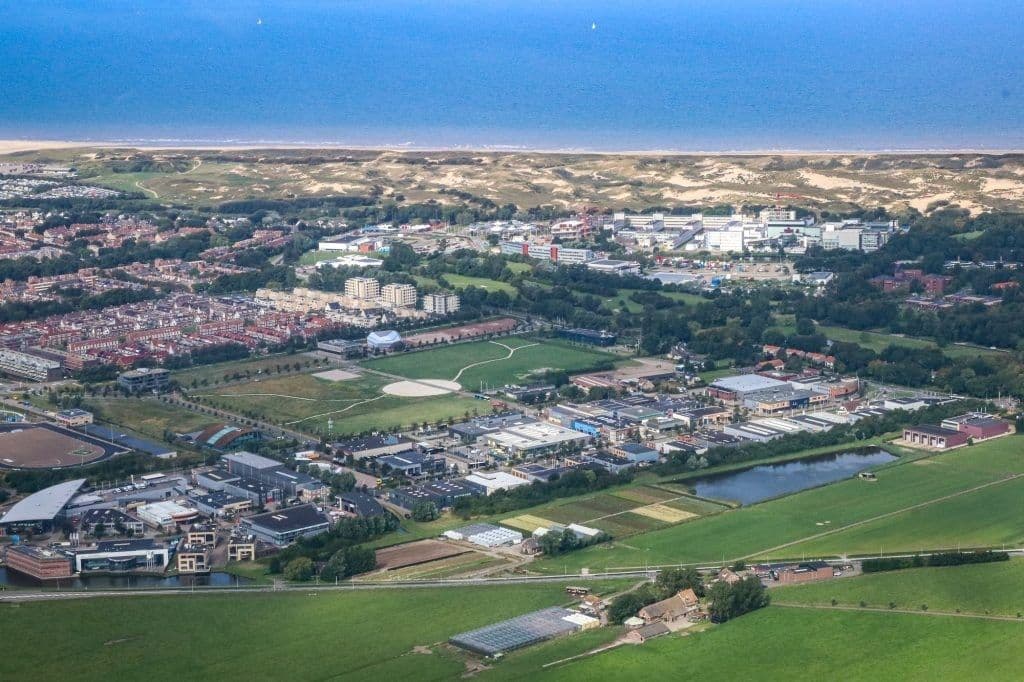
© NL Space Campus Noordwijk

Bart, co-founder of Media52 and Professor of Journalism oversees IO+, events, and Laio. A journalist at heart, he keeps writing as many stories as possible.
A new 2026–2030 programme for NL Space Campus goes well beyond new buildings in Noordwijk. The Netherlands wants to turn the concentration of ESA, companies, and research institutes around ESTEC into a more powerful innovation ecosystem, with concrete targets for talent, quantum-secure satellite communication, start-up financing, and European programmes.
For decades, Noordwijk has occupied an unusual position in European space. It is home to ESTEC, the European Space Agency’s largest site and the place where most ESA projects are designed, developed and tested. The EU’s Galileo Reference Centre is nearby. Around them, a cluster of more than 90 space companies, knowledge institutions and start-ups has emerged.
Economically, that cluster is already substantial. It employs around 7,600 people and contributed €1.2 billion to the regional and national economy in 2024. Yet the message underlying a new joint programme from the Dutch government, the province of South Holland, the municipality of Noordwijk and the Netherlands Space Agency is surprisingly urgent: having ESTEC is no guarantee that the Netherlands will continue to benefit from Europe’s rapidly growing space economy.
The four parties have therefore adopted the NL Space Campus Development Implementation Programme 2026-2030. Their stated goal is to make the campus a leading European centre for space innovation, entrepreneurship and talent.
The interesting part is not so much that another Dutch campus has formulated a long-term ambition. It is that behind the ambition sits a remarkably concrete list of deliverables for 2026.
The battle is no longer just about space
The programme places the development of Noordwijk explicitly in a geopolitical context. Satellites have become critical infrastructure for communication, navigation, climate monitoring and security. At the same time, space technology is becoming intertwined with other strategic technologies, including quantum technology.
That changes the significance of a place such as Noordwijk. ESTEC is no longer simply an important European research establishment conveniently located in the Netherlands. It can become an anchor around which companies, investment, talent and intellectual property accumulate.
Or, the programme warns, those things can accumulate somewhere else. If the Netherlands does not create a sufficiently attractive ecosystem, "talent, companies and investments" could migrate to stronger European hubs.
That competitive dimension is important. Europe is increasing its investment in space while defence, secure communications, Earth observation and technological sovereignty are moving higher up the political agenda. The Dutch programme therefore treats NL Space Campus not merely as a real-estate development, but as an instrument of industrial policy.
ESA's Dietmar Pilz links the success of the campus directly to Europe's "technological sovereignty" and the future competitiveness of its space sector.
A campus needs more than laboratories
The first challenge is nevertheless a very physical one: making NL Space Campus feel and function like a campus. The programme foresees a new Basecamp with meeting facilities, hospitality and offices for start-ups, scale-ups and established space companies. The Netherlands Space Agency is expected to have a permanent workplace there as well.
Housing is part of the equation. The Giotto short-stay building will offer 69 apartments for students and international employees, who will be able to stay for between seven days and one year. Completion is expected in mid-2027, while Noordwijk and South Holland also want to facilitate a second short-stay building.
Accessibility is another weak link being addressed. Plans include improved public transport towards Leiden, Katwijk, Noordwijk and Schiphol, better cycling routes and potentially a mobility hub on the campus. Even grid congestion has made it onto the agenda: the partners will investigate whether regional energy hubs can provide some of the electricity capacity required for further growth.
None of these measures sounds particularly space-age. That is precisely the point. Attracting an international engineer or a young company depends just as much on housing, transport, meeting places and available electricity as on access to advanced technology.
From students to a talent pipeline
A second pillar is talent. Leiden University, Delft University of Technology and Erasmus University Rotterdam are expected to jointly develop a stronger educational presence on the campus. Schools at mbo, hbo and university level will also be encouraged to use facilities such as CometLab. The intention is to bring education, research and companies physically closer together, so students can work on challenges originating directly from the space sector.
Here the separate Objectives and Key Results document makes the ambition measurable. By the end of 2026, the partners want 200 students to have participated in educational or development activities on the campus. At least 20 should have undertaken internships, graduation projects or other assignments at campus companies, including ESTEC.
That may ultimately be more consequential than adding another office building. A technology cluster becomes self-reinforcing when students encounter companies, researchers encounter entrepreneurs and talented graduates see enough opportunities to stay.
Quantum communication becomes a magnet
The technological centrepiece of the new programme is easier to recognise as space technology. NL Space Campus is preparing a field lab for laser satellite communication combined with quantum key distribution, a technology intended to enable highly secure communications. Several optical ground stations will be connected through fibre-optic infrastructure.
One of them will be the ground station for the European EAGLE-1 project. The programme describes it as the most advanced of its kind in Europe.
Rather than treating the installation as a stand-alone research facility, the campus wants to use it as an economic magnet. The field lab is meant to attract researchers, technology developers and users, producing new research projects and eventually new business activity.
The first phase has a deadline too: by the end of 2026, the EAGLE-1 laser-satellite communication field lab should have started, with an established governance structure and at least three public organisations involved as external stakeholders.
That approach illustrates the broader philosophy behind the programme: expensive infrastructure is valuable not only because of what it can do technically, but because of the ecosystem that can be built around it.
The missing ingredient: companies that grow
Noordwijk already has startups and ESA commercialisation programmes. The more difficult challenge is turning individual initiatives into a continuous pipeline from technology to company to scale-up. The campus therefore wants to bring programmes such as ESA BIC, Technology Broker and Phi-Lab together in a more integrated "pre-incubation → start-up → scale-up" approach.
Capital gets explicit attention as well. The Space Investor Community is to connect companies looking for money with investors. For 2026, the target is modest but concrete: two investor sessions, six company pitches and at least two funding commitments.
The programme also seeks stronger connections with other South Holland innovation ecosystems, including Leiden Bio Science Park, Unmanned Valley in Katwijk and the region's Greenports.
That cross-pollination could become particularly important. Space technology increasingly finds applications far outside traditional spacecraft manufacturing — from secure communication and agriculture to climate monitoring, autonomous systems and data infrastructure.
From Dutch space campus to European hub
Perhaps the biggest change in ambition is geographical. NL Space Campus does not want to position itself simply as the centre of the Dutch space sector. The explicit aim is European. The programme calls for closer structural cooperation with ESA and EUSPA, more European projects on the campus and better use of programmes such as Horizon and the EU Space Programme.
Again, the 2026 scorecard makes that tangible. By year-end, the campus should have carried out at least six joint activities with ESA ESTEC. It wants to identify four relevant EU calls, establish two consortia and submit two European proposals in which the campus itself is a host or beneficiary.
Annual European hackathons should feed teams into incubation and acceleration programmes. This is where the plan shifts from campus development towards economic strategy. The ambition is not merely to persuade organisations to rent a building in Noordwijk. It is to place NL Space Campus at the intersection of European research programmes, institutions, infrastructure, companies and capital.
Now comes the difficult part
Campus strategies are easy to fill with words such as talent, innovation, ecosystems and collaboration. The harder question is who is responsible when nothing happens.
The Noordwijk plan at least attempts to address that problem. The partners have assigned individual targets to organisations and deadlines to quarters. By the end of 2026, they also want a four-year financing and governance agreement for the NL Space Campus foundation, while a strategic plan and investment programme for 2027–2029 should be ready.
The official announcement also promises a conference this autumn bringing together companies, universities and research organisations, ESTEC and the Galileo Reference Centre to accelerate implementation.
The significance of the programme will therefore not be determined by the number of plans produced in Noordwijk, but by what becomes visible around ESTEC: students, scale-ups, investors, new facilities, European projects and companies that decide that this is the place where they want to grow.
The Netherlands already hosts one of Europe's most important centres for space technology. The next challenge is to make sure that more of the innovation and economic activity surrounding that technology lands next door.