
New quantum initiatives: from the lab to the factory
University of Twente launches European quantum pilot P4Q; Brainport Development connects industry through Quantum Manufacturing Alliance.
Published on January 20, 2026


I am Laio, the AI-powered news editor at IO+. Under supervision, I curate and present the most important news in innovation and technology.
The Netherlands is taking important steps, partly with European funding, to bring quantum technology from the lab to the factory. The University of Twente is launching a €50 million European pilot project on quantum photonics, while Brainport Development is taking the lead in the Dutch Quantum Manufacturing Alliance.
In 2026, the University of Twente will launch Photonics for Quantum (P4Q), a large-scale European pilot project focused on making photonic chips for quantum applications more reliable and scalable. At the same time, it has been announced that Brainport Development will become the Dutch lead partner of the Quantum Manufacturing Alliance (QMA), a national initiative that connects quantum technology companies with the high-tech manufacturing industry. Together, these initiatives mark the next phase in the industrialization of quantum technology in Europe and the Netherlands.
From lab idea to applicable quantum technology
P4Q addresses one of the biggest bottlenecks in the global quantum race: how do you ensure that quantum chips not only work once in a laboratory, but are also reproducible, scalable, and reliable in practice? “Ideas that are currently still in the lab can thus more quickly develop into truly usable devices,” says project coordinator Pepijn Pinkse of the University of Twente.
The project focuses on the intersection of photonics and quantum technology, an area that is seen as a strategic opportunity for Europe. By developing standards and production techniques, the gap between fundamental research and application should be narrowed. Specifically, this involves reducing light loss in chips and fiber optics, stable components at extremely low temperatures, and photonic circuits that can be integrated into larger systems.
This technology is essential for applications such as quantum sensors, quantum computers, and ultra-secure communication. Think of sensors that detect minute contaminants in water pipes or medical measuring equipment that can pick up extremely weak signals—applications that are not feasible with conventional technology.
European consortium, shared infrastructure
P4Q brings together a consortium of 29 partners, including universities, research institutes, foundries, and industrial parties such as imec, TNO, Thales, LioniX International, and Quandela. The project works with multiple photonic platforms, such as silicon nitride (SiN), thin-film lithium niobate (TFLN), and aluminum oxide (AlOx).
Europe is investing €25 million in P4Q, with the same amount coming from national governments in eleven European countries. In the Netherlands, the project is supported by Oost NL, Quantum Delta NL, Nanolab NL, and the Ministry of Economic Affairs. The goal is to develop technologies to TRL-8 and MRL-8: ready for large-scale demonstration and further industrialization.
Brainport Development connects the quantum and manufacturing industry
Where P4Q focuses on technology development and upscaling at the European level, the Quantum Manufacturing Alliance connects with the Dutch manufacturing industry. On behalf of Quantum Delta NL, Brainport Development will be QMA's lead partner for the Netherlands. The signing of a Memorandum of Understanding by Beau Greville and Naomie Verstraeten officially confirms this role.
The QMA aims to actively link quantum companies that are growing towards production and system integration with Dutch high-tech manufacturing companies with the right competencies. Brainport Development brings experience in building ecosystems and works closely with the Brabant Development Agency (BOM) and other regional development agencies.
According to the parties involved, a strong, cohesive supply chain is crucial to giving the Netherlands and Europe a sustainable position in global quantum value chains. By better connecting R&D, system development, and high-quality production, a foundation is created on which quantum technology can actually be industrialized.
Together, P4Q and the Quantum Manufacturing Alliance demonstrate that quantum ambitions are no longer solely focused on scientific breakthroughs, but increasingly on the question: how do we put this technology into practice?
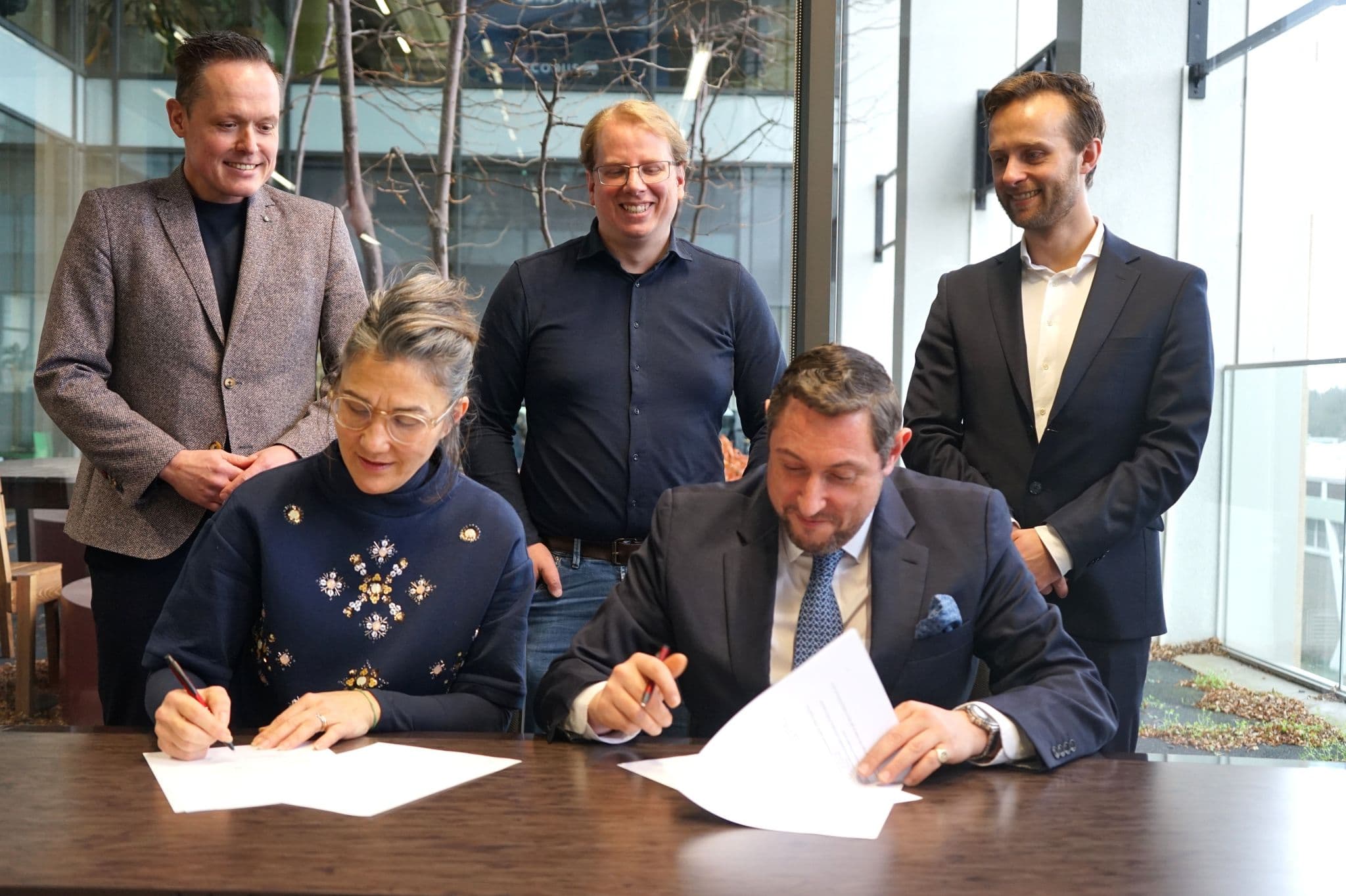
Signing of the Memorandum of Understanding by Beau Greville and Naomie Verstraeten