

Team IO+ selects and features the most important news stories on innovation and technology, carefully curated by our editors.
With the launch of Neuromorphic Computing NL (NC-NL), the Netherlands is taking an important step toward the next generation of intelligent and energy-efficient technology. In a new national coalition, knowledge institutes, industry, and government are joining forces to ensure that the Netherlands remains an international leader in neuromorphic computing.
Why neuromorphic computing is needed
Neuromorphic computing is one of the promising key technologies of Digital Holland (formerly Topsector ICT) and is considered a major engine for innovation and economic growth in the Netherlands.
The rapid growth of AI applications, data centers and automated systems is driving an explosive increase in global energy consumption. Traditional computer architectures are increasingly reaching their limits. Neuromorphic computing— inspired by the functioning of the human brain—offers a fundamentally different approach: extremely fast data processing with energy consumption that can be 10 to potentially even 1,000 times lower than that of current-generation systems.
This technology enables new applications such as intelligent edge systems: smart devices that process data locally and can respond instantly without relying on centralized data centers. Examples include smart sensors, medical devices, autonomous vehicles and automated industrial environments.
Reducing energy consumption
Such developments could significantly reduce the energy demand of digital infrastructure. Data centers in particular are major energy consumers, especially due to the rise of AI applications.
In the Netherlands, data centers used approximately 5,100 GWh of electricity in 2024, accounting for about 4.6% of the country’s total electricity consumption. That is roughly equivalent to the annual electricity use of almost two million households.
“Neuromorphic computing is many times more energy-efficient and sustainable. In addition, this key technology strengthens privacy, because sensitive data no longer needs to be sent to external servers,” says Frits Grotenhuis, director of Digital Holland. He believes neuromorphic technologies will trigger a new revolution in the digital world. “The potential applications are enormous, ranging from precision agriculture and smart energy grids to sustainable healthcare and beyond.”
Strong starting position
The Netherlands already has a strong position in semiconductors, artificial intelligence and materials research. At the same time, a growing ecosystem of international frontrunners and startups is emerging in the field of neuromorphic computing.
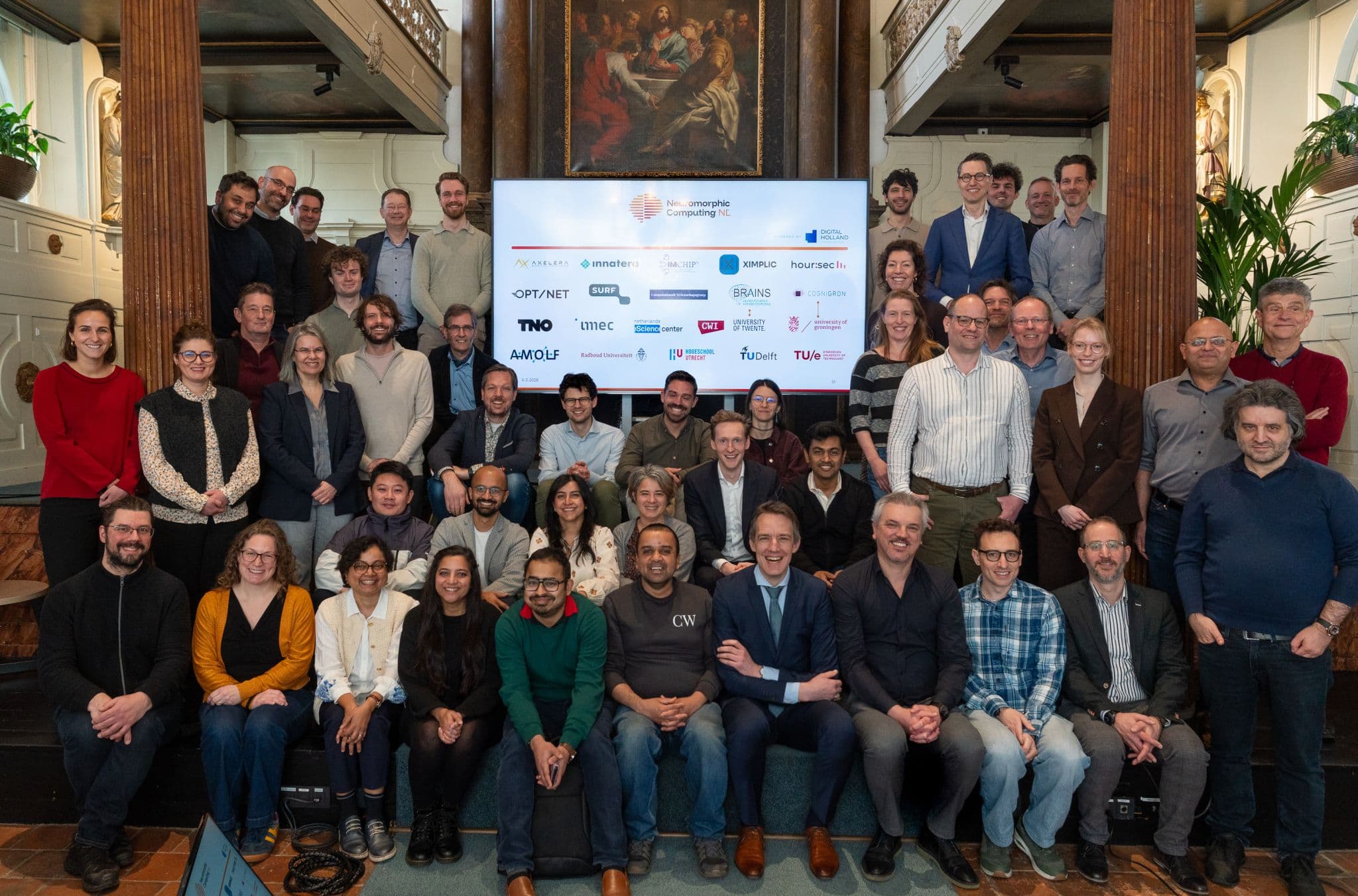
Together with leading partners from industry, academia and government, Digital Holland is now launching a new coalition: Neuromorphic Computing NL (NC-NL).
Participants include the University of Groningen, Radboud University, TU Delft, TU Eindhoven and the University of Twente, alongside organizations such as SURF, TNO, imec, the Centrum Wiskunde & Informatica, and companies including Axelera AI, Innatera, Hoursec and IMChip.
Johan Mentink, figurehead of the Dutch neuromorphic computing ecosystem, calls the launch an important step forward. “The launch of NC-NL marks a new milestone for neuromorphic computing in the Netherlands. By structurally joining forces, we create a unique position on the global digital stage.”
What this means for the Netherlands
According to the organizers, strengthening the Netherlands’ leading position in neuromorphic computing goes beyond technological progress. The initiative is expected to reinforce digital sovereignty, economic competitiveness, sustainability of AI systems, privacy and security, and overall innovation capacity.
The coalition’s Action Plan for Neuromorphic Computing focuses on three interconnected lines of action:
Ecosystem development: NC-NL brings companies, knowledge institutions and government together in a national coalition. The partners will jointly develop a technological roadmap, coordinate programs and attract public and private investments at both national and international levels.
Market-driven application lab: To accelerate the transition from technology to market, the coalition proposes an application lab where companies and research institutions can test and validate neuromorphic technologies. With access to hardware, benchmarks, tools and expertise, experimentation becomes easier and focused on concrete competitive advantages and societal impact.
Development and testing facility for new technologies: A shared prototyping infrastructure will make it possible to translate scientific breakthroughs into new devices, circuits and hardware architectures. Hybrid systems that combine neuromorphic computing with photonics and quantum technologies will also be explored.
€50 million investment needed
Through NC-NL, the partners aim to build a national ecosystem that structurally connects research, development and market applications.
To implement the Action Plan, the coalition estimates that an additional €50 million investment over the next five years will be required, on top of existing funding.
According to the partners, this investment would allow the Netherlands to capitalize on its international lead and contribute to shaping the future of computing.