
New chip brings powerful AI right to your device
A new EU-developed chip runs AI locally on devices like phones and laptops, cutting energy use and reliance on data centers.
Published on September 10, 2026
© Bart van Overbeeke

Team IO+ selects and features the most important news stories on innovation and technology, carefully curated by our editors.
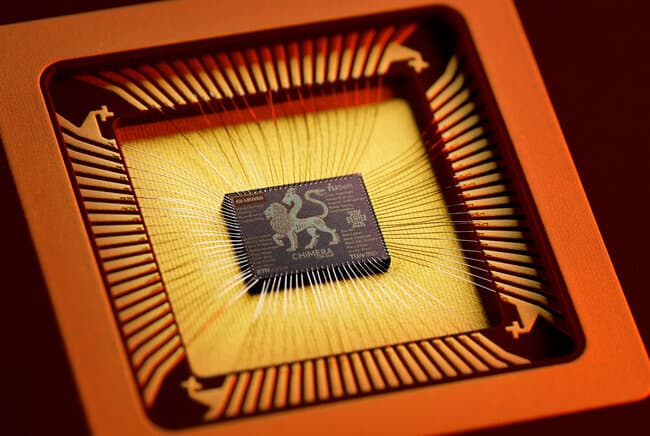
Dutch researchers at Eindhoven University of Technology (TU/e) have developed a new type of computer chip designed to run powerful AI calculations directly on everyday devices like laptops and smartphones, rather than relying on distant data centers. The chip, part of a European project called CONVOLVE, will be presented this month at the ESSERC conference in Spain to an audience that includes major industry players.
What is edge AI?
Most AI tools people use today, such as chatbots, work by sending a request over the internet to a massive data center, where powerful — and energy-hungry — computers process the request and send back an answer. "Edge AI" flips this model: instead of the calculation happening far away in the cloud, it happens locally, on the device itself, at the "edge" of the network, closer to the user.
Manil Dev Gomony, the project's lead researcher, explains that this means a user asking AI a question can run the model locally on their own device instead of sending the command to a remote data center and waiting for an answer to come back. The appeal is twofold: faster responses, since there's no round trip to a distant server, and lower energy use, since the device isn't relying on the enormous, power-hungry computing farms that run today's biggest AI models.
Why it matters now
The explosive growth of generative AI use in 2026 has placed enormous strain on the powerful chips housed in large data centers, driving up energy consumption and fueling the construction of massive data centers that consume huge amounts of water and take a toll on the environment. Gomony notes that data centers also require their own cooling systems and put pressure on local communities, while being far too large and power-intensive to fit inside a laptop, smart-home device, or smartphone.
The researchers also point to the growing number of smart devices in homes — solar panels, electric vehicles, heat pumps, and home energy storage — that need to make quick decisions based on factors like grid congestion and energy prices, all of which require fast, efficient local computing power.
A new way of designing chips
Rather than developing the AI algorithm, processor architecture, memory system, and circuits separately, the CONVOLVE team used what they call a "cross-layer design approach," optimizing all these layers together from the start. This allowed the team to balance competing priorities — accuracy, processing speed, chip size, and energy use — early in the design process, rather than trying to reconcile them afterward.
The resulting chip combines programmable RISC-V processors with specialized AI accelerators, including memory-centric and neuromorphic computing techniques, aimed at reducing how much data has to move between memory and processing units — a major source of energy consumption in AI hardware. Rather than relying on simulations, the team tested physically fabricated prototype chips under realistic AI workloads, measuring energy efficiency, throughput, latency, chip size, and accuracy against existing designs.
A European alternative
The project, which involves research partners in Leuven, Delft, and Zürich alongside various industry collaborators, is being framed as a European answer to computing power currently dominated by companies outside the continent. Gomony argues that Europe needs an affordable, green, well-designed alternative, and believes the CONVOLVE chip technology can contribute to the continent's competitiveness in smart edge-computing processors.
The team's results will be presented at ESSERC by PhD researcher Rick Luiken, one of several TU/e scientists — alongside Henk Corporaal, Sander Stuijk, Bas Ahn, and Marc Geilen — who contributed to the project since it began in 2022.