
Monumental raises $32M for robots that lay bricks
Monumental's autonomous robots are already building homes in Europe. A new $32M round aims to take that global.
Published on July 16, 2026
© Monumental

Team IO+ selects and features the most important news stories on innovation and technology, carefully curated by our editors.
Construction has a labor problem, and Monumental thinks robots are the fix. The Amsterdam startup, which builds autonomous bricklaying machines, has raised $32 million in a round led by Khosla Ventures to expand its robot fleet across Europe and push into the US.
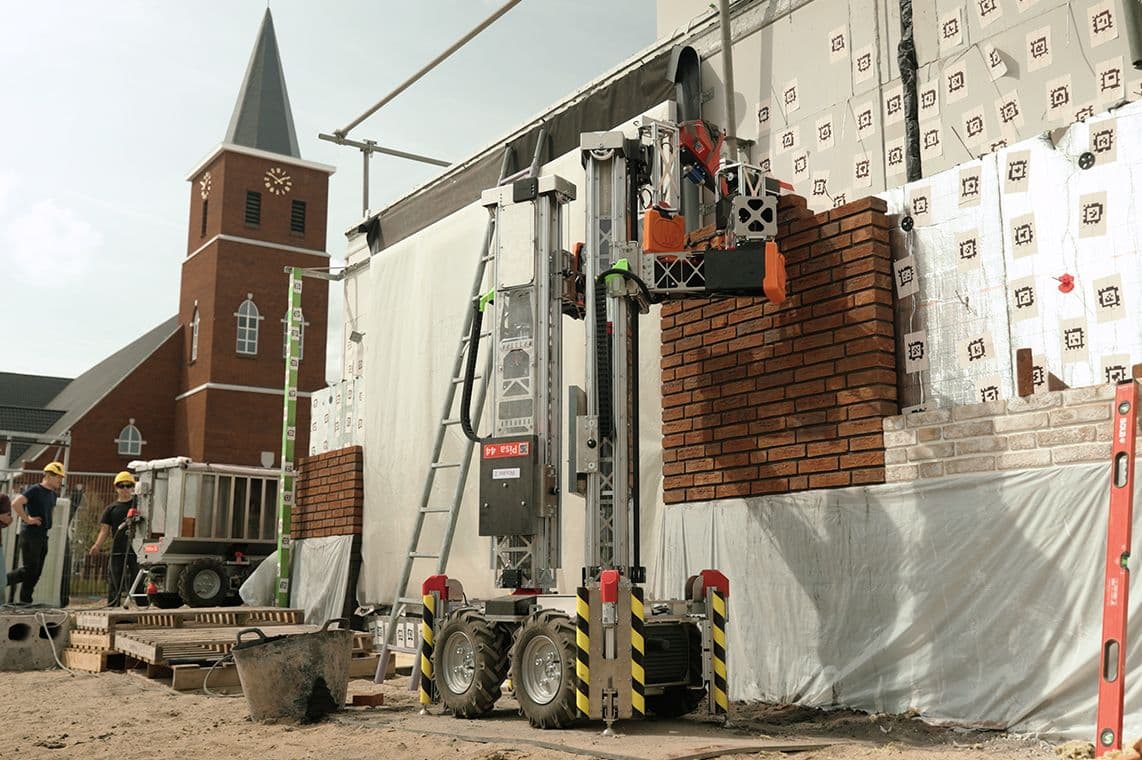
Founded by Salar al Khafaji and Sebastiaan Visser, Monumental builds autonomous bricklaying robots powered by its proprietary AI platform, Atrium. The electric robots pair advanced sensors, computer vision, and robotic cranes to lay bricks and mortar with millimeter-level precision, effectively functioning as autonomous subcontractors on active building sites.
.png&w=2048&q=75)
The robots that lay bricks
The core of Monumental's technology is Atrium, a software system the company describes as the connective layer between the digital and physical sides of construction. Atrium starts with design: an integrated architectural tool lets Monumental draw building facades in detail, pre-compute the exact position of every brick and mortar joint based on an architect's constraints, and then break the design into build-ready segments.
Before construction begins, the site is scanned to create a full 3D reconstruction, which is aligned with the building model and referenced to real-world features such as door frames and window openings. That process catches millimeter-scale discrepancies between blueprint and reality before a single brick is laid, producing what the company calls a precisely aligned digital twin of the site.
Once aligned, Atrium takes over execution: robots use onboard cameras to localize themselves relative to the digital twin, while a central planner interprets sensor data in real time to guide each machine, brick by brick, course by course — with multiple robots able to coordinate on larger builds.
Because the robots are designed to be scalable and cost-effective rather than built from precision-machined parts, Atrium also handles calibration — aligning each robot's cameras, sensors, and kinematics at Monumental's Amsterdam workshop using motion-tracking cameras before every deployment. Every action a robot takes on-site is logged, giving the company a continuous stream of telemetry, video, and quality data it uses to catch errors, monitor performance, and refine the fleet over time.
How Monumental sets itself apart
What sets Monumental apart from many robotics startups is its business model. Rather than selling hardware outright, the company operates on an outcome-based service model: contractors pay for completed walls rather than purchasing or operating the robots themselves. That approach is designed to remove the upfront cost and operational complexity that typically slow robotics adoption in construction, allowing builders to scale capacity without expanding their headcount.
The company says the model is already gaining traction. Monumental currently runs a fleet of more than 150 robots deployed across construction sites in the Netherlands and the UK. To date, its machines have contributed to the construction of more than 100 homes, along with a school, a community center, a hotel, and canal walls. Notably, nearly half of those homes were completed in the past three months, indicating a sharp acceleration in deployment pace.
Giving the construction industry the capacity to build
CEO and co-founder Salar al Khafaji framed the raise as a response to a structural problem facing the building industry: a shortfall of skilled labor that traditional hiring cannot solve. "Every robot we deploy expands the industry’s capacity to build. Khosla’s investment lets us put many more of them to work, in more countries, and beyond bricklaying," he stated.
Monumental has already been building out its UK presence, having appointed a dedicated country manager and expanded its local team there. The new capital will fuel the next phase of that growth. According to the company, proceeds will go toward hiring additional hardware and software engineers, expanding the robotic fleet's deployment across Europe and the UK, deepening its operations in the UK, broadening the range of construction tasks its robots can handle, and laying the groundwork for its first pilot projects in the United States.
"Construction costs have exploded while the industry itself has barely changed in decades. That combination has produced the housing crisis: we know how to build, we've just made it too expensive and too slow. Monumental is solving this by bringing robotics into the physical world, and the proof is already standing: canal walls, houses, a school, nearly 100 structures already built by robots. Beautiful buildings, built at scale, don't have to cost what they cost today," commented Vinod Khosla, founder of Khosla Ventures.