
Mistral CEO on company’s new direction: AI enters physical world
According to Arthur Mensch, CEO of Mistral AI, it won’t be long before the physical world becomes the playground of AI.
Published on June 1, 2026
Our DATA+ expert and Editor-in-Chief, Elcke Vels, explores AI, cyber security, and Dutch innovation. Her "What if..." column imagines bold scenarios beyond the norm.
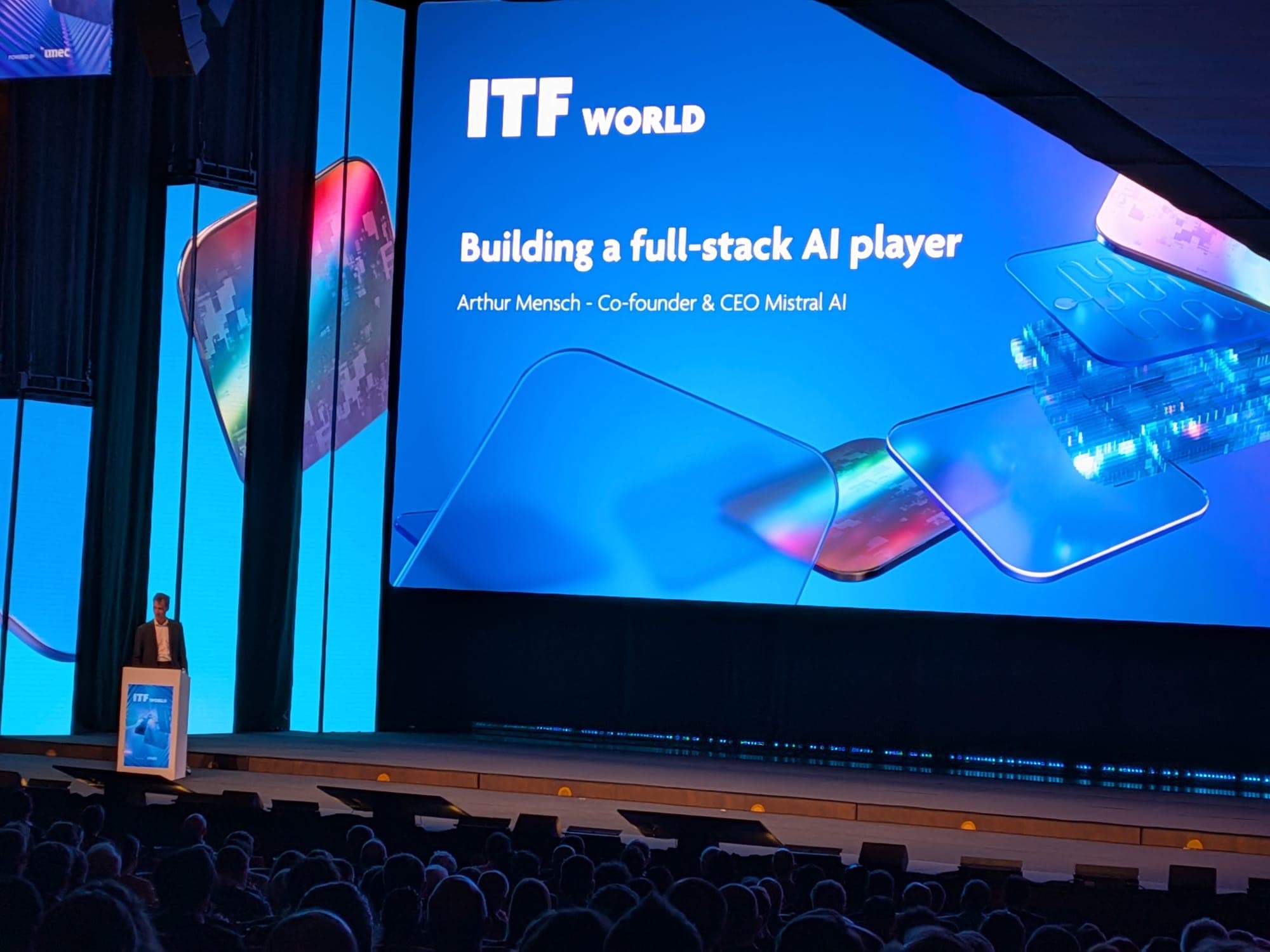
In recent years, AI has primarily made a name for itself as a language engine: systems that write text, generate code, and “carry on conversations.” But according to Arthur Mensch, CEO of Mistral AI, it won’t be long before the physical world becomes AI’s playground. At imec’s ITF World 2026, he outlined a clear path forward: Mistral wants to move away from large language models and instead shift toward systems that control the real world.
AI in software development works relatively smoothly. Generating, executing, testing, and adjusting code—the process is full of rapid feedback loops. “You essentially have an extremely efficient testing system,” said Mensch during his keynote. Every few minutes, the system checks whether the code works, allowing models to improve at lightning speed. That cycle also explains why AI is making such rapid progress in that area.
But as soon as AI makes the leap to the physical world, everything changes. Because there is no such thing as a rapid feedback loop there. In sectors like chemical engineering, chip manufacturing, or microscopy, the processes are slow, complex, and dependent on the real world. “You have to wait for results, interpret measurements, and repeat experiments. This fundamentally slows down the feedback loop.”
According to Mensch, the true value of AI lies precisely in the physical world. As soon as AI helps engineers work faster, predict maintenance needs, and design more complex systems more efficiently, its impact will surpass that of the purely digital world. This is already happening on a small scale, but it will accelerate significantly in the coming years.
A new direction for Mistral
It’s no surprise, then, that Mistral’s CEO is talking about the new direction the company intends to take. While it once started with pure large language models, Mistral is now also developing platforms that enable AI to be used for complex physical systems. In addition, Mistral has acquired several companies that specialize in translating simulations into more realistic and efficient models. “We have acquired companies active in this field that know how to convert simulations into processes that run a hundred times cheaper while being much more accurate, because they use real data.”
For example, Mistral AI recently acquired the Austrian company Emmi AI. This startup specializes in physical simulations. With this acquisition, Mistral AI aims to enable agents to use existing engineering tools. The acquisition strengthens Mistral AI’s position in industrial AI, and the company aims to become a key partner for manufacturers in sectors where precision and reliability are crucial, such as aviation, the automotive industry, and the semiconductor sector.
Moreover, Mistral has more in the works. The company is exploring the possibility of developing its own chips in the future. According to CEO Arthur Mensch, this should help further reduce the costs of AI models and decrease dependence on parties like Nvidia. At the same time, it should position the French AI player more strongly against competitors such as OpenAI and Anthropic. “We aren’t designing chips yet, but that’s something we will eventually do,” said Mensch.
Mistral’s ultimate goal is clear: AI is no longer just a tool for digital tasks, but a layer that is penetrating ever deeper into industrial processes.