
MedTech sector presents national ten-year growth plan
Technology must support Dutch healthcare and structurally strengthen economic growth.
Published on December 19, 2025

Team IO+ selects and features the most important news stories on innovation and technology, carefully curated by our editors.
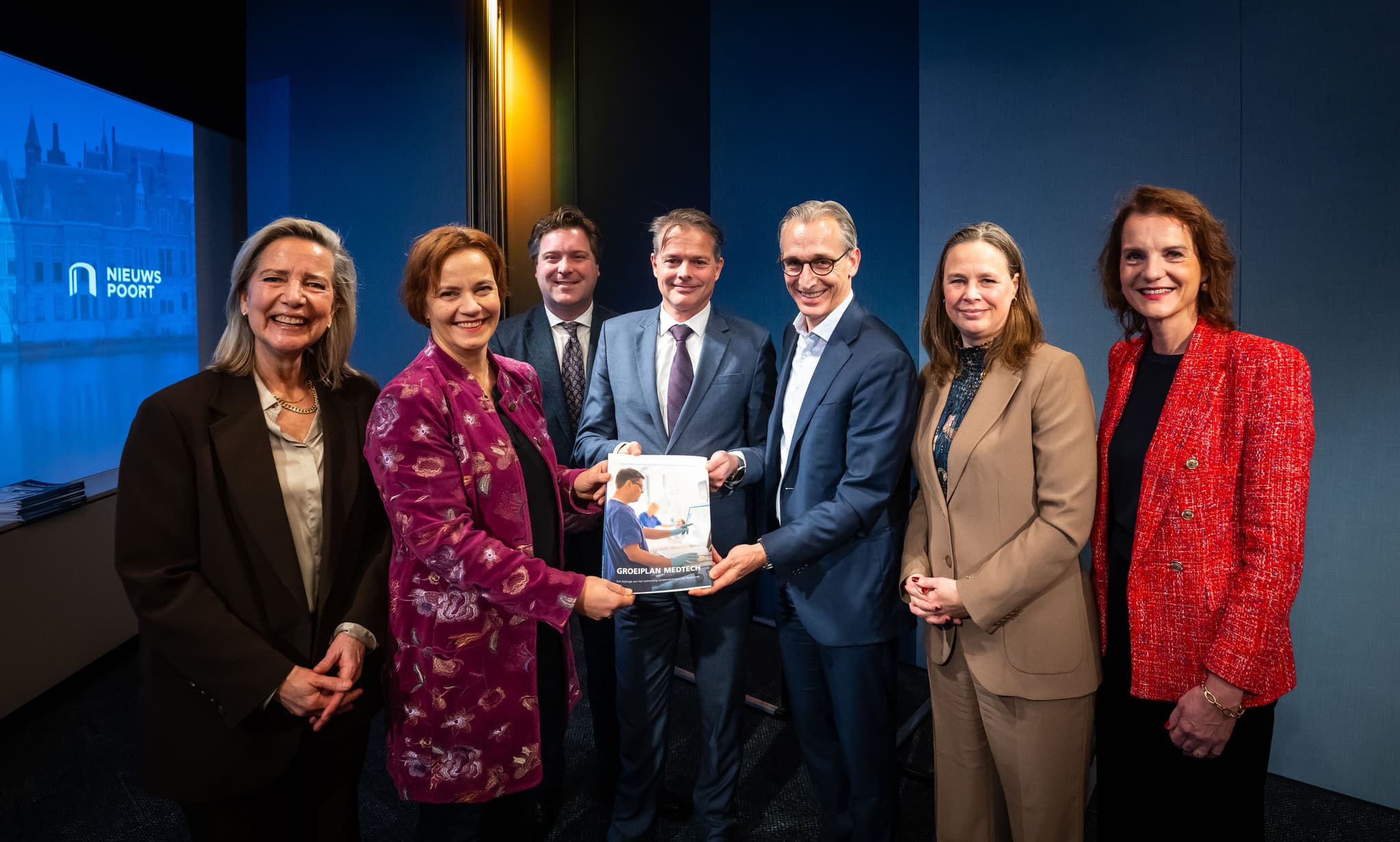
This week, the Dutch MedTech sector unveiled an ambitious growth plan to position the Netherlands at the top of Europe by 2035. The plan, presented to State Secretary Judith Tielen (VWS) and Tjerk Opmeer (EZ), shows how technology can structurally strengthen both healthcare and the economy. Through its “MedTech Growth Plan – Accelerate the Netherlands to the top of the medical technology sector (PDF),” the sector contributed to the Wennink report, presented last week, with a view to creating a future-proof and innovative Netherlands.
If the preconditions of the MedTech Growth Plan are met, the sector can make a major social and economic impact over the next ten years by:
- Creating 11,000 new jobs in high-quality engineering, R&D, and production.
- Generating approximately €5 billion in additional export value per year.
- Creating 75 new start-ups and scale-ups.
- Developing a healthcare system that can meet future healthcare demands.
"Investing in medical technology addresses two strategic interests of the Netherlands at the same time: first, a future-proof healthcare system and, second, a resilient, innovative economy. By making the right choices, creating the right conditions, and implementing stable policies, we can become one of the strongest MedTech ecosystems in Europe and the world. If we fail to seize this opportunity, we will lose a unique chance to provide better care for more people in the Netherlands and the rest of the world and to further develop our economy. The MedTech growth plan reflects the shared ambition of the MedTech sector and was developed with contributions from across the sector, from academic and top clinical hospitals to universities and knowledge institutions, government, and the business community," says Roy Jakobs, CEO of Royal Philips and figurehead of the MedTech sector in the context of the Wennink report.
"Technological innovation is not a luxury, but a pure necessity. Only with smart, scalable solutions can we keep healthcare accessible, affordable, and of high quality. As the director of a large university medical center, I see every day how urgent it is to connect technology, data, and medical expertise with clinical practice. This accelerates innovation where it counts: with the patient. But it's about more than just healthcare. If the Netherlands strengthens this ecosystem in the right way now, we will not only take a step towards better healthcare, we will also increase our strategic clout as a competitive MedTech country within Europe," says Stefan Sleijfer, chairman and dean of the Executive Board of Erasmus MC.
Startups and scaleups
"Innovation often comes from startups and scaleups. In the field of MedTech, the chain from idea to startup to scaleup is not functioning adequately, which means that too little innovation is coming to market. Through more intensive collaboration between knowledge institutions, venture builders, entrepreneurs, companies, hospitals, and investors, we can significantly improve the healthcare system and make the Netherlands an innovative leader in the field of medical technology," says John Bell, CEO of HighTech XL.
Increase in the number and complexity of patients due to double aging
The sector emphasizes that healthcare cannot do without technological innovation if it is to continue to provide accessible and affordable care to patients. The increase in the number and complexity of patients due to double aging (of both patients and healthcare providers) requires rapid, accurate diagnosis and treatment, as well as the appropriate deployment of healthcare professionals.