
Made by Human: inefficient, human work with value
In the column series “What If,” Elcke Vels explores scenarios that go beyond the status quo.
Published on March 21, 2026

Our DATA+ expert and Editor-in-Chief, Elcke Vels, explores AI, cyber security, and Dutch innovation. Her "What if..." column imagines bold scenarios beyond the norm.
I have a confession to make. AI can do many things much better than we humans can, and sometimes that makes me feel inferior. I sometimes think to myself, “How slow and inefficient I am compared to a machine,” especially when it comes to translating texts. Is there really any value left in being human? In this column, I’ll try to reevaluate what it means to be human in a world full of smart algorithms—and I’ll propose a “Made by Human” certificate. Just in case it ever comes to the point where AI actually takes over the world.
In the creative sector, it writes articles, creates art, and designs logos. In the financial world, it predicts results that would take humans months to achieve. In the medical world, it makes diagnoses with an accuracy that a doctor cannot match. Where isn’t AI these days?
Fear of AI
AI certainly still has limitations. It’s not yet the well-oiled machine it will likely become someday. Yet some already fear they’ll soon be completely obsolete. Who can compete with something that works faster and cheaper? People are far from efficient. We suffer from overstimulation, laziness, winter blues, concentration problems, hyperactivity, and colds.
Value in being human
Is there actually any value left in that—being human? I had to think about it myself for a moment. But: I now suggest there is. Human work has its own power. There is something AI cannot replicate: the thought process, the intention, the imperfection. Take a painting. The mixing of paint, the imperfect brushstrokes, the days-long process—it bears little resemblance to a well-oiled machine. But that is precisely where the power lies. We recognize ourselves in that inefficient way of working, and that is why we have an emotional connection to it. It is precisely what gives it value.
We can already see that today. You’d rather buy a painting by an artist than a mass-produced print of the same work, churned out in a second at IKEA. The same goes for handmade furniture or a handwritten letter.
“Made by Human” certificate
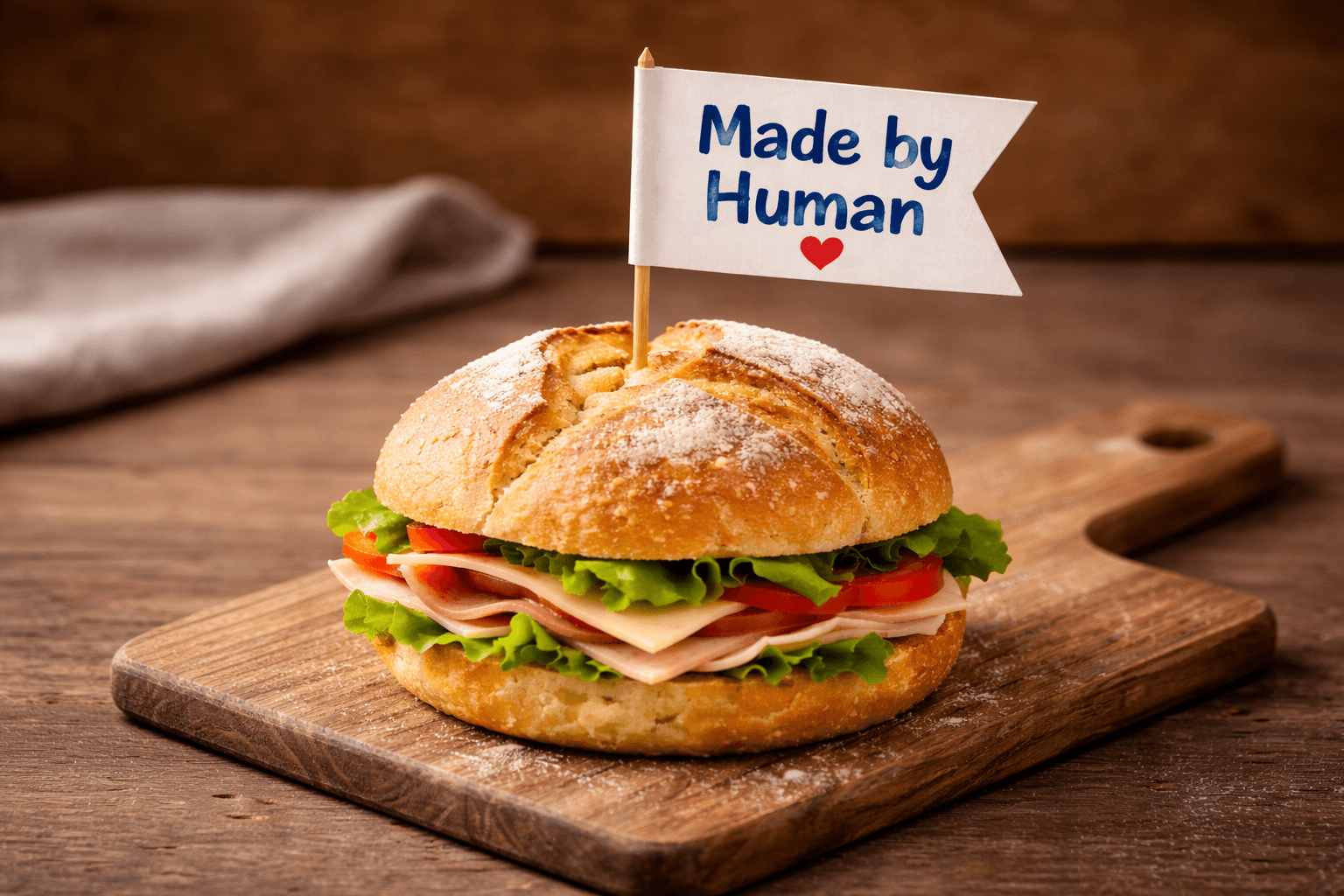
That inefficient humanity deserves recognition. What if we introduced a “Made by Human” certificate for everything that’s truly made by people? A quality label that shows it was made with time, love, and craftsmanship.
Inspection authority
Of course, this would need to be monitored. An independent body would have to conduct random checks on products and services—a sort of inspection authority. And no—AI should not be involved in these activities.
The scenarios are endless
The scenarios in which such a label could be valuable are endless. In the culinary sector, for example: an artisanal cheese or bread bearing the “Made by Human” stamp gains premium status compared to factory-made products. In fashion and design: a handmade garment or a unique design gains a story that AI-made clothing cannot offer. Even in software development, a piece of code written by a developer could receive a special label, making it clear that a human is behind the creative process—and that can build greater trust with customers in certain niches.
Food for thought
A small stamp, but a powerful signal: some things simply taste and feel better when there’s an inefficient human process behind them. Perhaps it’s worth considering the introduction of such a certificate, just in case the world soon becomes 99% AI-made.