
Macron and Jetten witness new Franco-Dutch quantum alliance
The agreements, signed in Eindhoven, link French expertise in semiconductor manufacturing with Dutch capabilities in materials analysis.
Published on September 4, 2026

Team IO+ selects and features the most important news stories on innovation and technology, carefully curated by our editors.
TNO, the French quantum company Quobly, and the Dutch TNO spin-off Orange Quantum Systems are expanding their cooperation to help turn silicon-based quantum processors into industrially manufacturable systems.
French President Emmanuel Macron and Dutch Prime Minister Rob Jetten witnessed the signing of two quantum-technology partnerships in Eindhoven on Wednesday. The agreements link French expertise in semiconductor manufacturing with Dutch capabilities in materials analysis, systems engineering and automated testing.
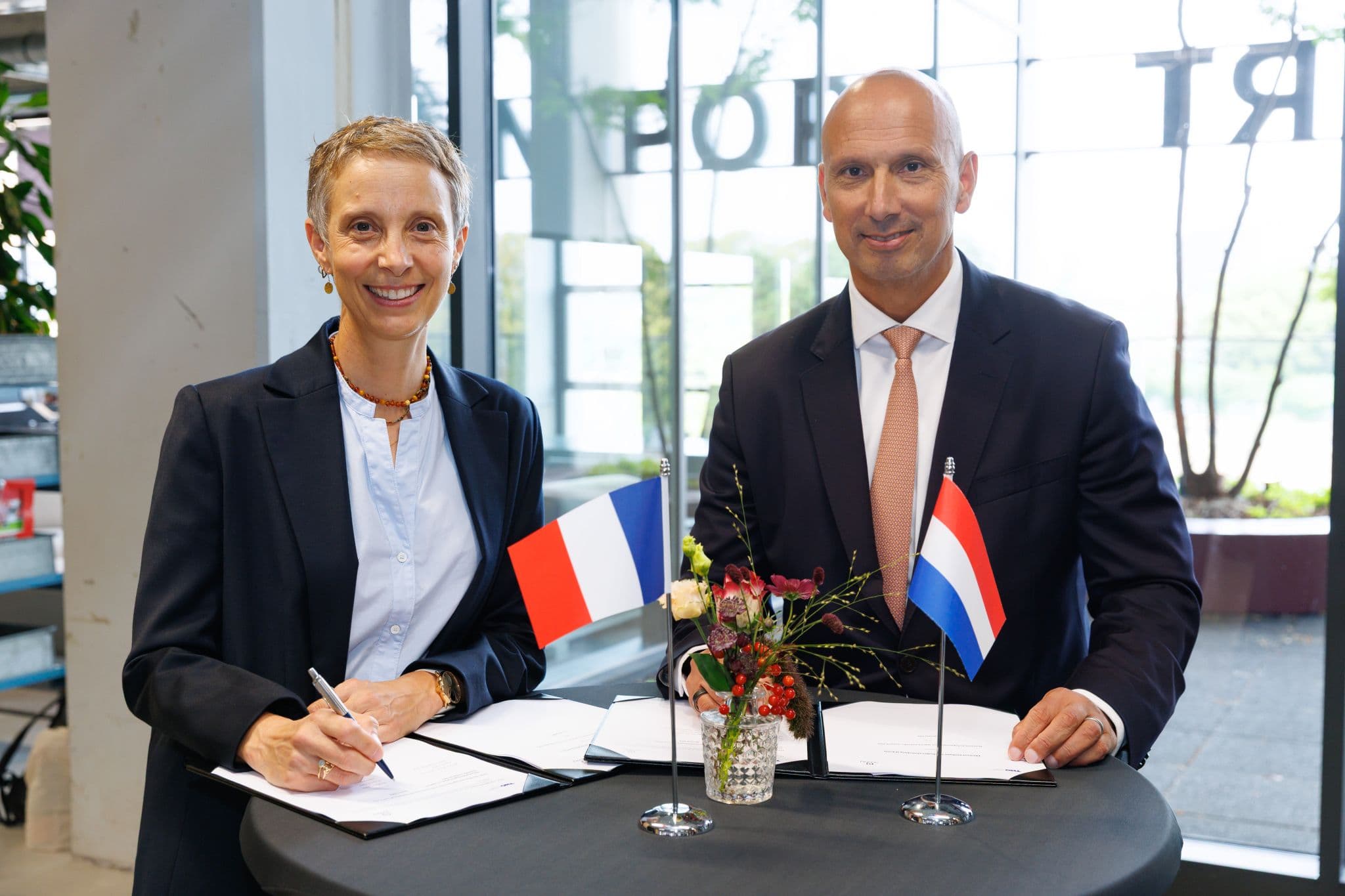
TNO CEO Tjark Tjin-A-Tsoi and Quobly CEO Maud Vinet signed a Memorandum of Understanding aimed at accelerating the development and industrialisation of silicon spin qubits. French deep-tech company Quobly also entered into a separate partnership with Orange Quantum Systems, a Dutch supplier of equipment for testing quantum chips.
The agreements were concluded during Macron’s visit to the Eindhoven region, where European technological sovereignty was a main theme. Together with Jetten, the French president met representatives of French and Dutch technology companies and visited chip-machine manufacturer ASML.
From research to industrial production
The agreement between TNO and Quobly builds on research cooperation that began in late 2025 and was announced in January. That initial collaboration concentrated on materials research and the characterisation of silicon spin-qubit devices.
The new MoU broadens the relationship. The partners will work on measurement methods, simulations, systems integration and high-throughput characterisation, the process of testing large numbers of devices quickly and consistently.
Quobly develops quantum processors using silicon spin qubits. Unlike several competing quantum-computing approaches, these qubits can be produced using technologies derived from the conventional semiconductor industry. The company’s platform is based on 300-millimetre fully depleted silicon-on-insulator, or FD-SOI, wafers and draws on partnerships with European semiconductor organisations including CEA-Leti, STMicroelectronics and Soitec.
TNO brings expertise in materials analysis, device characterisation and systems engineering. Its facilities include the Quantum Information Technology Test Facility, where quantum devices can be examined at extremely low temperatures.
The partners want to determine how materials, production variations and device characteristics affect qubit performance. Such insights are needed to improve manufacturing yields and move beyond small laboratory prototypes.
“We are building quantum computers for industrial scale,” Vinet said. “That means solving the engineering challenges behind the qubit as seriously as we solve the qubit itself. Our cooperation with TNO strengthens this approach by bringing together complementary European expertise in materials, devices and industrialisation.”
According to Tjin-A-Tsoi, Europe already possesses much of the knowledge required to establish a strong position in quantum computing. Combining TNO’s testing capabilities with Quobly’s industrial platform could help bring silicon spin qubits closer to commercial applications, he said.
Automated testing becomes essential
Quobly’s separate agreement with Orange Quantum Systems addresses another obstacle to scaling: the testing of increasingly large numbers of qubits.
OrangeQS develops automated test equipment for quantum processors. Under the partnership, its modular OrangeQS MAX platform will be adapted for semiconductor spin qubits. The system was originally developed to test superconducting quantum-processing units.
Testing individual experimental devices manually is still possible in a research laboratory. It becomes impractical, however, when manufacturers need to evaluate large arrays of quantum devices and identify variations across complete wafers. Automated measurement and screening are therefore prerequisites for industrial quality control.
The OrangeQS partnership will focus on automated measurement protocols and high-throughput testing at cryogenic temperatures. The aim is to detect defects and performance differences earlier in the production process, shortening the feedback loop between chip design, manufacturing and testing.
European supply chain
The two agreements illustrate how Europe is trying to connect expertise that is currently distributed across countries and organisations. France has an extensive semiconductor research and manufacturing base, while the Netherlands has a strong position in advanced equipment, systems engineering, metrology, and open testing infrastructure.
Bringing those capabilities together does not guarantee that Europe will win the global quantum race. Silicon spin qubits still face major technical challenges, including consistent fabrication, control of large qubit arrays and error correction. But the partnerships tackle a crucial step that often separates scientific breakthroughs from commercially usable technology: creating a repeatable manufacturing and testing process.
For Macron and Jetten, the signings provided a concrete example of the technological sovereignty discussed during their meeting in Eindhoven. The companies involved create a cross-border development chain that stretches from silicon quantum-chip design and semiconductor production to characterisation and automated testing.