
“Kilometers wide, centimeters deep”: education system is failing
In the NRC podcast 'It's not that simple', OECD’s Andreas Schleicher paints a troubling picture of Dutch education.
Published on March 14, 2026

Bart, co-founder of Media52 and Professor of Journalism oversees IO+, events, and Laio. A journalist at heart, he keeps writing as many stories as possible.
One-third of Dutch 15-year-olds read below the basic level. According to OECD researcher Andreas Schleicher, it is not only an educational problem but a risk for productivity, democracy, and social cohesion. In the NRC podcast Zo Simpel is het Niet (It's not that simple), journalists Marike Stellinga and Maarten Schinkel examine how a system that appears efficient can still slide backwards, and why “more money” is not automatically the answer.
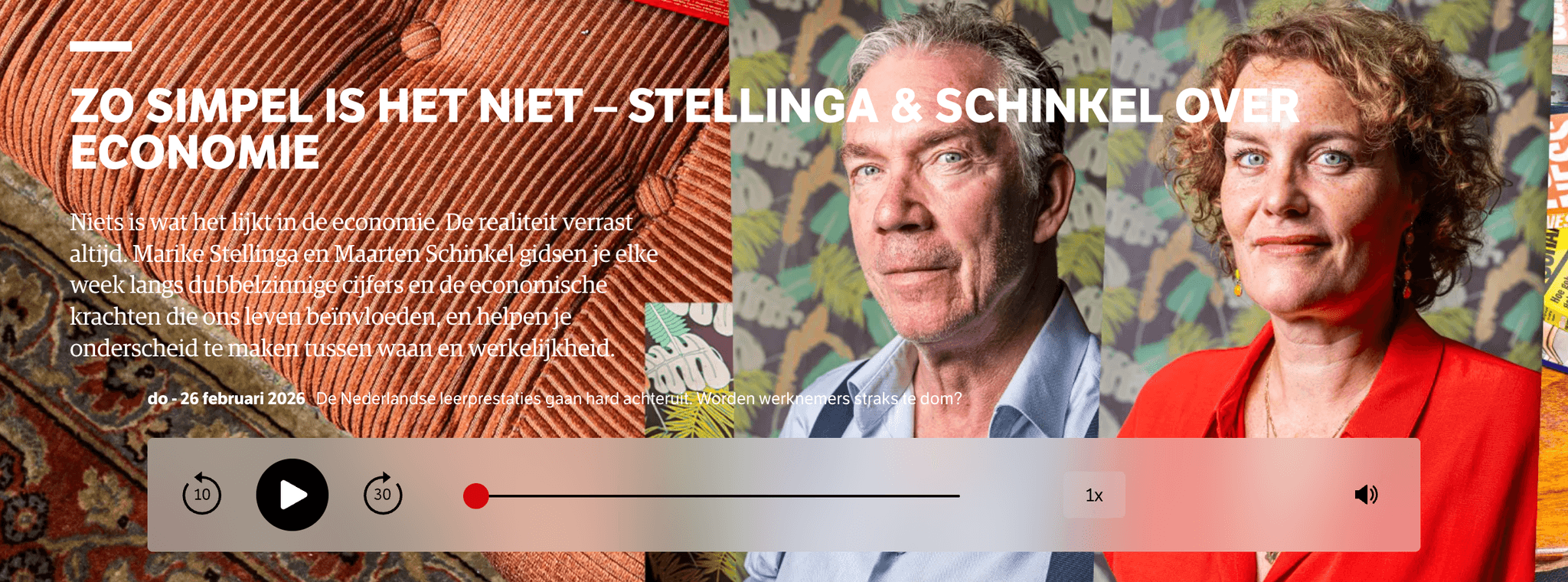
Sources for this article: NRC podcast Zo Simpel is het Niet (Marike Stellinga & Maarten Schinkel), interview with Andreas Schleicher at the OECD in Paris; OECD/PISA data and analysis.
From European top to the bottom of the list
The shock lies not in a single poor measurement but in the trend. In the podcast, Stellinga and Schinkel describe how PISA scores - the OECD’s international student assessment - have been declining across Europe for about a decade, with the Netherlands standing out negatively.
Reading is the most painful example: while Dutch students were among the best readers in Europe at the beginning of this century, “we are now near the bottom.”
Their most confronting figure: this. According to PISA, that is the minimum level needed to function properly in society and further education. “At the beginning of this century, it was one in seven children,” the podcast notes. In other words, in roughly two decades, the Netherlands moved from a problem affecting a minority to a risk that affects one in three students.
Mathematics scores are also declining sharply, although the Netherlands still performs relatively better there. Schinkel and Stellinga cite a global ranking in which the Netherlands ranks around 10th in mathematics (still the best in Europe), but around 35th in reading, “sandwiched between Vietnam and Turkey.”
“School today is our economy and society tomorrow”
Andreas Schleicher, the public face behind PISA at the OECD since the early 2000s, views education through the lens of a data-driven researcher who compares countries and visits systems around the world.
“I’m really someone who learns from data and evidence,” he says in the conversation Stellinga and Schinkel conducted with him at the OECD in Paris.
His central message goes beyond the score charts: cites calculations showing that significant improvements in PISA scores translate into much higher economic value later
“Our schools today are our economy, our society tomorrow,” Schleicher says.
In his view, the relationship between skills and economic prosperity has not weakened—it has grown stronger. Schleicher cites calculations showing that significant improvements in PISA scores translate into much higher economic value later.
Or, as he bluntly summarizes: without stronger basic skills, “you will not have economic growth in the future.” Especially since the Netherlands is already performing poorly in terms of labor productivity.
A lottery at the school gate
A second alarm bell from Schleicher concerns not only averages but inequality between schools.
According to him, in 2022, the gap between weak and strong schools was larger in the Netherlands than anywhere else. The system is “erratic”: a student’s success can depend heavily on whether they end up in a strong or weak school.
Remarkably, Schleicher says those extreme differences are not primarily explained by students' socio-economic background, as is often assumed. “That is not the story in the Netherlands,” he argues. His hypothesis is more uncomfortable: expectations are simply lower, and the system does too little to correct underperforming schools.
A key factor here is something the Netherlands often prides itself on: school autonomy. Schleicher highlights the contrast with France. In the Netherlands, about 9 out of 10 decisions about education are made by schools themselves; in France, it is 1 out of 10.
Autonomy can stimulate innovation and diversity, but it also requires strong, collective quality control. And that is where the system falters, he says, especially when parents choose schools based on convenience, social climate, or reputation, while educational outcomes lag behind.
Three weak spots: expectations, focus, cohesion
In the interview, Schleicher points to three elements that the Netherlands seems to have lost.
High expectations and discipline. Dutch students are performing worse but still receive “pretty decent grades.” In Schleicher’s interpretation, that signals that expectations have been lowered.
Focus: less, but deeper. His criticism is almost a slogan: the Dutch curriculum is “a kilometer wide and a centimeter deep.” We want many things - citizenship education, projects, competencies - but core subjects are not mastered deeply enough.
Cohesion and proven methods. Autonomy is fine, Schleicher says, but not if every school reinvents the wheel. “You don’t ask doctors to develop their own medicines.” In education, he argues, those shared principles have eroded too much.
The forgotten factor: parental involvement
Another striking observation in the podcast concerns parents. Between 2018 and 2022, Schleicher says, active parental involvement in schooling nearly halved. He does not mean parents must spend hours tutoring, but rather the small signals: asking how school went, showing that education matters, and demonstrating respect for teachers. “School will never be able to compensate for what does not come from parents.”
That analysis clashes with the popular image of the “helicopter parent.” Schleicher flips the narrative: frequent contact with school is not necessarily real engagement with learning. It can also become a consumer relationship, which he considers dangerous.
Smartphones, AI, and the battle for attention
Stellinga and Schinkel place a timeline next to the declining PISA trend. Scores began to fall around 2012, roughly the same period when smartphones became ubiquitous. They emphasize that correlation does not prove causation, but the overlap is striking. Schleicher does see technology as a factor and supports limits such as banning phones in schools. But if the smartphone is the elephant in the room, AI is the mammoth.
He refers to studies suggesting that students who rely heavily on AI remember less and perform worse when it comes to deeper understanding. His core insight: learning requires “cognitive struggle.” AI can support that struggle, for example through instant feedback, but if it becomes more than a tool, “it makes us dumber.”
For Schleicher, the implications quickly become societal. Economic inequality can still be redistributed, he says; social inequality is much harder to repair. He points to children who can still read a text but are no longer able to distinguish facts from opinions, a problem with direct consequences for participation in a democracy.
Not a money problem, but a design problem
Stellinga and Schinkel conclude their OECD visit with an uncomfortable lesson: this cannot be solved simply by adding more budget. “Not necessarily more investment, but investment that is different, better, smarter, and more focused.”
Education is too important to treat as a sum of projects, preferences, and transactions. This conclusion may sound almost old-fashioned, but perhaps that is precisely the point. Basic skills, teacher authority, focus, and coherence have become more necessary again in an age of distraction.
Because ultimately, they determine who can participate in an economy and a democracy already under pressure.
This article is based on the NRC podcast Zo Simpel is het Niet with the interview with Andreas Schleicher (OECD) recorded in Paris, supplemented with OECD/PISA data discussed in the episode.