
Irish lasers help build the internet in space
Mbryonics selects Pilot Photonics’ lasers for fast, reliable optical communication in space.
Published on June 21, 2026
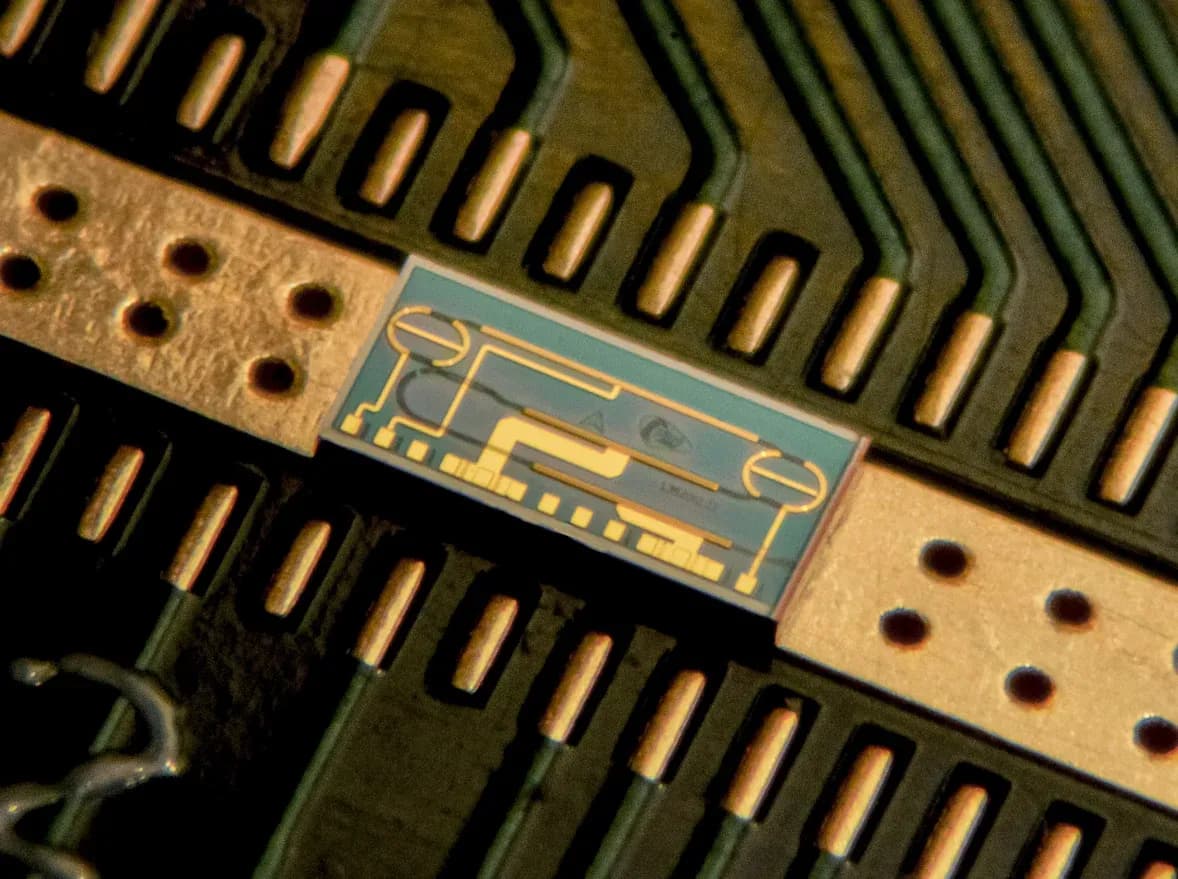
Pilot Photonics tunable laser detail

Team IO+ selects and features the most important news stories on innovation and technology, carefully curated by our editors.
The space industry is on the verge of a revolution in data communications. Traditional radio signals are reaching their physical limits as demand for data grows explosively. Laser-driven optical communication offers a solution. Irish company Mbryonics is taking a major step by selecting the laser technology of fellow Irish company Pilot Photonics 🔗︎. Together, they will develop the next generation of optical transceivers. This technology is expected to enable an unprecedentedly fast and stable network beyond Earth’s atmosphere 🔗︎.
Flashes of light instead of radio waves
Satellites still mainly transmit data via radio waves. This method is reliable, but its bandwidth is limited. Meanwhile, the amount of data collected in space is growing exponentially. Optical communication using lasers offers a way forward. With this technology, satellites can transmit data through directed beams of light. This enables much higher data speeds. Mbryonics is playing a key role in this transition with its StarCom product line 🔗︎.
The company works closely with the European Space Agency (ESA) through the ambitious HydRON project 🔗︎. The project aims to build a fully optical network in space 🔗︎. This network is intended to connect different satellites in various Earth orbits seamlessly 🔗︎. Mbryonics’ transceivers form the crucial link in this infrastructure 🔗︎. They convert electronic data into light signals and back again. By switching to laser technology, the capacity of satellite links could increase to as much as one hundred terabits per second 🔗︎. This opens the door to a true internet in space 🔗︎.
Pilot Photonics’ technological breakthrough
Reliable laser communication in space requires extremely precise equipment. Mbryonics has therefore chosen Pilot Photonics’ advanced laser sources 🔗︎. These lasers are not only highly compact, but can also be tuned extremely quickly 🔗︎. They use so-called nanosecond tuning 🔗︎. This is a crucial specification for communication between moving satellites. Satellites travel at enormous speeds relative to one another, causing the Doppler effect, in which the frequency of light shifts.
Pilot Photonics’ lasers can adjust their wavelength within nanoseconds to compensate for this shift 🔗︎. In addition, the lasers have a very narrow linewidth. This means that the light is extremely pure, preventing noise on the link. Thanks to these characteristics, the transceivers can maintain stable and coherent connections across vast distances in space. The technology has been specifically designed to withstand the extreme conditions beyond Earth’s atmosphere, including intense cosmic radiation and major temperature fluctuations. The components are therefore “rad-hard by design”, ensuring a long operational life.
Scaling up to mass production
Demand for optical terminals for satellites is growing rapidly. Mbryonics is therefore preparing for a substantial production scale-up. The company currently uses the Photon-1 facility in Galway, Ireland 🔗︎. To meet future demand, it is building a new production facility in Shannon called Photon-2 🔗︎. This state-of-the-art plant is expected to be fully operational by 2027 🔗︎. The goal is to produce thousands of optical terminals per year there 🔗︎. Volume production of the transceivers is expected to start as early as the second quarter of 2025 🔗︎.
By keeping production in-house and in Ireland, Mbryonics retains full control over quality and the supply chain. The collaboration with Pilot Photonics strengthens that position. The two companies complement each other perfectly through their specialist expertise. The short physical distance between the Irish partners also facilitates rapid prototyping and hardware testing. This is essential for keeping the time to market for these complex systems as short as possible.
Global standards and interoperability
One major bottleneck in today’s space industry is that systems from different manufacturers often cannot communicate with each other. Mbryonics wants to break down this barrier. The company is pursuing full interoperability between different satellite constellations. To achieve this, Mbryonics is working not only with Pilot Photonics, but has also entered into a strategic partnership with Japanese telecom giant NTT 🔗︎. Together, they are integrating advanced DSP chips into the optical transceivers 🔗︎. These chips process digital signals and allow the transceivers to switch flexibly between different communication standards 🔗︎.
Mbryonics is also actively involved in the US DARPA Space-BACN programme. This programme is specifically aimed at connecting different commercial and military satellite networks. By meeting these demanding international standards, Mbryonics’ transceivers become attractive to a very broad market. Satellite operators can then expand their networks easily, without having to worry about compatibility issues. This clears the way for a global, optical space network.
European autonomy in the chip sector
The collaboration between the two Irish technology companies also has an important geopolitical dimension. Europe wants to become less dependent on technology from other parts of the world, especially in semiconductors and photonics. The Mbryonics–Pilot Photonics project fits this ambition perfectly. Development is partly supported by the EU Chips Joint Undertaking project, which has a budget of €110 million 🔗︎. This initiative focuses on strengthening Europe’s strategic autonomy in silicon photonics.
By developing and manufacturing this technology in Europe, the European Union is safeguarding its own access to space. The success of this collaboration shows that Europe has the expertise needed to take the lead in the next phase of space exploration. The combination of Irish innovative strength and European financial support provides a solid foundation for the future. In the years ahead, the integration of photonics into space technology will only increase, with Mbryonics and Pilot Photonics at the forefront.