
Intelic AI rewrites rules of drone warfare with unified command
At Blue Magic Netherlands, Intelic AI showed how a single operator can command heterogeneous drone fleets in one mission.
Published on December 7, 2025
Miel van den Brekel, Intelic AI, © Nadia ten Wolde

Bart, co-founder of Media52 and Professor of Journalism oversees IO+, events, and Laio. A journalist at heart, he keeps writing as many stories as possible.
When Miel van den Brekel presses 'play' to show a short video at the Blue Magic Netherlands event in Eindhoven, the room falls silent. On screen, an operation that until recently belonged to the realm of theory: a fully integrated reconnaissance-strike mission, executed by multiple drones from different vendors, controlled by a single operator.
“A world’s first,” Van den Brekel says. “Multiple drones working together, planned from one mission environment, integrated into a battlefield management system.”
The exercise, conducted in Georgia in cooperation with U.S. and European partners, shows what Intelic AI believes the future of warfare will look like: fleets of unmanned systems that can sense, decide, and act as one.
And the key, they argue, is software.
Nexus: the unifying layer modern conflict demands
Intelic AI, with 50 employees split between Ukraine and the Netherlands, develops Nexus, a platform-agnostic command-and-control layer that integrates drones, payloads, and onboard AI into a single coherent ecosystem. In an era where Europe alone counts more than 600 drone manufacturers, fragmentation is not a nuisance; it is a strategic liability.
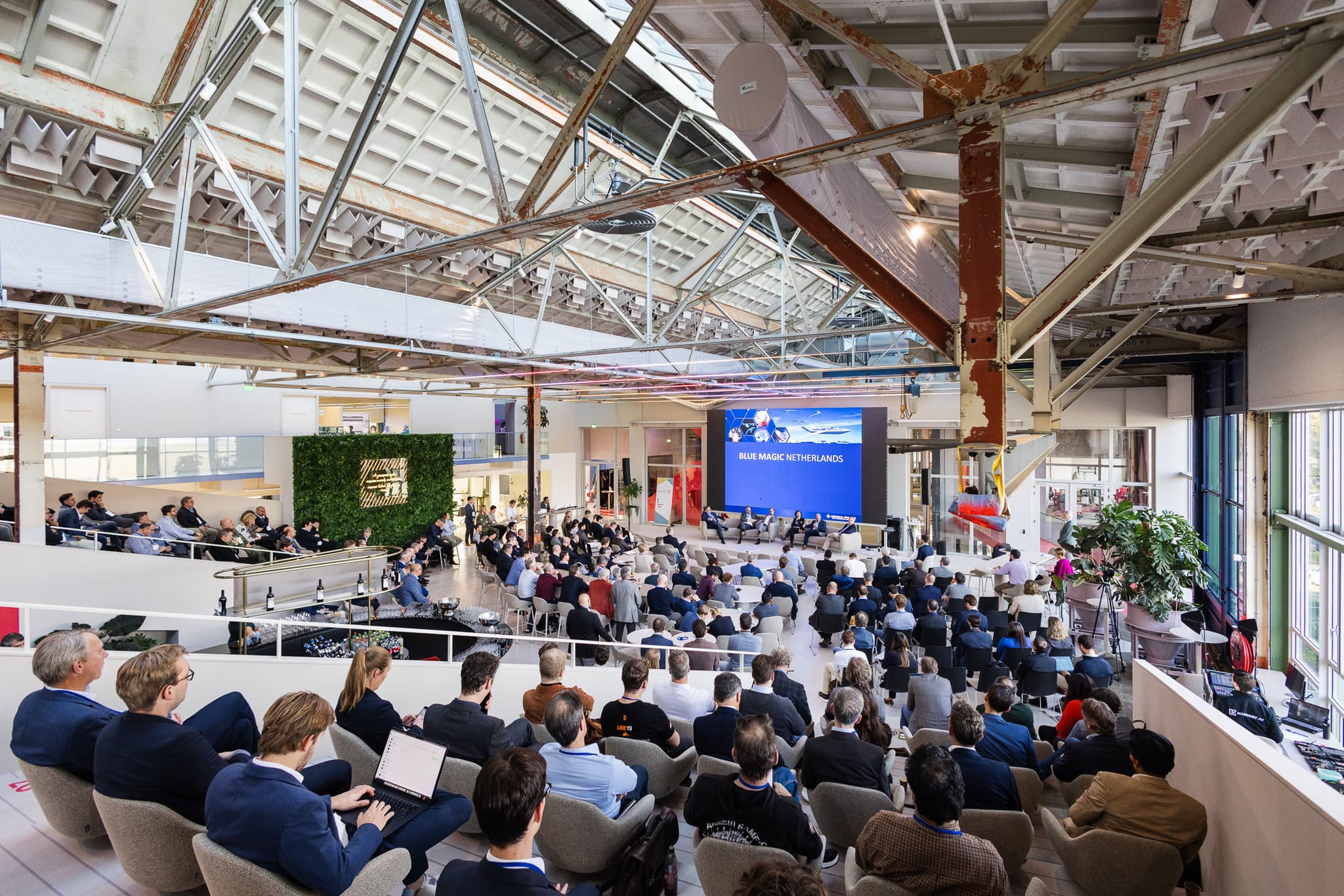
Blue Magic Netherlands
Read our stories about this event, focused on innovation in the defense industry.
“More than 90 percent of drone manufacturers build on open-source tools never designed for modern defense,” Van den Brekel explains. “Every system comes with its own interface, its own workflows. Operators retrain endlessly, switch between screens, and improvise setups. In Ukraine, they literally use Google Meet to stay synchronized.”
The consequences are brutally real: slower decisions, higher cognitive load, increased error rates and lost lives.
Nexus solves that by offering a single military user interface that integrates with any remote system, from small quadcopters to larger fixed-wing platforms. For manufacturers, it becomes the backbone for autonomy; for AI companies, a plug-in environment where modules become instantly deployable capabilities.
“We turn fragmented control into unified command,” Van den Brekel says. “Speed improves, training cycles shrink, and mission effectiveness increases.”
Miel van den Brekel, Intelic AI, © Nadia ten Wolde
A battlefield-proven software strategy
If Intelic’s progress seems rapid, it is because they test and iterate in the harshest environment imaginable: Ukraine. “The first time we went there, our software wasn’t good at all,” Van den Brekel admits. “And the Ukrainians wondered: why do these guys keep coming back?”
The answer: trust. Intelic’s engineering team returns week after week, refining the product with soldiers at the front. Improvements are deployed quickly; feedback loops are relentless. That approach has paid off.
“This is where the heart of our company lies,” says Van den Brekel. “Working with brigades, drone companies, and operators who depend on us every day.”
Unlike futuristic visions of drone swarms and full autonomy, Nexus focuses on low-level automation that soldiers actually want: predictable behavior, reliable task execution, and simple training. “You build trust first,” he says. “Then you extend capabilities.”
How it works: autonomy at the edge
During the Q&A, Van den Brekel dives into the technical architecture. Nexus consists of a military user interface and an autonomy agent installed on the drone’s companion computer (Raspberry Pi, Nvidia Jetson, etc.). That onboard agent can automate tasks, integrate with fire teams for last-mile targeting, and collaborate with other drones when radios allow. It supports open standards like MAVLink, PX4, and Ardupilot, but is designed to be modular enough to incorporate whatever protocols the field demands.
Because Nexus runs as a web-based application, it can operate on laptops, tablets, or servers, even without internet. And yet, the technical ambition comes with real risks. When asked what he fears most, Van den Brekel recounts a commander’s dark humor: “He said, ‘If something goes wrong, we kill you.’”
It’s a reminder: this is not a lab experiment. Lives depend on reliability.
Scaling with General Atomics, and toward a NATO blueprint
At Blue Magic, Intelic announced a deepening collaboration with General Atomics, the U.S. defence giant and co-organizer of the Blue Magic event. The partnership will validate how Nexus can operate GA platforms with minimal crew during live exercises, and how lessons from Ukraine can shape future NATO doctrine.
“This will not be just a demonstration,” Van den Brekel says. “This will create a blueprint for how NATO fights.”
The plan aligns with Intelic’s two-phase strategy: Prove in the field; scale through partners. With manufacturers joining the ecosystem, AI partners plugging in modules, and militaries demanding interoperable systems, Nexus aims to become the neutral European software backbone for unmanned systems.
The war in Ukraine has made one thing unmistakably clear: software - fast, adaptable, autonomous - now determines battlefield outcomes. That shift is reshaping industry, procurement, and national defense strategies across Europe. Intelic AI believes Nexus is the missing piece that will enable swarms of heterogeneous systems to operate as a single, coherent force.
“We’ve proven it in the field,” Van den Brekel says. “And we’re just getting started.”