
Inside the building that powers the internet
Somewhere in Amsterdam Science Park, the internet becomes physical. A tour inside Equinix's data center.
Published on May 4, 2026
.jpg&w=2048&q=75)
© Equinix

Mauro swapped Sardinia for Eindhoven and has been an IO+ editor for 3 years. As a GREEN+ expert, he covers the energy transition with data-driven stories.
An array of closet-like cabinets, a constant fan noise, and a warm room temperature. That’s in short how the behind-the-scenes of the internet, a data center, looks. In Equinix’s AM3 and AM4 facilities at Amsterdam’s Science Park, this is no different. On a sunny spring day, I had a chance to take a closer look.
"People don't realize how much of their daily life runs through places like this," says Michiel Eielts, managing director of the Dutch division of American data center operator, and my tour guide. "When you go to a hospital, when you board a train, when you open a banking app — all of that depends on infrastructure sitting in buildings like this one."
The data center is one of the nine operated by Equinix in Amsterdam, spread across six different locations. In addition, the American company operates two other hubs in Enschede and Zwolle. Seeing first-hand the number of cables, computing power, and infrastructure behind even just one of these hubs reveals the hidden complexity behind a simple action, such as sending an email.
Tens of customers, kilometers of cables
Through Equinix’s infrastructure, information passes from the government, cloud providers, and gaming companies. The company operates so-called colocation data centers, where multiple customers can rent a space to run their servers. Around 60 different telecommunications carriers are present, meaning a customer can choose any provider without laying a single extra meter of cable.
In each of the building stories, the scenario is similar, with tens of stacked cabinets housing racks on which servers run. Depending on each customer‘s need, one can rent a few cabinets or larger clusters of computing capacity.
Yellow fiber cables snake through overhead trays, carrying data between racks and between customers. Blue cables — a remnant of an earlier era — carry the last traces of copper connectivity. The yellow fiber, Eielts clarifies, carries the vast majority of traffic today.
On the top floor of the building, the fan noise is louder. “Here is where more powerful computing units are, so the fans spin faster,” says Equinix Netherlands managing director. Dissipating all the heat the servers produce is key to guaranteeing their performance. Cooling is indeed one of the essential components of a data center, alongside connectivity infrastructure and computing.
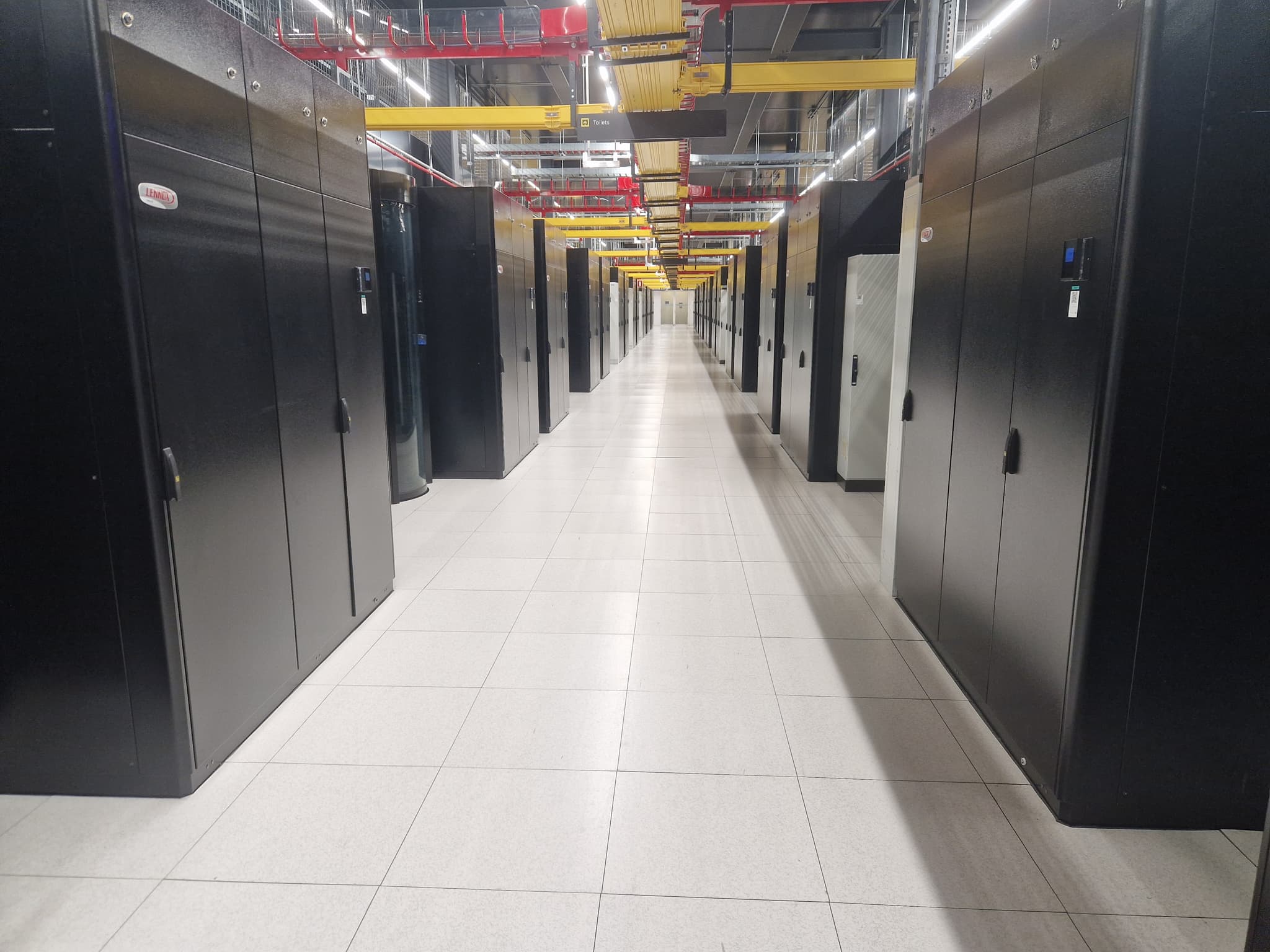
A view of one of the datacenter levels - © IO+
An elaborate cooling system
Beneath the floor of every level is an air cooling system, needed to prevent overheating. Most of the year, the facility relies on external air cooling. Michiel escorts me outside the building, where cooling towers draw ambient air into every story, ensuring the room temperature never exceeds 27 °C.
The building cooling circuit is a closed loop, meaning the water in the building stays there. However, in the hotter summer months, the data center can use a set of pumps that draw water from an underground reservoir. Beneath the data center, wells reach into 150 meters into the earth, where groundwater sits at a constant 10 °C.
We walk downstairs to see the complex system of pumps that tap from the reservoir. The groundwater is not mixed with the water already in the facility and is returned to the groundwater system via a second well.
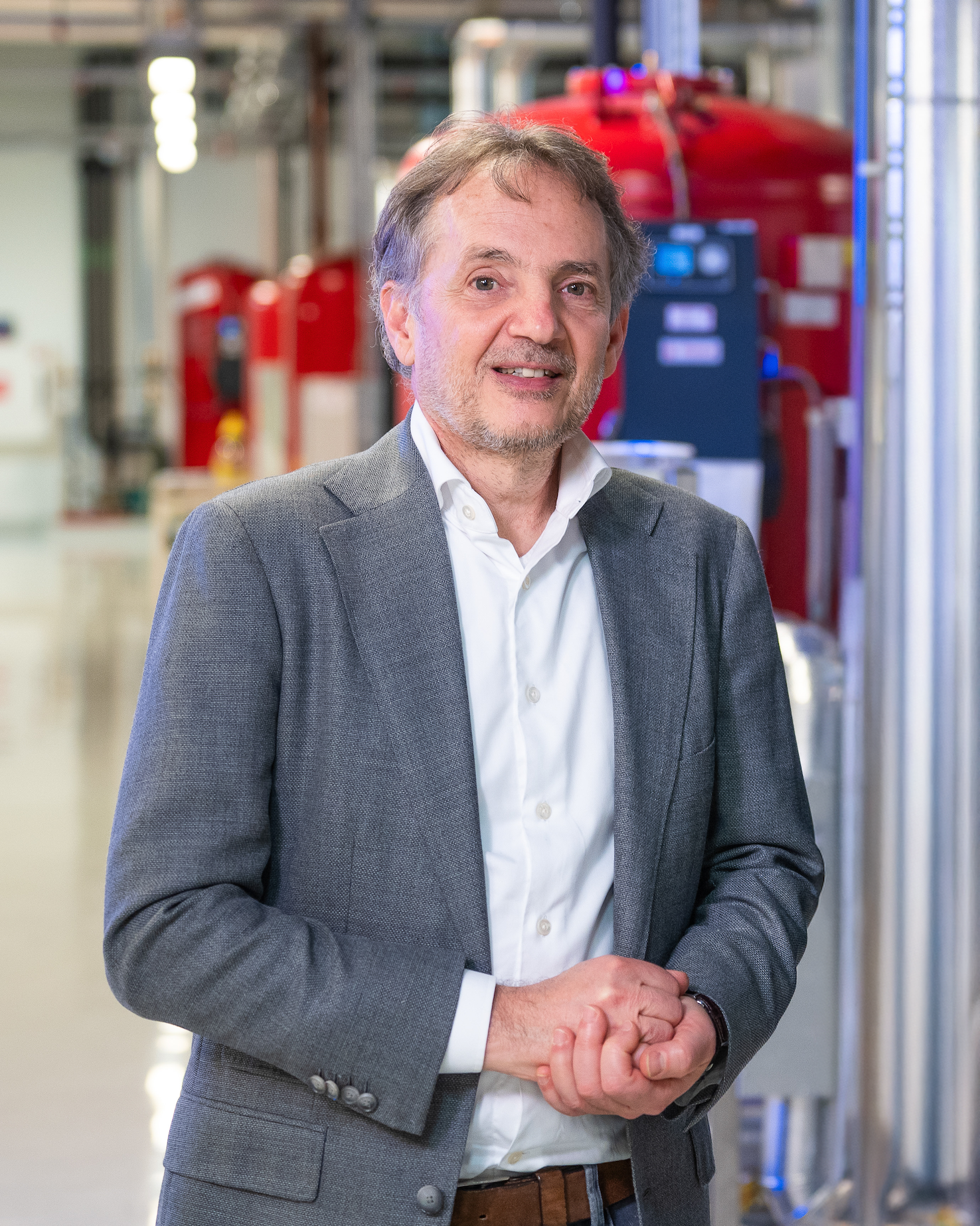
Michiel Eielts
Managing director at Equinix Netherlands
Next to his role at Equinix, he is also the chairman of the Dutch Data Center Association.
Achieving high efficiency
Thanks to these technologies, the facility has a Power Usage Effectiveness (PUE) coefficient of 1.2. PUE is an industry standard measuring data center efficiency. The metric is calculated by dividing the total facility energy consumption by the energy consumption of IT equipment. A PUE of 1.0 means perfect efficiency. Dutch data centers must, by law, have a PUE of 1.2 or less.
All Dutch Equinix data centers run fully on renewable power. However, to guarantee connectivity in the event of a blackout, the site has an array of diesel generators. Each one is similar to a cruise ship’s engine and can run continuously, as long as refueling is available. “As a critical infrastructure, we have priority on fuel resupply,” explains Eielts.
In 2012, this campus was named the most sustainable data center in Europe. “More than ten years later, we are still among the top three most efficient in the world,” says Eielts with a sense of pride.
In addition, waste heat from the servers enters the heat network, which can power the nearby buildings at the Amsterdam University of Applied Sciences.
One of the world’s internet hotspots
Being located in Amsterdam’s Science Park is not a coincidence. In 1988, the first Dutch connection to the Internet was established by a group of academics from the Centrum Wiskunde en Informatica (CWI). Six years later, the Amsterdam Internet Exchange (AMS-IX) — one of the world's largest internet hubs — was founded, and has since become a strategic infrastructure center.
Undersea cables terminate close by, as 35% of all Amsterdam’s internet traffic flows through this node — making it one of the world’s internet hotspots. “From here, a company can reach 80% of European users, which is why many international businesses decide to set foot here,” explains Eielts.
Eielts has led Equinix operations in the Netherlands for 17 years and has witnessed the surge in data center growth. When the company opened its location at the Science Park, the data center had a 2 MW capacity — enough to support a large bank's operations. Nowadays, the site capacity has grown tenfold, driven by a surging demand for connectivity.
Moreover, the firm is building its largest data center in the country in Lelystad, which is set to reach an average usage capacity of 86 MW. The company is also awaiting final approval to construct two additional data centers in Amsterdam. Since last year, the city has enforced a permanent ban on the construction of new data centers, which doesn’t apply to facilities that had already been pre-approved, as is the case with the two additional Equinix projects.
The Internet inside a building that doesn’t give it away
As we reach the lobby again, the tour is over. Michiel leaves for a meeting, and I walk to the nearby bus stop to reach the station. The silver facade of the building shines brightly in the sun, brighter than the industrial lights inside, and the fan hum makes space for the noise of passing trucks and my bus. Outside, Amsterdam carries on. Inside, so does the internet.