
Industry seeks to shed dependencies, government lags behind
While large industrial companies are taking concrete steps to reduce their vulnerability, a similar movement is absent on the public side.
Published on January 23, 2026

Bart, co-founder of Media52 and Professor of Journalism oversees IO+, events, and Laio. A journalist at heart, he keeps writing as many stories as possible.
As Dutch industrial companies increasingly and proactively work to reduce their strategic dependencies, the government remains strikingly quiet. This contrast stands out in new RaboResearch findings on the resilience of the Dutch business community. Where large industrial enterprises in particular are taking tangible steps to become less vulnerable to geopolitical and economic shocks, a comparable movement is lacking on the public side.
The result is a growing asymmetry between an industry that thinks ahead and a government that mainly reacts.
Strategic dependency is high on the industrial agenda
The research shows that around 20% of all Dutch companies are actively working to reduce their strategic dependence on other countries. They do so, among other things, by importing less, bringing critical activities back to the Netherlands or Europe, and organising sensitive processes, such as data storage or customer service, closer to home.
A closer look reveals that this movement is strongly concentrated among large companies, and particularly within the industry. Among large enterprises, the share actively working to reduce dependencies has risen to around 50%, both in relation to countries outside the EU and within Europe.
Industry is clearly leading the way, not out of ideology but out of necessity.
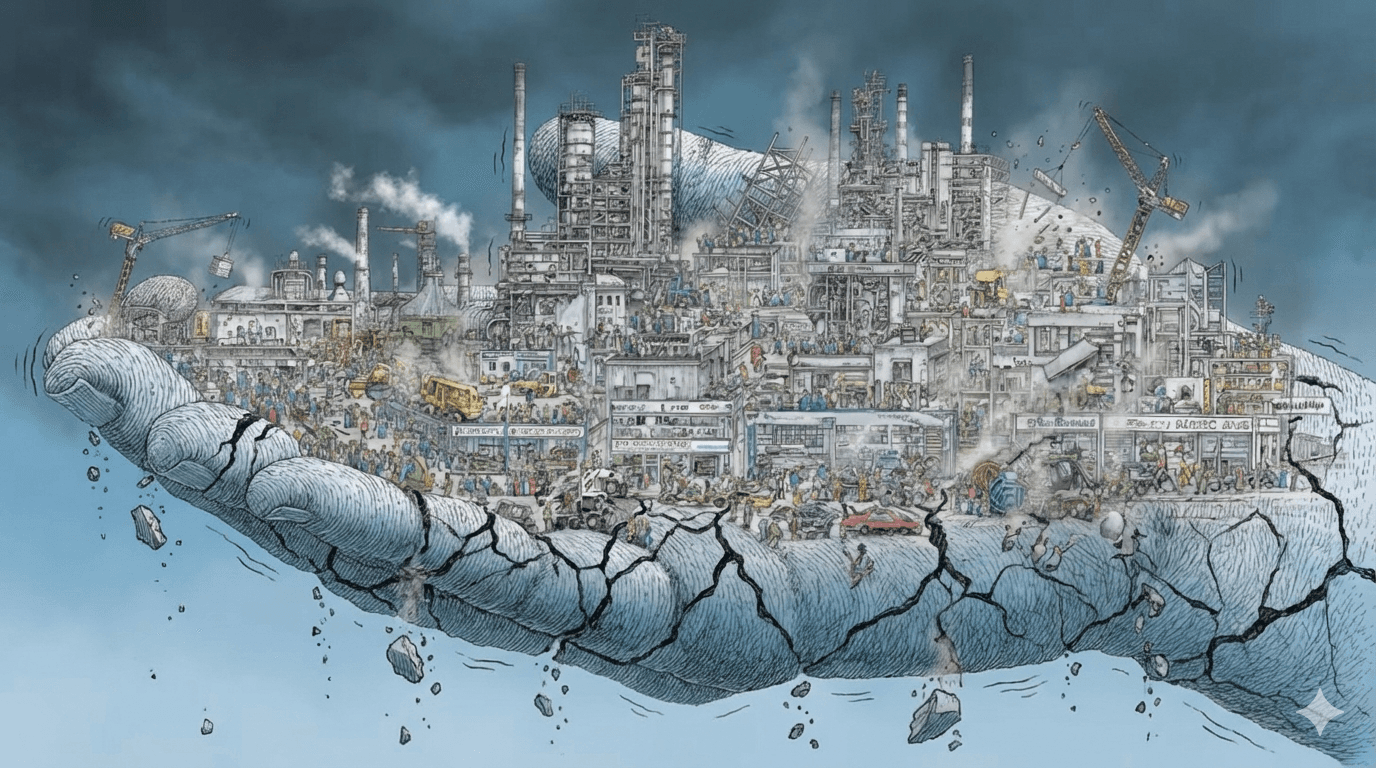
two speeds in resilience: industry vs government © IO+, source RaboResearch
For the industry, dependency is not an abstract risk
Industrial companies experience strategic dependency directly on the shop floor. Production lines grinding to a halt due to supply disruptions, energy price shocks, export restrictions or geopolitical escalations strike at the heart of their operations.
That is precisely why strategic autonomy in industry is increasingly translated into concrete choices:
- Reconsidering offshoring;
- working with more regional or European suppliers;
- bringing crucial production steps back in-house;
- investing in their own infrastructure and buffers.
The research shows that this course is not a temporary response to recent crises. Compared with last year, the picture has hardly changed. Strategic dependency has become a structural part of the industrial agenda.
Government: plenty of words, little systematics
What the research does not show is equally telling: a comparable, systematic movement on the government side. While industrial companies explicitly map out and reduce their dependencies, the government lacks a similarly clear and coherent policy aimed at strategic autonomy.
This is all the more striking given that the government is responsible for key domains such as:
- energy security;
- digital infrastructure;
- data security;
- vital supply chains;
- public services.
Where companies translate risks into investment decisions, government action often remains confined to policy papers, pilots, and fragmented initiatives. The step from analysis to execution appears more difficult than in the business world.
Two speeds of resilience
The RaboResearch study thus exposes a fundamental tension: industry and government are moving at different speeds. Companies, especially in industry, are forced to look ahead, run scenarios, and make strategic choices. Governments more often operate reactively, within existing frameworks and political cycles.
This difference becomes problematic when public and private dependencies intersect. Industrial companies may bring production back home, but they remain dependent on public infrastructure, permits, grid capacity, and regulation. If these are not matched by equal strategic focus, a vulnerable mismatch emerges.
The European Alternative
Read all our articles about European alternatives for popular non-European digital apps and tools.
Strategic autonomy requires public–private alignment
The implicit message of the research is clear: strategic autonomy cannot be organised by companies alone. Without a government that feels the same sense of urgency and translates it into decisive policy, resilience will remain fragmented.
At a time when geopolitics, technology and the economy are becoming ever more intertwined, strategic independence requires coherence between industrial policy, energy policy, digitalisation and public services.
Industry has taken the first step. The question now is whether the government will follow.