
How Rigidbody brings plant intelligence to midsized manufacturing
Rigidbody is one of the AI Pitch Competition finalists with "not a dashboard of complicated numbers, but actions operators can take".
Published on October 25, 2026
Rigidbody

Bart, co-founder of Media52 and Professor of Journalism oversees IO+, events, and Laio. A journalist at heart, he keeps writing as many stories as possible.
Ahead of the AI Pitch Competition finals on 12 November at the Evoluon in Eindhoven, IO+ concludes its deep-dive series profiling the eight finalists and one wildcard. In this final instalment, the student-founders of Rigidbody, a spin-out from an Eindhoven University of Technology (TU/e) hydrogen initiative, explain how physics-informed time-series models and local LLMs are democratising industrial process optimisation for mid-sized manufacturers.
Over the last few decades, heavy industrial plants have generated mountains of telemetry data. Yet, converting raw sensor streams into tangible operational improvements has traditionally required dedicated armies of data scientists and simulation engineers. As a result, comprehensive process optimisation has remained the exclusive playground of massive multi-billion-euro conglomerates. For mid-sized manufacturers, the backbone of the European supply chain, rich operational insight remains locked behind legacy equipment tags, disparate sensor streams, and binders of engineering schematics.
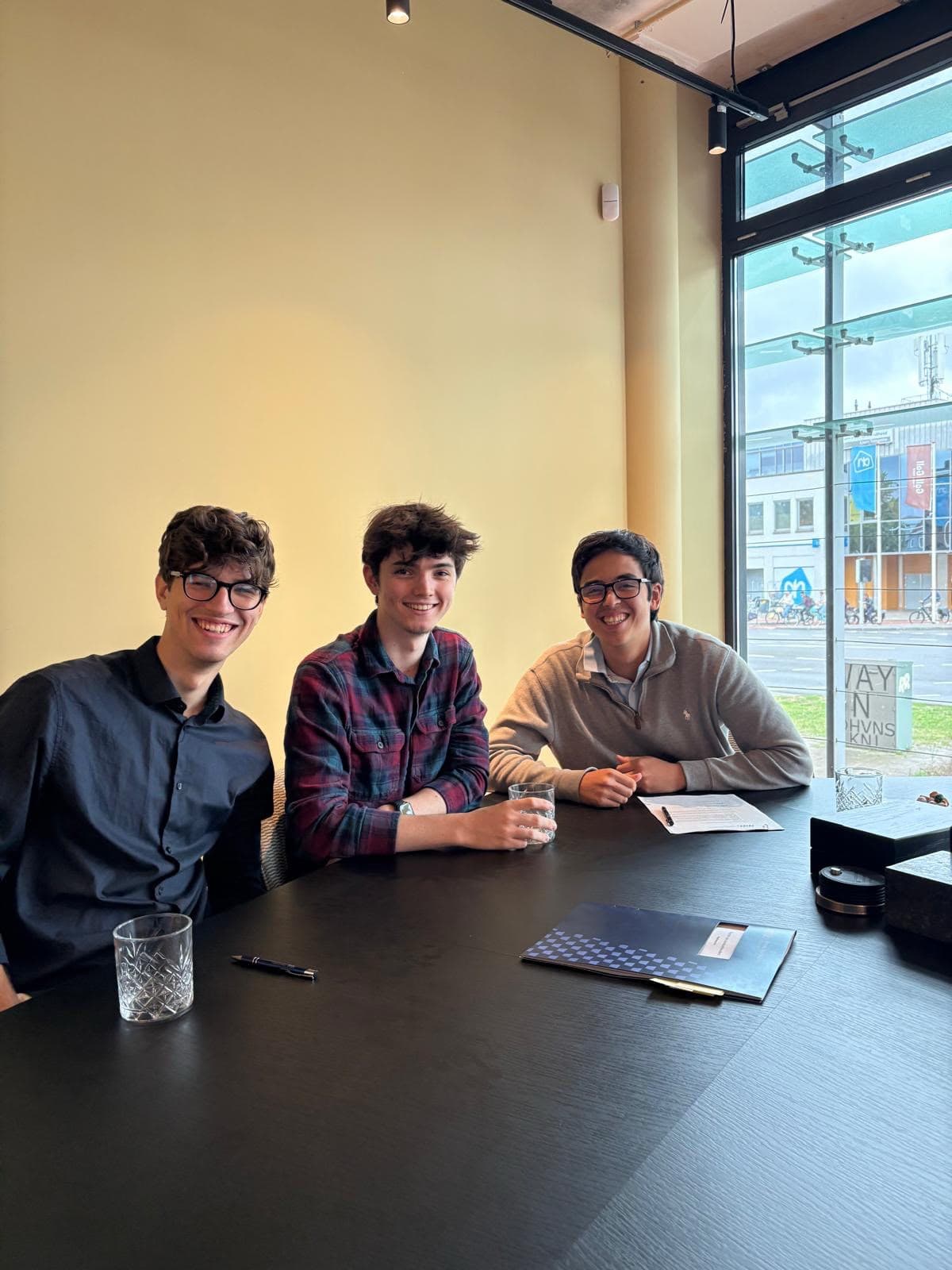
Eindhoven-based startup Rigidbody aims to break that monopoly. Founded by a multidisciplinary team of TU/e engineers - Charlie Johnston (AI/ML Lead), Rafael Marques Isakov (Business Strategist), and Alex Udrea (Control Systems Engineer) - the startup combines physics-informed time-series models with local language models to create a plug-and-play intelligence layer for factory floors.
Below, the founders discuss leaving the comfort of university life, why operational trust requires interpretable recommendations, and how shaving a few percentage points off industrial energy consumption can ease strain across Europe's power grid.
Physics-informed forecasting meets local language models
"Over the last few decades, industrial plants have generated vast amounts of data, but extracting significant value from it has required full teams of dedicated analysts," the Rigidbody founders explain. "That's why, in practice, only the largest plants have been able to make this routine. With thousands of interconnected systems, each defined across piles of documentation, the limiting factor has always been context."
Modern machine learning changes the economics of understanding complex industrial layouts: "With the right tooling, local LLMs are able to read documentation, mine historical data, and decode tags with far less human effort. Rigidbody is building on top of that, designing physics-informed time-series models that predict process performance, not just equipment failure, with a language layer that makes them deployable without an analytics team."
Crucially, the startup rejects proprietary vendor lock-in: "We don't assume a dedicated team of engineers is waiting on standby, and our software won't be restricted to a single equipment vendor. We aim to provide mid-sized manufacturers with the capabilities once held exclusively by the big players. Not as a dashboard of complicated numbers, but as recommendations that operators can act on. All of it is designed so sensitive operational data can stay on-site if needed."
The semiconductor supply chain as a beachhead
While Rigidbody’s architecture is fundamentally sector-agnostic, scaling an industrial enterprise requires proving generalizability without turning into a custom consultancy. "While processes across industrial sectors are indeed different, the underlying equipment often has cross-industry similarities that make scaling easier," the team notes. "Bringing the project to a large-scale market will involve a strong portfolio of successful pilot projects to show that the concept generalises. We must leverage AI to onboard each client faster than the last, because if each deployment requires months of bespoke development, we'd be more akin to a consultancy service. That's why our language layer is designed to assist in adapting our product to different plants."
To establish initial traction, the startup is leveraging Brainport’s unique industrial concentration: "One beachhead market we're currently exploring is the semiconductor supply chain, where process optimisation is very important, and many manufacturers are exactly the mid-sized companies we're building for. The Brainport region provides us with direct access to the sector, and two of us have already worked with semiconductor fabs through coursework at TU/e."
"The primary obstacle to scaling is establishing strong operator trust. It is essential that operators can rely on our software, which is why we are building Rigidbody with operational safety at the forefront of our design."
Explainability over black-box outputs
When algorithms interact with expensive, high-voltage, or pressurised equipment, blind trust is dangerous. "When dealing with expensive machinery, it's important that our software is able to stay transparent and justify the decisions it makes," the founders emphasise. "To address this, we're designing our software with a language layer that allows operators to stay in the know, explaining to operators what changes need to be made along with the evidence needed to back it up."
Closing the loop between machine and operator also creates a continuous feedback engine: "An operator who understands why a suggestion was made knows whether or not they should accept it and why. In the cases where our model makes a suggestion that is rejected, the justification can become training data: a mistake the model can learn from."
Lightening the load on Europe’s strained power grid
Beyond optimising margins for factory owners, process efficiency carries measurable societal and environmental consequences. "According to the International Energy Agency, industry accounts for 24% of total final energy consumption within the Netherlands as of 2024," the team points out. "This means even marginal improvements to industrial efficiency can have a meaningful effect on the country's energy usage. Unlike grid upgrades and electrification, such improvements can be achieved without the need for new infrastructure or the years-long time investments that come with them."
"We believe that by making plant operations more efficient, our software should be able to reduce the energy consumption of plants, and in many cases their material waste as well. This would alleviate pressure on the power grid and allow for less costly manufacturing. While AI job displacement is a concern for many, our software aims to provide a level of process optimisation to the plants that have never been able to afford it, but does not replace the benefit of dedicated engineers."
From TU/e student team Splitter to independent venture
Rigidbody's genesis stems directly from hands-on work in the Dutch energy transition. "For the past year, our team has been building connections in the hydrogen industry as part of a TU/e AI-based student initiative called Splitter," the founders recall. "That year showed us the role that AI can play in plant optimisation more generally, and that's what Rigidbody is built on."
Making the leap to a commercial startup required taking real entrepreneurial risk: "Our biggest hurdle has been choosing to leave the comfort that a university project provides. Splitter continues as a student team: the three of us wanted to take the fundamental idea further, and to pursue our startup Rigidbody. This meant walking away from an industry we had strong connections in, including a potential pilot partner, in favour of a more general AI solution."
"We chose to do this now because AI has opened the door to an entirely new market that otherwise wouldn't have the capital for robust process optimisation. Domain knowledge can now be encoded with a high degree of automation, and the opportunities AI provides are exactly what make a company like Rigidbody possible."
On-premise inference: Future-proofing for the EU AI Act
Given the sensitivity of industrial intellectual property and operational telemetry, Rigidbody rejects mandatory cloud pipelines. "Data privacy is an ever-present concern in software development, and the advent of generative AI makes it ever more pertinent," the team notes. "As regulatory frameworks around AI continue to ramp up, it's important that we future-proof our system, designing it with a privacy-first mindset. Our system is designed for local deployment first and foremost, with all inference happening on-site by default, though it could support cloud compute when an operator needs it."
Specialised on-premise intelligence over monolithic frontier models
Looking 5 to 10 years ahead, the team sees industrial software undergoing a structural decentralisation. "Our long-term goal is to become the de facto intelligence layer for mid-sized manufacturers across industry," the founders state. "We'll achieve that goal by developing our product in a single sector, and scaling once our approach has been proven with real operators."
"We're already seeing a broader shift to small specialised models, often leading to stronger, more cost-effective performance than the frontier on tightly scoped tasks. Rigidbody aims to play a role in the move towards specialised intelligence, which makes it possible to use intelligence that actually lives in a plant, without over-relying on cloud services."
Gaining credibility in a conservative industry
Operating from Brabant provides the team with a dense concentration of precision manufacturers, but breaking into plant rooms as young founders remains an uphill climb. "Being in the Netherlands gives us access to a large market of mid-sized industrial manufacturers across many different sectors," the team observes. "Our year in the hydrogen sector has shown us that mid-sized European plant operators are missing the process optimisation the large plants have. It's often difficult to gain credibility as young founders in a well-established industry, but last year gave us experience collaborating with operators at a Dutch hydrogen plant, and we hope to continue planning pilot programmes in industry now as Rigidbody."
Taming the hype: Accountability stays in the control room
Weighing in on the AI for Good versus AI for Disaster debate, Rigidbody grounds the conversation in traditional control-engineering discipline. "Generative AI is driving a positive disruption in industrial manufacturing, making convoluted data pipelines far more human-understandable by providing context that otherwise might have been buried," the team reflects. "This shifts how industrial work is organised, as well as how operators spend their time."
"There are definite risks, but most are familiar within the field. Control systems have always had to earn trust through reliable behaviour and tightly scoped safeguards, and AI is no different. Accountability must stay with people, a principle that plants have always worked with. Operators must be prepared to know when and why a model is incorrect, and avoid the risk of placing blind faith in the tools. Equally, as developers, we must create safeguarded systems that show their reasoning and not just their outcomes."
Delivering impact where hardware meets code
When the finalists pitch at the Evoluon on 12 November, Rigidbody will pitch a pragmatic blend of control theory, computer science, and chemical engineering. "To solve this problem, you need an understanding of software, control systems, and processes relevant to industrial manufacturing, a skillset our team holds," the founders conclude. "We're three students: a final-year computer science and engineering bachelor's student, a chemical engineer pursuing a Master's in innovation management, and a mechanical engineer following a Master's in mechatronics. All three of us have built an understanding of how industrial plants operate during our time in the hydrogen sector, and we're now looking to apply it across industry."
"A lot of AI creates tooling for those who build software. We're exploring a field that's far less saturated, where the gains show up in real-world machinery instead of a dashboard."
The AI Pitch Competition is organised by Erasmus Enterprise, BOM, and IO+, and supported by the Province of North Brabant. The finals take place during AI Summit Brainport on 12 November at the Evoluon in Eindhoven.