
How Peter Wennink responds to the main criticism of his report
Wennink: Anyone who wants to preserve prosperity, healthcare, education, and security must grow the pie and fix the underlying conditions.
Published on January 4, 2026
Bart, co-founder of Media52 and Professor of Journalism oversees IO+, events, and Laio. A journalist at heart, he keeps writing as many stories as possible.
After receiving widespread praise, Peter Wennink’s roadmap for the Netherlands’ future earning capacity also drew sharp criticism: too technocratic, too little attention to people, financially shaky, too harsh on social security, and too selective in its sectoral choices. Now that the dust has begun to settle, we take a closer look at the main criticisms — and at how Wennink himself has responded.
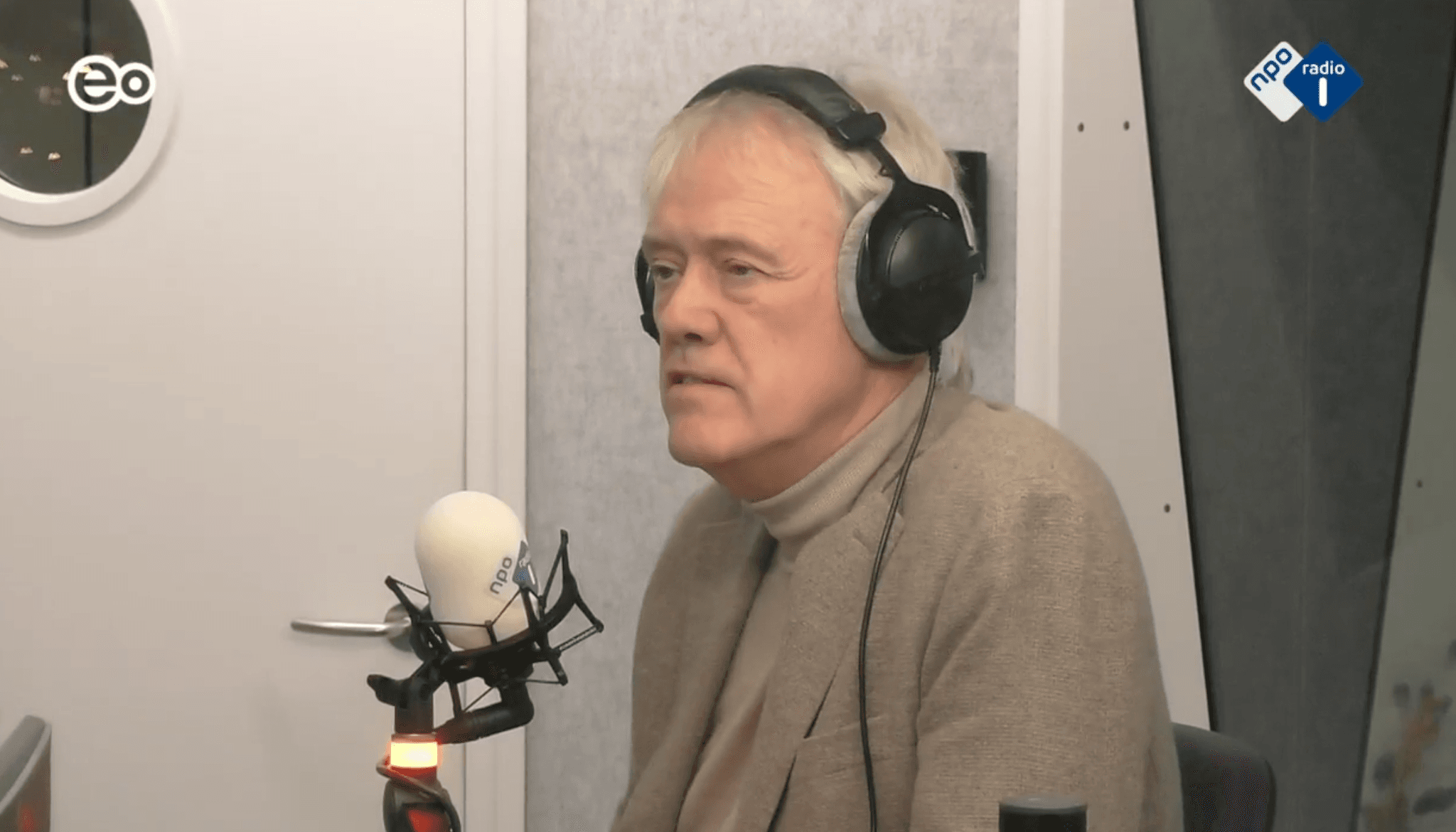
He appeared on Nieuwsuur, WNL op Zondag, and in conversations with Sven Kockelmann. For this analysis, we primarily drew on his radio interviews on NPO Radio 1 and BNR, in which Wennink does not engage in damage control but instead offers a consistent defense: anyone who wants to safeguard prosperity, healthcare, education, and security must first expand the economic base, and, above all, fix the underlying conditions.
Urgency and discomfort
When former ASML CEO Peter Wennink presented his report in early December, the tone was anything but comforting. He spoke of “dark clouds” gathering over Dutch prosperity and warned that without a productivity boost and major technological investments, the economy would eventually collapse under its own weight. At IO+, we described the report as “full of urgency and discomfort.” According to Wennink, the Netherlands is growing too slowly to sustain healthcare, education, security, and the energy transition in the decades ahead. His diagnosis: structural growth of 1.5 to 2 percent is required, while current projections fall well short.
While some boardrooms read the report as a Dutch version of Mario Draghi’s European wake-up call, others heard a message that rubbed uncomfortably against political and social sensitivities. The criticism came from many directions. In his interviews, Wennink consistently returned to the same core argument: this is about earning capacity, and about removing the bottlenecks that currently make investment all but impossible.
Criticism 1: “This is growth thinking; we could also redistribute wealth”
A fundamental objection is that Wennink’s roadmap assumes economic growth is essential. Critics argue that rising costs could also be covered through a different tax mix - higher taxes on capital or corporations - and that growth is not the only societal choice.
Wennink’s response is consistent and morally framed. He defines a “responsible society” around four pillars: work and income, quality education, good healthcare, and security. Those pillars, he argues, are becoming more expensive due to aging populations and geopolitical tensions. Growth, in that view, is not ideology but arithmetic. Without growth, maintaining the same level of public services inevitably means cutting elsewhere.
Redistribution is possible, he concedes, "but there is no fence around the Netherlands.” Capital and companies will leave if the investment climate deteriorates. His repeated references to energy prices, nitrogen regulations, grid congestion, and talent shortages are meant to underline that these factors are interconnected. That, he argues, is precisely why the report exists.
Criticism 2: “The human dimension is missing; unions weren’t involved”
A second line of criticism focused on the report’s perceived business-first perspective. Trade unions felt sidelined because they were not involved in the advisory process. Union De Unie described the report as treating workers primarily as “production factors” and “cost items.”
Wennink’s response operates on two levels.
Procedurally, he concedes that more time should have been spent on implementation and social embedding. In his NPO interview, he acknowledged that involving employees and social partners more deeply would have strengthened the report — but the tight deadline made that impossible.
Substantively, however, he rejects the criticism. Companies, he argues, are not abstract entities but groups of people. Flexibility, in his view, is not an ideological preference but a response to a world shaped by geopolitical uncertainty and technological disruption. Fundamental social protections remain non-negotiable, he insists — the real question is whether the burden of those protections has shifted too heavily onto employers.
In that sense, Wennink openly chooses an economic lens, not because people don’t matter, but because safeguarding healthcare, education, and social security requires a strong economic base.
Criticism 3: “The social proposals are too harsh”
The sharpest political resistance focused on social security, particularly the proposal to shorten continued wage payments during illness. Trade unions dismissed the idea as unrealistic and socially unjust.
Wennink counters by framing this not as austerity, but as risk management. In an economy that must remain flexible, he argues, employers cannot bear unlimited risks. At the same time, he stresses that core protections - sickness benefits, unemployment insurance - are not up for debate.
What often goes unmentioned, he adds, is that the report does not simply call for people to “work harder,” but to work differently: higher productivity, better use of talent, and enough skilled workers to actually carry out the energy transition, infrastructure upgrades, and healthcare reforms. The bottleneck, in other words, is not just financial; it is operational.
Criticism 4: “Sector choices - are you willing to follow through?”
Another point of contention concerns the selection of priority sectors and projects. With limited space, grid capacity, and environmental leeway, Wennink argues that the Netherlands must make choices. Critics point out that he is tough on sectors such as livestock farming and paper production, while taking a more accommodating stance toward heavy industry and steel.
His response follows a familiar line: strategic autonomy is multi-layered. Steel, for example, remains relevant for defense and resilience. Moreover, precisely because it is a difficult sector, innovation and decarbonization can have the greatest impact there. If such industries leave the country, there is no guarantee that their emissions will be reduced elsewhere — and the Netherlands loses the ability to steer innovation.
Criticism 5: “Too top-down, too much public money for business”
Another recurring concern is that the report calls for massive public investment — figures between €150 and €187 billion are frequently cited — with insufficient guarantees that this will not simply benefit large companies.
Here, too, Wennink draws a distinction. The government, he insists, does not need to invest directly in companies. Its role is to fix the conditions: permitting, grid capacity, talent pipelines, energy pricing, and nitrogen policy. Once those barriers are removed, private capital will follow. The proof, he argues, lies in the dozens of concrete proposals that emerged from the roundtables: ideas and capital are available, but execution is blocked.
Criticism 6: Do the numbers actually add up?
Perhaps the most fundamental criticism concerns the report's financial foundation. How solid are the numbers underpinning its urgency? Wennink argues that without intervention, the Netherlands is heading toward an unsustainable fiscal trajectory. Rising costs for healthcare, defense, aging, and climate policy would require sustained growth of 1.5 to 2 percent, backed by investments of up to €187 billion. Without that growth, public finances would eventually come under severe strain.
Critics challenge this reasoning. Economists point out that the report combines CPB scenarios that were never meant to be merged. While Wennink suggests debt levels could approach 200 percent of GDP, CPB projections under unchanged policy hover closer to 120-130 percent. Others argue that lower growth does not automatically imply declining purchasing power; much depends on policy choices and redistribution.

Notably, Wennink does not attempt to refute these critiques with alternative calculations. He is explicit that his report is not a CPB forecast. It is a roadmap. The figures, he says, are meant to show scale, not precision.
“The issue is not the decimal point,” he argues, “but the fact that we are structurally spending more than we earn.” For him, this is not a technical debate but a governance issue. Maintaining today’s level of prosperity requires an economy that continues to generate sufficient value.
This reframing shifts the discussion away from spreadsheets and toward systemic constraints. According to Wennink, the real bottlenecks are not financial but institutional: grid congestion, nitrogen regulations, slow permitting, and fragmented policymaking. Capital is available, he insists, but the system prevents it from being deployed.
The core of his defense: not consensus, but urgency
Whether one agrees with him or not, Wennink does not seek compromise for its own sake. He embraces controversy as proof that the conversation has finally begun. One of his most quoted lines captures that stance: “Politics is not an extraterrestrial life form.” In other words, this is not just a problem for policymakers, but for society as a whole.
That is also where his approach is most vulnerable. Once the direction is declared clear and “the time for reports is over,” the debate inevitably shifts to execution: who pays, who benefits, and who bears the pain.
And it is precisely there, critics argue, that the report still leaves too many questions unanswered: particularly about how workers, communities, and social partners are meant to be carried along in what would amount to one of the most far-reaching economic transitions in decades.
Perhaps that is the real follow-up this report demands: not another roundtable on projects, but a serious conversation about social consent. Because if Wennink is right that it is “one minute to twelve,” the real challenge is no longer whether the Netherlands must move, but how to do so without tearing itself apart.