
How One Horizon brings independent AI automation to enterprises
'Building a demo is easy; turning it into a reliable business solution is much harder' - One Horizon has learned from earlier endeavours.
Published on October 23, 2026
One Horizon
Bart, co-founder of Media52 and Professor of Journalism oversees IO+, events, and Laio. A journalist at heart, he keeps writing as many stories as possible.
Ahead of the AI Pitch Competition finals on 12 November at the Evoluon in Eindhoven, IO+ continues its deep-dive series profiling the eight finalists and one wildcard. In this seventh instalment, the team behind One Horizon, second-time founders operating from the AI Innovation Center on the High Tech Campus in Eindhoven, discusses avoiding Big Tech vendor lock-in, running AI locally, and how horizontal orchestration lets domain partners automate everything from coding to tax advice.
A handful of American hyperscalers dominate much of today’s enterprise AI narrative, raising uncomfortable questions across Europe about digital sovereignty, operational continuity, and data ownership. When businesses outsource critical workflows to external black-box foundation models, they frequently trade away autonomy for convenience.
Eindhoven-based startup One Horizon is building an alternative architecture. Founded by repeat entrepreneurs Gijs van de Nieuwegiessen and Tijn van Daelen (who previously built Flow.ai and delivered enterprise automation for giants like Disney, Spotify, and Deutsche Telekom), One Horizon offers an independent, horizontal orchestration platform. By letting companies run AI models on their own hardware, swap model providers at will, and maintain deterministic human oversight, the company aims to ensure businesses can automate operations without surrendering control.
Below, Gijs van de Nieuwegiessen outlines One Horizon's vision for vendor-neutral automation, the realities of European deep-tech funding, and why the future of AI belongs to specialised, domain-specific systems.
An independent orchestration layer: Avoiding single-vendor lock-in
"One Horizon provides the technology behind secure, independent AI automation," Van de Nieuwegiessen explains. "Our platform brings together AI assistants, autonomous workflows, work management, and human oversight."
Rather than functioning as another wrapper around a single proprietary model API, the platform is engineered to remain modular and execution-agnostic. "Businesses can run AI locally, choose their own models and agent frameworks, and control what AI can access or do," he states. "Everything works together in one platform, with data encrypted and people in control. What makes us different is that we don't just provide AI tools. We provide the technology needed to turn AI into real business solutions, without locking customers into a single provider."
Horizontal reach through specialised domain partnerships
While One Horizon began by orchestrating autonomous workflows in software development, the underlying engine is designed to span enterprise functions across verticals. "One Horizon is a horizontal platform that can support many industries," Van de Nieuwegiessen notes. "We started with software development, but our technology can also power solutions for finance, customer service, and other business processes."
To expand without stretching engineering resources across dozens of distinct verticals, One Horizon relies on a collaborative ecosystem strategy: "Our approach is to work with industry partners. We provide the technology, while partners bring specialist knowledge, help develop AI models, and bring solutions to their markets. This allows us to focus on building one strong platform rather than developing a separate product for every industry. The challenge is finding the right partners, proving business value, and adapting solutions to local markets and regulations."
Human-in-the-loop and local-first execution
In high-stakes enterprise decisions, unmonitored autonomy can create severe liability. One Horizon embeds human oversight directly into the workflow lifecycle. "We believe people should remain in control of AI, especially when it makes decisions that affect their business or customers," Van de Nieuwegiessen emphasises. "One Horizon makes AI work visible and allows people to review results, approve important actions, and control which tools and data AI can access."
On-premise deployment reinforces data confidentiality: "Businesses can also run AI locally, keeping sensitive information on their own hardware instead of sharing it with external providers. Our goal is to help people do their jobs better, not simply replace them. We believe the best results come from combining AI with human expertise."
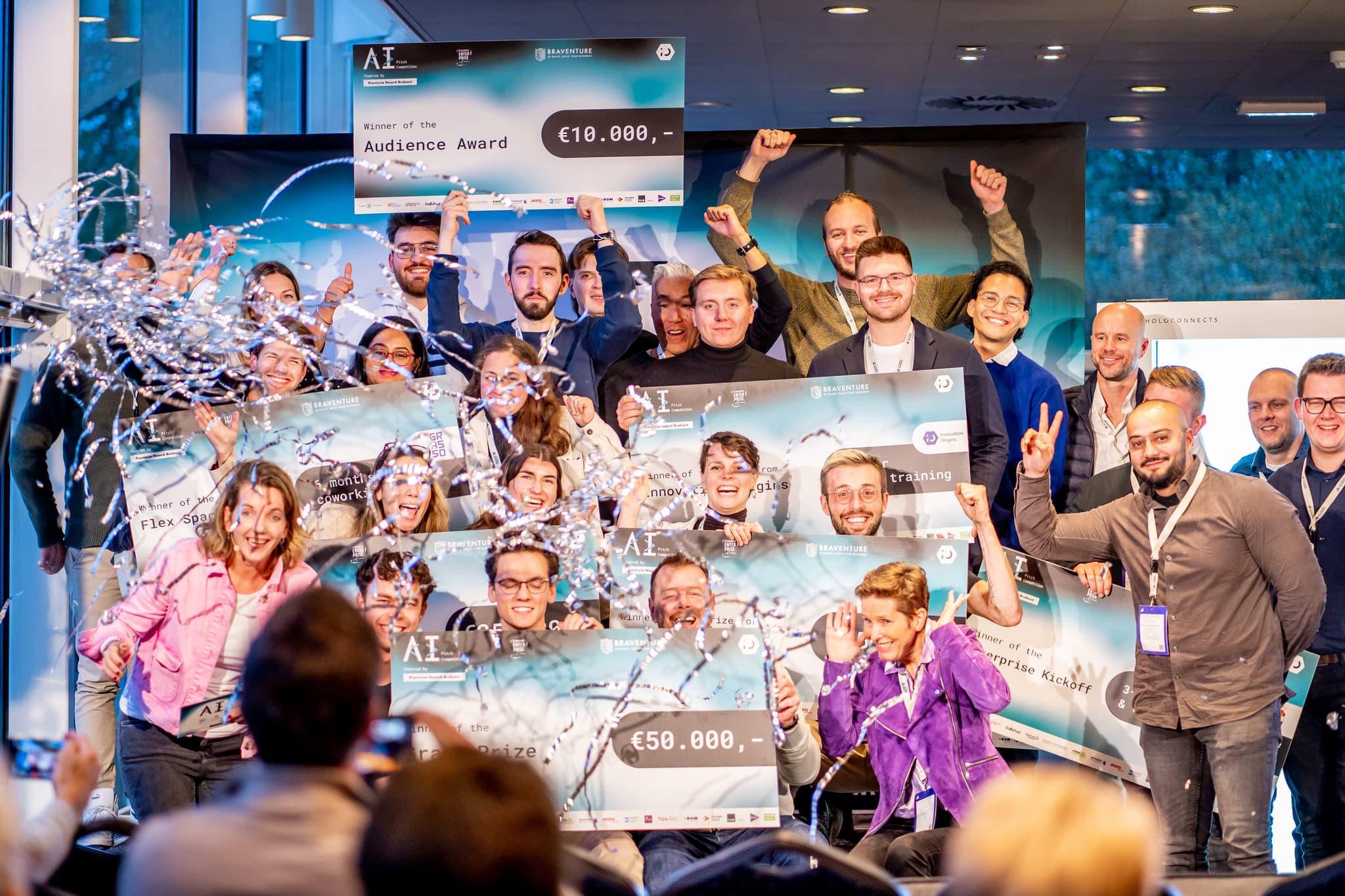
The AI Pitch Competition
Read all the other profiles of the finalists here, and also enjoy last year's AI Pitch Competitiostories.
Safeguarding European digital sovereignty
Concentrating AI infrastructure in Silicon Valley creates operational vulnerabilities for European industries seeking long-term resilience. "We want European businesses to benefit from AI without giving up control of their data, technology, or operations," Van de Nieuwegiessen explains. "Today, much of the AI industry depends on a small number of large technology companies. That creates risks around privacy, business continuity, and independence."
By decoupling workflow logic from specific model providers, organisations regain leverage: "One Horizon gives organisations more choice. They can run their own local AI, use external providers when they want, and stay in control of how their data is handled. We believe Europe has a real opportunity to build its own AI solutions, combining powerful technology with local knowledge and human expertise."
Hard-won lessons from Flow.ai: Moving past the demo phase
Having already navigated the journey from startup inception to international enterprise deployment, the founders bring a measured, pragmatic perspective to the current generative AI boom. "We are second-time founders," the founder reflects. "At Flow.ai, we were among the early Dutch companies bringing AI solutions to businesses worldwide. Through our earlier work, we worked with companies including Disney, Spotify, and Deutsche Telekom. That experience taught us something important: building an AI demo is easy, but turning it into a reliable business solution is much harder. With One Horizon, we're applying those lessons to a new generation of AI."
Yet, funding non-standardised enterprise software in Europe remains an uphill battle: "One of our biggest challenges is finding early support in Europe. Investors often want proven sales before taking risks, while AI is changing how companies are built almost every month. No established playbook exists for this market. We are learning, adapting, and building as the technology and market evolves."
Zero-knowledge encryption and AI Act readiness
European compliance frameworks, including the GDPR and the newly enacted EU AI Act, require strict data governance, auditable boundaries, and demonstrable human oversight. "Security, privacy, and control are central to One Horizon," Van de Nieuwegiessen explains. "Businesses can decide what AI is allowed to access, which tools it can use, and when a person must approve its work. They can also see what AI has done and review the results."
The underlying data architecture prevents unauthorised vendor access: "We encrypt customer data so that One Horizon cannot read it. Customers can run AI locally, keeping sensitive information on their own hardware and deciding when to share it with external services. These capabilities help organisations meet their responsibilities under regulations such as GDPR and the EU AI Act. We also consider these requirements when developing specialist AI solutions with our partners."
A future built on specialised, agentic workforces
Looking 5 to 10 years out, the company sees artificial intelligence transitioning from novel software add-ons to the foundational fabric of enterprise operations. "We believe AI will become part of how almost every business operates," Van de Nieuwegiessen says. "Our vision is for One Horizon to become the technology behind these AI-powered businesses, connecting people, AI agents, and business systems."
"We see a future where companies use their own specialist AI, trained with industry knowledge and supported by human experts. They can automate entire workflows while remaining in control of their data and decisions. Our ambition is to make this technology accessible to businesses of all sizes, with European technology and infrastructure providing a strong foundation for independence."
Eindhoven's ecosystem: Deep tech strength, conservative capital
Operating out of the AI Innovation Center on the High Tech Campus in Eindhoven provides One Horizon with immediate proximity to advanced hardware and software engineering talent. "Eindhoven is one of the strongest technology regions in the Netherlands," he notes. "It brings together talented engineers, innovative companies, and people who enjoy solving difficult problems. Being based at the AI Innovation Center puts us close to that community."
However, they voice a familiar critique regarding regional risk tolerance: "What we would like to see more of is support for early-stage companies taking real risks. Europe has the talent and knowledge to compete in AI, but we also need investors and customers willing to back new ideas before everything has been proven. We believe Eindhoven can play an important role in building Europe's next generation of AI companies."
Moving beyond the frontier model race
As the debate over the existential risks and disruptive consequences of artificial intelligence rages, One Horizon views the challenge through the lens of governance and power distribution. "We are very optimistic about what AI can achieve," Van de Nieuwegiessen reflects. "It creates opportunities for businesses and industries that were difficult to imagine just a few years ago. Our biggest concern is not the technology itself, but who controls it."
The founders argue that raw model parameters will soon yield to applied domain intelligence: "We believe the advantage of having the largest AI model will become less important as open-source models improve. The real value will increasingly come from combining AI with specialist knowledge and solving real business problems. This creates a huge opportunity for Europe. We can develop our own solutions, protect our independence, and ensure that people remain responsible for how AI is used."
Proven execution on stage at the Evoluon
When the finalists assemble at the Evoluon on 12 November, One Horizon intends to stand out by demonstrating battle-tested commercial reality over unvalidated prototypes.
"We should win because we know what it takes to turn AI into real business value," Van de Nieuwegiessen concludes. "We have built and scaled AI solutions before, and we're applying that experience to a much bigger opportunity. One Horizon provides the technology businesses need to automate their work securely, use their own AI models, and stay in control."
"We also believe the future belongs to specialist AI solutions built together with industry experts. Our first examples, including autonomous software development and AI-powered Dutch tax advice, show how one platform can support very different business needs. We want to help build that future from Europe, for businesses around the world."
The AI Pitch Competition is organised by Erasmus Enterprise, BOM, and IO+, and supported by the Province of North Brabant. The finals take place during AI Summit Brainport on 12 November at the Evoluon in Eindhoven.